
Court Schedule and Hearing Details
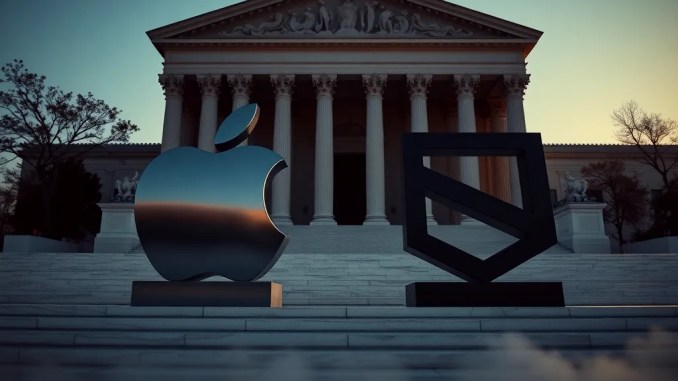
The US Supreme Court will hold an oral hearing for file 25-1311 in the App Store dispute between Apple and Epic Games on January 11, 2027. The court will hear oral arguments from both sides; a decision is not expected immediately. The hearing will be a limited and focused review within the boundaries of the first legal question outlined in the filing.
Which Question the Court Accepted and its Scope
The Supreme Court accepted Apple’s filing on June 30, but stated that only the first question in the filing would be examined. This limitation means the court will not automatically reassess all of the App Store’s commercial policies, commission rates, or payment infrastructure. The core question the court focuses on is this: can behaviors not explicitly prohibited in a previous court decision be considered contrary to the “spirit” of that decision, and what sanctions can be applied accordingly?
The legal framework of the “contrary to the spirit” discussion
This discussion involves two fundamental elements. First, the extent to which a behavior must be clearly and unambiguously defined in a court decision; second, what sanctions will be considered reasonable and proportionate if it is found to be contrary to the spirit. The court will determine intent and limits by considering the text of the previous decision, the language of the instructions given by the court, and the parties’ practice. Correspondence, case studies, and lower court findings will be decisive in determining which actions are directly prohibited and which have an indirect effect.
Apple and Epic’s filing process: calendar item by item
June 30: Supreme Court accepts Apple’s application.
September 14: Apple submits its arguments on the merits.
November 13, 2026: Epic Games’ response deadline (extended).
January 11, 2027: Oral hearing.
These stages are critical for the parties to submit their written arguments to the court and for the judges to grasp the legal framework. In the oral hearing, the judges will question the legal issues in the petitions, revealing any shortcomings and potential consequences.
What results might the January 11 hearing produce?
The January 11 hearing is not expected to directly lead to immediate changes in App Store policies. We can summarize the possible outcomes in three scenarios:
1) Narrow legal ruling: If the court interprets the question of violating the spirit of the order only narrowly, the decision will be limited to the case file and will not provide a direct precedent applicable to general App Store applications.
2) Limitation or approval of sanctions: If the court rules that there is a violation of the spirit of the order, lower courts will determine which sanctions will be applied. This process may result in operational adjustments, restrictions, or compensation liabilities for Apple.
3) Need for further review: If the court interprets legal principles broadly and sets clear rules, the case may be sent back to lower courts for re-examination of the scope and effects of the application. This could pave the way for widespread changes.
People Also Ask: Short answers to frequently asked questions
Will this hearing change App Store commission rates? No. The hearing focuses on legal interpretation about “spirit of the order” rather than setting or changing commission rates directly; Any downstream effects on policy would come through further litigation or regulatory steps.
Is the Court reviewing only one question? Yes. The Supreme Court accepted only the first legal question presented in Apple’s petition; the second question is not before the Court at this time.
When will the decision be final? The Court issues decisions with written opinions after oral argument; timing ranges from weeks to months depending on complexity and whether separate opinions are filed.
How to prepare: The parties’ hearing strategies
Apple’s strategy will likely be to emphasize the ambiguity in the current decision text and argue that the concept of contravention of the spirit should be interpreted narrowly. Apple will present technical and practical details with examples to show that its applications do not explicitly violate the court decision. Epic, on the other hand, will demand broadly interpreted sanctions by proving that its applications harmed the purpose of the decision, creating indirect but clear effects. Both sides will attempt to convince the judges with concrete examples of lower court records, email correspondence, and in-app behavior.
Practical example: How might “contrary to the spirit” have been applied?
Example scenario: The lower court may not have explicitly prohibited an app developer from using a specific payment method; the decision may only contain a general provision aimed at protecting consumer interests. If Apple indirectly incentivizes developers by technically or contractually restricting access to this payment method, Epic may argue that this practice is contrary to the spirit of the decision. The court will then examine whether the act directly contains a prohibitive statement and whether the practice undermines the purpose of the decision. Examples of evidence: timestamped correspondence, app update records, developer agreements, and user flow analysis.
Steps to follow and possible scenarios
1) Oral hearing on January 11, 2027: Judges question the arguments and clarify legal principles.
2) Supreme Court decision: Written reasoning is published; The scope of the decision constitutes a legal precedent.
3) Referral to lower courts: Implementation and compensation issues are detailed in lower courts.
Summary and what to expect
The January 11, 2027 hearing is a critical stage in the case between Apple and Epic, where legal boundaries will be determined, but it will not instantly change the final App Store rules. If the court’s interpretation clarifies how the concept of violating the spirit of the law will be applied, the case may translate into concrete implementation results in lower courts in subsequent steps. The evidence presented by the parties and the court’s choice of narrow or broad interpretation will determine the actual outcomes of the case.








Be the first to comment