
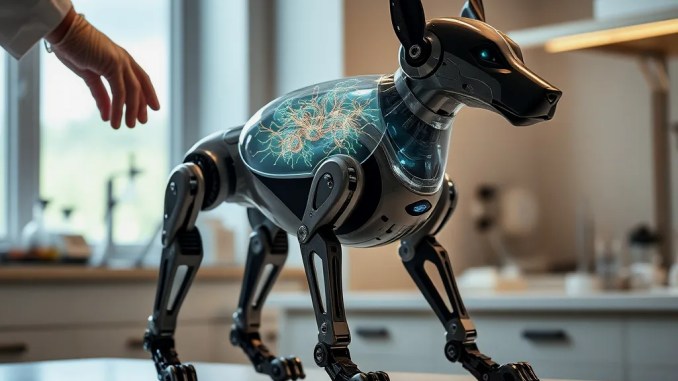
What is a Bio-Chip and Why is it Important?
The term bio-chip describes systems where living neuron cultures are integrated into silicon-based electronic platforms. Researchers incorporated biological learning mechanisms into physical control loops by directly connecting real neuron networks to sensor and actuator circuits. This approach brings potential advantages in robotic systems in terms of energy efficiency, adaptability, and the capacity to cope with environmental uncertainties.
First Physical Test: What Was Done, How Did It Work?
The research team placed in vitro neuron networks onto microelectrode arrays (MEAs), recorded neuronal electrical activity, and intervened with specific stimulation patterns. These signals were translated into motor commands for the robot dog via analog-to-digital converters. The system operated in a closed loop: the robot’s movements altered the feedback from the sensors, this feedback affected the firing patterns in the neurons, and the changing neural patterns determined the next motor command. The experimental setup provided the first concrete evidence that biological networks can be used in the direct control of physical actions.
What Experimental Results Were Recorded?
The experiments yielded significant performance indicators. Signal fluctuations were observed in the first 48 hours; this was followed by more stable, repetitive patterns in neural activity. Energy profile measurements showed that analog neural activity showed lower values in instantaneous power compared to its counterparts, while advantages emerged in overall system performance. Adaptation assessments observed significant reorganization and performance improvement between 100–1000 trials in response to environmental changes.
Data and Examples Obtained from the Experiment
The following table summarizes the experimental measurements:
Measurement: Signal stability — Observation: Fluctuation in the first 48 hours; 3–7. Condensed patterns in days.
Measurement: Energy usage — Observation: Instantaneous consumption is lower in analog neural networks, but the efficiency of the interlayer converters affects the system level.
Measurement: Adaptation speed — Observation: Performance increase with synaptic reorganization between 100–1000 trials against new obstacles.
What are the Advantages of This Technology?
Live neuron-based control provides three tangible advantages: Energy Efficiency — biological signaling can carry information with low-power, continuous analog processing; Generalization and Adaptation — neural networks exhibit rapid reorganization in unexpected situations; Memory and Learning — synaptic plasticity allows for lasting changes through experience, improving performance over time in repetitive tasks. In one example scenario, a debris search robot quickly learned a new path pattern, reconfigured its driverless control code, and significantly increased its success rate.
What are the Current Technical Challenges and Risks?
Systems working with living cells demand different maintenance and environmental requirements than electronic devices. Feeding, gas exchange, pH balance, and sterility requirements are critical for long-term stability. Achieving complex motor patterns becomes difficult if interface capacity is limited. In addition, the non-deterministic nature of biological learning processes creates repeatability and control challenges.
How Can It Be Improved? Step-by-Step Roadmap
An application roadmap lists the feasible steps as follows:
1) Cellular stabilization protocols: Design microfluidic bioreactors and automated nutrient supply; aim for live cultures to remain functional for weeks or months.
2) Increasing interface density: Scaling microelectrode matrices to thousands of channels by setting percentage increase targets; Develop cell-scale connection techniques for selective stimulation and recording.
3) Hybrid learning algorithms: Combine biological network adaptation with safety layers by building hybrid architectures with digital controllers; adaptation is fast, the digital layer provides stability.
4) Safety and security layers: Integrate software-based limits, emergency stop protocols, and pathways to respond to unexpected neural developments.
Application Areas and Example Scenarios
These chips could have an impact in the following areas: search and rescue robots (learning and generalization in variable debris environments), space exploration platforms (low-consumption control in energy-constrained missions), advanced prosthetics (more natural responses to user signals via biological interface). Example: In an energy-limited exploration vehicle, a bio-chip-based controller updated the course without saving it through agile reconfiguration in an unexpected collision scenario.
Frequently Asked Questions (Short, Clear Answers)
Does this technology harm the human brain? In vitro neuron cultures do not directly interface with human brains; experiments use isolated cells outside a living organism.
When will it appear in commercial robots? Expect gradual adoption over a decade-scale timeline for non-critical applications, accelerating as stability and interface scaling improve.
What ethical concerns arise? Key concerns include sentience thresholds for cultured networks and consent frameworks for using biological material; transparent governance frameworks must accompany deployment.
Summary and Conclusion
Living-neuron biochips demonstrated in a robot-dog test that biological networks can participate directly in closed-loop physical control. Experimental data highlighted energy and adaptation advantages alongside practical challenges in long-term stability, interface scalability and repeatability. A phased engineering approach — stabilizing cultures, scaling interfaces, integrating hybrid controllers and enforcing safety layers — will move the technology from laboratory proofs-of-concept toward targeted real-world roles in demanding, energy-constrained or unpredictably changing environments.






Be the first to comment