
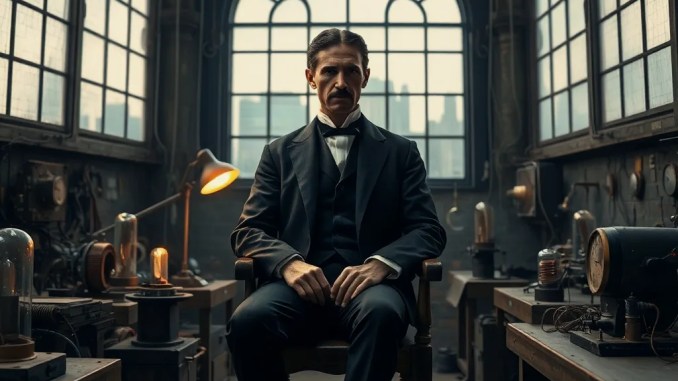
Tesla’s Core Claim: Death as Transformation of Energy
Nikola Tesla argued that death is not annihilation but a transformation. He framed this idea using the first law of thermodynamics: energy cannot be created or destroyed, only converted. Tesla extended that principle to consciousness, proposing that mental phenomena might change form rather than cease. This claim functions as a philosophical proposition informed by scientific metaphor rather than an empirically demonstrated fact.
Childhood Perceptions That Shaped His Thinking
Tesla reported vivid sensory phenomena from early childhood: intense flashes of light, unusual sounds, and heightened perception of vibrations. He used those experiences as working tools—visualizing inventions and testing them mentally before building prototypes. Those lifelong traits made him rely on internal simulation as a method: construct complete apparatuses in the mind, run them through imagined operation, and only then build physical models. This practice influenced both his technical creativity and his metaphysical speculations about consciousness.
Concrete Innovations That Grounded His Reputation
Tesla translated inventive visions into repeatable experiments. He contributed to alternating current systems, demonstrated wireless energy transfer by lighting lamps in 1891 experiments, and unveiled a remote-controlled boat in 1898 that foreshadowed modern robotics and remote-control technologies. He also proposed a planetary-scale wireless transmission network intended to deliver power across distances without wires. These accomplishments show he combined imaginative theorizing with practical engineering, lending credibility to his broad claims even when those claims extended beyond tested science.
How Tesla Connected Energy, Frequency, and Vibration to Life
Tesla regularly emphasized energy, frequency, and vibration as explanatory primitives. He suggested that natural phenomena and living processes can be understood in terms of energetic interactions and resonant behaviors. Practically, he applied resonance principles in designs such as tuned coils and oscillators; Philosophically, he used the same language to speculate that consciousness might persist as patterns of energy or resonant states under different conditions.
Personal Experiences Interpreted as Evidence
Tesla recounted an experience in Paris where he believed he saw his mother enveloped in light, followed shortly by receipt of news of her death. He considered such episodes as suggestive evidence that mental imagery might connect with events beyond immediate sensory access. Clinically, however, anecdotal apparitions do not meet the standards of repeatable observation and controlled testing required to establish causal links between consciousness and post-mortem persistence.
Posthumous Handling of His Papers and Conspiracy Narratives
After Tesla died in New York in 1943, US authorities reviewed his personal files for national-security concerns. That review seeded later claims that authorities suppressed revolutionary technologies—wireless power, directed-energy devices—because they threatened incumbent interests. Documentary records confirm government seizure and review, but reliable evidence that the state permanently concealed functioning, world-changing inventions remains lacking. Distinguish documented inventory and classification from speculative narratives about deliberate, long-term suppression.
What Modern Science Actually Shows About Energy and Consciousness
Contemporary research measures energetic aspects of living systems—bioelectric potentials, electromagnetic fields, and ultraweak photon emission (biophotons). These findings illustrate that organisms emit and interact via measurable physical phenomena. Example: neural activity generates electrical fields detectable by EEG and MEG, and cells under stress change biophoton emission profiles. None of these results, however, demonstrate that subjective consciousness continues after organic death. They map correlations between physical processes and conscious states, not evidence of post-mortem persistence.
Relevant Scientific Concepts and Why They Don’t Prove Survival After Death
– Thermodynamics: Conservation of energy applies to physical systems; equating it directly to persistence of personal identity requires additional premises that lack empirical support.
– Electromagnetic emissions: The brain’s fields reflect neural computation but fade as metabolic processes stop.
– Biophotons: Low-level light emission accompanies biochemical reactions; researchers use it as a noninvasive indicator of cellular state, not as a carrier of identity.
– Quantum entanglement: Entanglement shows nonlocal correlations at particle scales but does not provide a mechanism for macroscopic mind-to-mind transfer or survival of individual consciousness.
How to Evaluate Claims That Conflate Science and Metaphor
Apply step-by-step scrutiny to assertions that map physical laws onto metaphysical conclusions:
Step 1: Identify the physical law invoked and its domain of validity (eg, thermodynamics applies to measurable physical quantities).
Step 2: Check whether the claim adds testable mechanisms that connect the law to the proposed metaphysical outcome.
Step 3: Search for reproducible experiments or independent observations that would falsify or support the mechanism.
Step 4: Distinguish anecdote from controlled evidence; prioritize replication and clear operational definitions of key terms (consciousness, persistence, identity).
Step 5: Weigh alternative explanations such as coincidence, selective memory, and cognitive biases.
Practical Examples That Clarify Limits
Example 1: A sealed device converts electrical energy to heat; Conservation laws predict energy balance, not emergent subjective experience. Example 2: EEG signals disappear after brain death; Instruments show the loss of organized, information-rich electrical patterns that correlate with conscious processes. These examples show conservation of measurable energy while signaling the collapse of the physical structures that support subjective awareness.
Why Tesla’s Ideas Remain Culturally Fertile
Tesla’s synthesis of engineering brilliance and expansive imagination creates durable narratives. His vivid personal experiences, dramatic inventions, and rhetorical appeal to universal laws make his remarks about death and consciousness resonate. They inspire fruitful questions that guide some experimental research into the energetic correlates of life, even as those experiments remain silent on post-mortem survival.
Bottom Line for Readers Seeking Evidence
Tesla offered a coherent and evocative hypothesis: consciousness may transform rather than end. That hypothesis leverages legitimate physical language but currently lacks the experimental bridge to demonstrate continuity of personal identity after death. Scientific progress can narrow unknowns—by refining measurements of brain energetics, by improving post-mortem neurophysiology studies, and by clarifying the relation between information patterns and subjective experience—but, as of now, Tesla’s claim remains a philosophically interesting possibility, not an empirically established fact.







Be the first to comment