
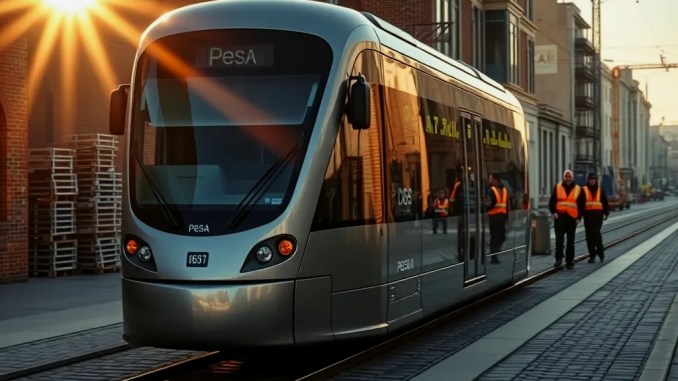
SBF secures €6 million contract to outfit Pesa’s Twist 3.0 trams for Krakow
Leipzig-based supplier SBF AG won an order worth about €6 million to supply interior roof systems, lighting, support structures and HVAC ducting for new Pesa Twist 3.0 trams destined for Krakow. Production will start in March 2027 with first deliveries planned the same month and shipments continuing through 2030. The scope covers three- and four-section tram variants across a framework program of up to 90 vehicles; Krakow’s operator MPK has so far executed firm contracts for 65 units.
What SBF will deliver and why it matters
SBF will provide complete overhead systems tailored to each vehicle length and layout: integrated lighting modules, ceiling panels with mounting interfaces for passenger information systems, structural brackets that tie into the carbody, and conditioned-air distribution channels sized to Pesa’s Twist 3.0 HVAC units. Delivering these systems early in the vehicle build cycle reduces final assembly bottlenecks and shortens integration testing time. For operators, pre-engineered ceiling and ducting packages lower lifecycle maintenance costs by simplifying access to cabling and service points.
Timeline and production milestones
Production commencement: March 2027. Initial component deliveries: March 2027 (matching Pesa’s vehicle assembly start). Serial shipments: phased across 2027–2030 to align with MPK’s acceptance schedule and the three separate tram procurement contracts. Staged delivery minimizes depot disruption and allows incremental crew training and infrastructure adjustments.
Framework program etc. confirmed orders: how Krakow reached 65 firm trams
Krakow’s framework agreement with Pesa, signed 3 April 2025, allows procurement of up to 90 Twist 3.0 trams in three length and configuration groups: roughly 30 bi-directional ~33 m units, 30 single-ended ~33 m units, and 30 single-ended ~43 m units. Frame agreements set maximum quantities, prices and technical baselines but do not obligate immediate purchase.
MPK converted part of the framework into firm contracts in three tranches that total 65 units:
– 18 August 2025: Contract for 30 bi-directional ~33 m trams (~PLN 558.5m net), deliveries scheduled between early 2028 and early 2029.
– 1 December 2025: Contract for 20 single-ended long trams (~PLN 461.1m net), deliveries from Q3 2028 to mid-2029.
– 3 February 2026: Contract for 15 single-ended ~33 m trams (~PLN 273m net), deliveries planned Aug 2028–Jun 2029.
Financing structure and dependency on EU funds
Funding for the latest 15-unit tranche uses Poland’s National Recovery Plan resources, distributed via Bank Gospodarstwa Krajowego. That facility offers a fixed 1% interest rate over a 20-year repayment term for the tranche. The remaining 25-vehicle option under the framework remains available but depends on securing additional European Union co-financing or domestic budget allocation before MPK exercises purchase rights.
Fleet renewal: which older vehicles will be retired and when
Krakow intends to use the new Twist 3.0 fleet to retire S-series and older models. Specifically, the procurement will enable phased withdrawal of 105Na, E1 and c3-series trams and portions of the EU8N fleet. Phased delivery timing aligns with maintenance planning: as each batch of new trams arrives and enters service, equivalent older vehicles will be decommissioned and either cannibalized for parts or prepared for sale or scrapping depending on condition.
Operational benefits and passenger experience improvements
The Twist 3.0 platform emphasizes modular interiors, improved accessibility, and energy-efficient subsystems. SBF’s integrated roof and lighting packages contribute to these benefits by enabling:
– Brighter, uniform passenger illumination with LED modules optimized for low glare and long life.
– Faster HVAC response and balanced cabin temperatures through ducting sized for real passenger loads, improving comfort in summer and winter.
– Easier maintenance access via standardized ceiling panels and service cutouts that reduce downtime for repairs or upgrades.
Why SBF and Pesa continue to collaborate
The two companies previously partnered on Leipzig tram builds, creating a tested working relationship across engineering interfaces and assembly sequencing. For Pesa, using an experienced subsystem supplier reduces integration risk; for SBF, repeat business accelerates design reuse and cost predictability. Both firms can apply lessons learned—such as mounting detail standardization and optimized wiring harness routing—to lower defect rates and shorten acceptance testing windows on Krakow units.
Practical implications for Krakow transport planners and passengers
For transport planners: stagged deliveries allow rolling fleet modernization without major service interruptions; reduced maintenance needs can reallocate depot labor to network reliability tasks. For passengers: expect newer vehicles with improved ride quality, better climate control and more modern interiors, plus a gradual reduction in age-related service incidents as older trams retire.
What to watch next and potential risks
Key milestones to monitor:
– March 2027: SBF production kickoff and components first-shipments.
– 2028–2029: Major vehicle deliveries and entry-into-service windows for each contract tranche.
Primary risks include supply-chain disruptions for critical components, delays in EU funding decisions for the optional 25 vehicles, and integration snags during initial system-level testing. Mitigations lie in early component validation runs, contingency sourcing and maintaining clear interface documentation between Pesa and SBF.






Be the first to comment