
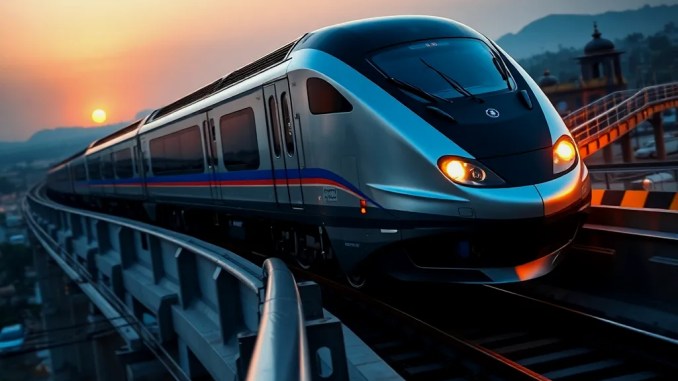
Eight-Car Formation, 557-Passenger Capacity, and Operational Flexibility
The train measures about 202 meters and uses an eight-car formation with four motorized and four trailer coaches. Designers configured seven coaches in a 3×2 standard seating layout and one coach in a 2×2 executive layout, yielding an overall capacity around 557 passengers. Two designated wheelchair spaces and accessible entry features support passengers with reduced mobility. Operators can couple two eight-car sets into a 16-car formation to expand capacity for peak services. Driver cabs sit at both ends to enable bidirectional operation and faster turnarounds during terminal stops.
Electric Traction, Regenerative Braking, and Performance Targets
The train runs on a 25 kV, 50 Hz single-phase AC overhead system and aims for 280 km/h in tests and a commercial top speed of 249 km/h. Regenerative braking returns kinetic energy to the overhead system during deceleration, improving energy efficiency and lowering operating costs. Power electronics and traction control software manage torque distribution across powered bogies to optimize adhesion and reduce wheel slip at high speed. Aerodynamic engineering reduced drag and tunnel-pressure transient effects through CFD-led shaping of the nose and vehicle body, which helps maintain stability and reduces noise at sustained high speeds.
Passenger Accessibility, Flow, and Station Interface
Platform-to-floor alignment minimises vertical step heights to speed boarding and alighting. Retractable steps integrated into doors reduce horizontal gaps and provide a consistent threshold across varying platform heights. Dedicated wheelchair doors and seating areas, tactile Braille signage, and visual displays in English, Hindi and regional languages provide inclusive wayfinding. Onboard announcements and automatic passenger information systems synchronise visuals and audio to help passengers make connections and receive real-time service updates.
Interior Systems: HVAC, Noise Control, Power and Connectivity
Each coach contains two HVAC units sized for high passenger density and rapid thermal recovery when doors open. Acoustic insulation in the carbody and underframe, plus noise-damping panels, skirts and axle covers, targets a comfortable in-cabin sound environment even at near-design speeds. Power outlets for laptops and mobile phones, overhead luggage racks, and Wi‑Fi with preloaded infotainment content meet modern passenger expectations and reduce perceived journey time. Toilets employ biological treatment systems to minimize environmental impact and simplify maintenance in corridor-free configurations.
Operational Control, Safety Systems and Driver Interface
Driver cabs incorporate an intelligent onboard control suite that integrates with the central traffic management system for faster decision-making and coordinated operations. The suite displays predictive braking profiles, energy usage metrics and condition-based maintenance alerts. Redundant safety systems include continuous train control signaling compatibility, automatic train protection, and diagnostics that monitor bogie status, wheel wear and brake performance. These systems speed fault detection and reduce unscheduled downtime.
Design for Tunnel Transits and Environmental Conditions
CFD analyzes informed nose geometry and pressure-relief detailing to reduce micro-pressure waves during tunnel entry and exit, lowering passenger discomfort and external noise. Body sealing and HVAC filtration were designed for diverse climatic conditions found along the Mumbai–Ahmedabad corridor, from humid coastal sections to hotter inland segments, ensuring consistent thermal comfort and component longevity.
Accessibility and Universal Design Features in Detail
Accessibility features follow a layered approach: (1) physical design—low-floor interfaces and wide doorways that match platform heights; (2) assistive hardware—retractable steps and accessible door controls; (3) sensory aids—Braille signage and multilingual visual displays; and (4) operational support—priority seating, staff-assisted boarding zones and pre-boarding notifications. This combination reduces dwell times and improves service reliability for passengers requiring assistance.
Manufacturing, Contracts and Deployment Timeline
BEML manufactures the trainsets in Bengaluru, building on a program that saw Integral Coach Factory earlier develop two eight-car sets. In September 2026, National High Speed Rail Corporation Limited ordered rolling stock supply and maintenance packages valued at over INR 5,400 crore. The Ministry indicated a target for commercial service commencement on 15 August 2027, starting with initial runs on the Surat–Bilimora section; detailed testing and commissioning schedules remain subject to regulatory approvals and test outcomes.
Maintenance Strategy and Lifecycle Considerations
The procurement package includes maintenance provisions to support high-cycle, high-speed operations. Condition-based maintenance systems use onboard sensors and diagnostic telemetry to schedule interventions by remaining predictive rather than purely time-based. This approach extends component life, reduces inventory costs for spare parts and improves fleet availability over the asset lifecycle.
Practical Examples and Passenger Impact
Example: coupling two eight-car sets during a festival period increases seating capacity without requiring additional driver changes or larger stabling facilities. Data-driven HVAC control reduces electrical consumption by running only the units required for actual load conditions rather than a fixed schedule, saving energy and improving passenger comfort. Reduced dwell times via level boarding and retractable steps can cumulatively improve corridor throughput and timetable adherence by several minutes per intermediate stop on busy services.






Be the first to comment