
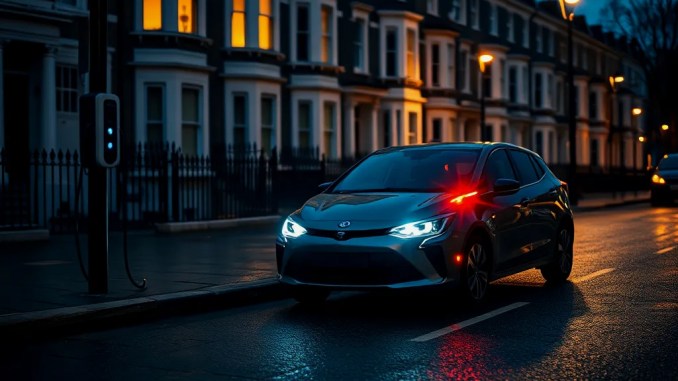
The UK government is reconsidering its 2030 target for new electric vehicle (EV) sales after automakers warned the current path is outpacing market realities. Officials are reportedly weighing options to lower the required share of zero-emission cars from 80% to roughly 60%, while defenders of the existing timetable say any weakening would stall charging network investment and climate progress.
Eyes Turn to the Critical Meeting on 11 November
Ministers will seek a decision at a Downing Street meeting on 11 November where trade-offs between industrial competitiveness and climate commitments will be tested. Louise Haigh and other senior officials aim to bridge divisions between the Treasury and departments pushing to protect emissions targets. Options under discussion include keeping the 80% 2030 mandate, stepping it down to 70% or 60%, or — in a more extensive revision — moving it to 50% as an interim target. Current expectations in Westminster tip towards a compromise near 60% and longer transition flexibilities for manufacturers through 2034, but no final decision has been announced.
Electric Car Sales Could Not Reach the Specified Rates
The legal binding UK zero-emission sales regime that took effect in 2024 requires battery electric vehicles (BEVs) to reach a progressively larger share of new-car sales: 33% in 2026, 80% in 2030 and 100% in 2035. Industry data published on 5 November by the Society of Motor Manufacturers and Traders (SMMT) shows BEVs accounted for just 26.6% of sales from January to October 2026-equivalent months, leaving the sector behind the legal ramp. October volumes rose year-on-year by 32.7% to 48,858 units, yet the cumulative pace still lags the 33% threshold for the year.
Automobile Manufacturers Pay Attention to Cost Pressure
Manufacturers stress that consumer demand and price sensitivity limit how fast EV penetration can climb without deep discounts or generous finance deals. To hit current targets at today’s demand levels, carmakers say they must deploy large incentives, low-interest credit and marketing-led promotions that compress margins and raise financing needs. Internal forecasts circulated across the sector predicting BEV share near 27.2% in 2026 — about six percentage points below the 33% statutory requirement — and roughly 37.5% in 2028, well short of the intended 52% for that year. That gap forces a choice: either maintain ambitious quotas and accept heavier subsidy-like dealer incentives, or relax quotas and reduce near-term financial pressure on factories and jobs.
£1.7 Billion Investment in Charging Infrastructure is at Risk
ChargeUK, the trade body for the charging industry, warns that diluting sales targets risks undermining around £1.7 billion of planned charging infrastructure investment. Charging operators base rollout decisions on forecasts of EV uptake; slower sales extend payback periods and threaten project viability. Practical examples include planned depot chargers and rapid motorway sites whose business cases rely on high utilisation rates within five to seven years. If government policy signals weaken demand growth, private investors and utilities may pause or scale back deployment, creating geographic and capacity gaps that in turn discourage consumers from switching from petrol and diesel.
Despite talks about easing interim EV quotas, ministers say the ban on sales of new internal combustion engine (ICE) cars by 2030 remains intact. The policy framework that phases out petrol and diesel-only vehicles in 2030, while allowing certain hybrid types during transition, still stands. Equally, the 2035 requirement that every new car and light commercial vehicle sold be zero-emission is still official policy. The current conversation focuses narrowly on the intermediate percentage milestones manufacturers must achieve before 2030 and the scope of temporary flexibilities.
How a Reduced 2030 EV Target Would Work in Practice
If the government a 2030 EV sales target from 80% to 60% it could apply one or more of the following mechanisms: time-limited credits that let manufacturers offset shortfalls with verified early compliance elsewhere; model-specific exemptions for plug-in hybrids or other low-emission powertrains; scaled penalties for non-compliance to reduce immediate cost shocks; or phased ramping that eases annual increases. Each mechanism changes incentives: credits preserve investment signals while lowering short-term obligations; exemptions shift manufacturer product strategies; and fines simply raise compliance costs for late movers.
Impacts on Consumers, Industry and Climate Goals
Short-term consumer effects would likely include fewer forced price promotions as manufacturers no longer need to move specific volumes to meet quotas. However, a weaker regulatory pathway can slow charging rollout, raise long-term costs for motorists in areas with sparse infrastructure, and reduce market certainty that underpins supply-chain investment in battery factories and skilled labor. From a climate perspective, delaying interim targets does not immediately break the 2035 ambition, but it compresses the transition window thereafter — meaning faster and potentially more disruptive change later if demand must catch up with more aggressive post-2030 ramps.
Concrete Examples and Step-by-Step Industry Responses
Manufacturers typically react through a sequence of measures when targets tighten or loosen: 1) Reprice across model ranges and target fleet customers with bespoke finance; 2) Adjust production volumes between EV and ICE lines to optimize inventory; 3) Renegotiate supplier contracts for battery components to reflect new volume forecasts; 4) Reassess capital expenditure timetables for new plants and tooling; 5) Lobby government for transitional measures or state support. Charging operators follow a similar path: reforecast utilisation, delay marginal sites, seek public funding to plug revenue gaps and repurpose urban hubs for mixed uses where demand stays low.
Questions Policymakers Will Face at the Downing Street Meeting









Be the first to comment