
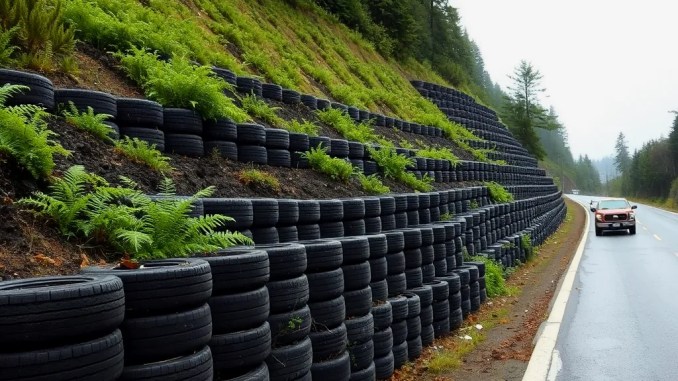
Project Background and Problem Addressed
In 1990, highway widening and elevation work on US 42 near Roseburg, Oregon, reactivated a dormant landslide beneath the roadway. Engineers identified that conventional soil fill would add excessive weight and further destabilize the slope. To reduce driving loads on the old slide mass while meeting roadway structural needs, contractors removed part of the heavy soil fill and replaced it with shredded scrap tires as a lightweight engineered fill. The removed soil served as a balancing counterweight lower on the slope.
Why Shredded Tires Were Chosen
Shredded tires provided a low-density alternative to soil, cutting imposed loads without sacrificing required volume. The material offered rapid placement with minimal compaction demands, good drainage characteristics compared with cohesive soils, and availability from regional suppliers. Cost incentives from Oregon’s DEQ recycling program reduced per-ton material costs, making the solution financially attractive compared with hauling lighter natural fill from distant borrowing sites.
Materials, Quantities, and Logistics
The project used approximately 5,800 short tons of shredded tire material—equivalent to roughly 580,000 individual passenger tires once processed into fragments. Four suppliers delivered material from distances ranging from 150 to 275 miles. Shipments used heavy trucks with about 28-ton payloads, meaning thousands of loaded trips. Contractors staged the shredded tires in lifts and placed them to design thickness, then covered the tire layer with compacted soil facing.
Design Details and Pavement Structure
At its thickest, the shredded-tire fill reached about 3.8 meters. Engineers capped the tire mass and shaped side slopes with 0.9-meter-thick compacted soil cover to protect against erosion, reduce frost effects, and provide a conventional working surface for pavement construction. The pavement section above the tire fill consisted of a 58-centimeter crushed-rock base and 20 centimeters of asphalt surfacing, designed to distribute traffic loads so the tire fill would compress predictably under service loads.
Construction Steps and Quality Controls
Contractors followed a step-by-step workflow: excavate and remove unstable soil; place shredded-tire material in defined lifts; lightly level and minimally compact each lift as specified; install soil cover layers and compact to required density; build the crushed-rock base; and lay the asphalt surfacing. Quality control included verifying source material gradation and contamination limits, monitoring lift thicknesses, field density checks on the soil cover and base, and instrumentation to record settlement and slope movement during and after construction.
Monitoring Results and Performance Data
Post-construction monitoring recorded approximately 50 centimeters of settlement in the tire fill—about 13% of its initial thickness—under the applied loads. Instruments such as inclinometers and extensometers showed that initial elastic deflections at the pavement surface were roughly twice those expected from equivalent conventional soil fills, but deformation rates stabilized over time. These observations indicate that shredded-tire fill can compress more initially yet reach a stable condition suitable for roadway applications when designed with appropriate pavement depth and settlement allowances.
Cost Breakdown and Recycling Incentives
Material costs normally run about $30 per ton, but Oregon’s DEQ recycled-material incentive covered $20 per ton, leaving a net material charge of close to $10 per ton. Including placement, spreading, and compaction, the project’s all-in cost worked out to about $18.33 per ton. Those incentives and the reduced need for hauling heavy native soil from borrow areas made the option cost-competitive for this site-specific landslide remediation.
Advantages, Limitations, and Lessons Learned
Advantages: shredded tires reduced mass and load on the slide, used diverted waste material, and lowered project costs through incentives and reduced hauling distances. Limitations: visible higher initial settlement and increased elastic deflection required deeper pavement structure and careful allowance in design. Lessons learned include rigorous source control for shredded material to avoid contaminants; designing for expected long-term settlement rather than only immediate deflection; and combining tire fill with a compacted soil cover to protect against surface erosion and facilitate pavement construction.
When to Consider Shredded-Tire Fill for Geotechnical Projects
Consider shredded-tire fill when the primary design objective is to reduce weight on unstable slopes, embankments over compressible foundation soils, or when conventional lightweight fills are unavailable or uneconomic. Perform site-specific settlement analyses, allow for greater initial compression, specify protective cover soils and robust pavement sections, and include a monitoring plan to validate predicted performance.
Practical Example Summary for Engineers
Project: US 42, near Roseburg, OR (1990–1993). Shredded-dash fill: ~5,800 short tons; maximum fill thickness: ~3.8 m; cover soil: 0.9 m compacted; pavement: 0.58 m crushed rock + 0.20 m asphalt; measured settlement: ~0.50 m (≈13%); incentive-reduced material cost: ~$10/ton net; all-in placed cost: ~$18.33/ton. These design and performance metrics give a practical reference for comparing lightweight fill alternatives on landslide remediation projects.
Key Takeaway
Using shredded tires enabled a cost-effective, waste-diverting, and technically viable remediation for a reactivated highway landslide in Oregon by significantly reducing imposed driving loads. Success required tailored structural design, allowances for extra initial compression, careful material controls, and instrumented monitoring to confirm long-term stability.









Be the first to comment