
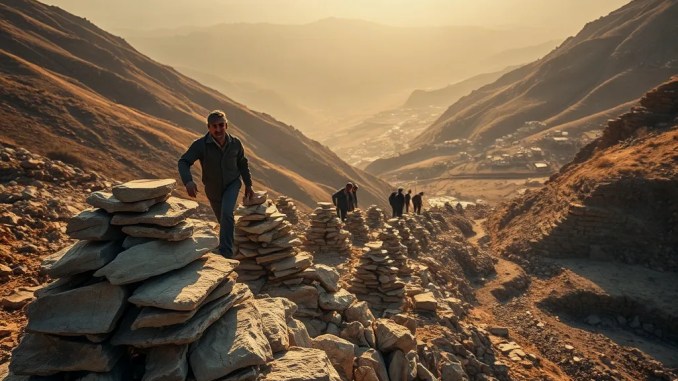
Why Ladakh builds artificial ice towers and how they solve seasonal water shortages
Engineers and community teams in Ladakh construct cone-shaped ice stupas to capture winter runoff and release it gradually during the spring crop season. They divert water from melt streams into a vertical injection system that sprays droplets into sub-zero night air. Droplets freeze before reaching the ground and accrete into a tall conical ice mass. The cone geometry reduces sun-facing surface area per unit volume compared with shallow ice ponds, slowing melt and preserving stored water for when farmers need it most.
How the ice stupa method works step-by-step
1) Source and diversion: Teams tap stream or spring flow at a higher elevation and route it into HDPE pipes or metal tubing using gravity. Flow control valves and coarse filters remove large debris to protect nozzles.
2) Pressurization and elevation: Gravity head or small local pumps increase pressure so water exits the vertical riser as a fine spray. The nozzle and riser height are chosen so spray droplets travel through the coldest night air.
3) Nozzle atomization and freezing: A vertical nozzle projects droplets outward; sub-zero night temperatures freeze those droplets in flight and on contact with existing ice, causing radial and vertical build-up that forms a cone.
4) Layered growth and seasonal shaping: Operators run the system intermittently through cold months to add concentric frozen layers. Workers may shape the cone’s slope slightly during formation to optimize solar angle and wind shedding.
5) Controlled melt and distribution: As temperatures rise in spring, the cone melts from the top and sides; meltwater channels into downstream canals and fields. Communities time releases to match crop irrigation needs.
Design principles: why the cone excels over flat reservoirs
Surface-area-to-volume efficiency: A cone of given volume exposes less horizontal area to direct solar radiation than a shallow basin. Doubling cone height quadruples surface area but increases volume eightfold, so taller cones store proportionally more water with relatively less melting exposure.
Passive, low-energy operation: The process uses gravity and nighttime ambient freezing; no refrigeration or continuous electricity is required. Small pumps or localized pressure heads suffice where gravity alone is inadequate.
Durability and maintenance: The conical shape sheds wind-driven snow and limits dark-surface exposure. Periodic nozzle maintenance, debris filtration, and monitoring of inlet pressures represent the main upkeep tasks.
Performance data and scale: from prototypes to 40-metre ambitions
Early prototypes built by Sonam Wangchuk around 2013–2014 achieved roughly 6 meters in height and stored near 150,000 liters. Project teams now target stupas up to 30–40 meters tall, which—if constructed—could store on the order of 10–16 million liters per structure, similar to the capacity of a small reservoir.
Scaling requires proportionally higher flow rates and nozzle pressures to deliver water to the increased freezing altitude and to build larger ice volumes rapidly during the cold window. For example, to grow a 40 m cone within a winter season, engineers estimate continuous equivalent flows and impulse sprays measured in tens to hundreds of liters per minute at sufficient head (or pump pressure) to atomize droplets across the increased travel distance.
Site selection, climatic limits, and operational windows
Elevation and nighttime lows: Successful ice stupas require nights that consistently drop below freezing for prolonged periods. Higher elevations (eg, 3,000 m and above) with clear, cold nights allow efficient droplet freezing.
Wind and solar exposure: Designers orient construction to reduce exposure to prevailing afternoon sun and strong katabatic winds that can accelerate sublimation or uneven melting. Micro-siting in natural concavities also reduces wind throw and improves water reuse.
Water source reliability: The winter runoff or spring-fed sources must provide a dependable baseline flow. Intermittent or highly variable sources demand flexible scheduling and additional storage upstream.
Community benefits, costs, and labor considerations
Benefits: Ice stupas deliver on-demand irrigation water in spring, protect seedling phases of barley and vegetables, and reduce dependence on diesel pumps. They also create local seasonal work for construction and monitoring.
Costs and labor: Capital costs remain modest compared with engineered reservoirs: pipe, nozzle sets, simple valves, and possible small pumps. Labor for construction, nozzle clearing, and seasonal operation typically involves village teams; costs scale with intended stupa size.
Scientific uncertainties, monitoring needs, and best-practice metrics
Researchers note gaps in direct, comparative measurements between cone stupas and terrace reservoirs. Useful monitoring metrics include:
– Stored volume estimate: Repeated photogrammetry or lidar scans to compute ice volume over time.
– Meltout timing and yield: Continuous flow monitoring at outlet channels to quantify liters delivered to fields per degree-day of warming.
– Energy equivalence: Measuring any auxiliary pumping energy to calculate net energy per liter stored relative to alternatives.
– Longevity and structural consistency: Independent verification that large stupas reach design height and maintain intended geometry across seasons.
Examples and practical tips from field implementations
Example 1 — Community-run 6 m stupa: A village team used a 30 m vertical riser with a 12 mm nozzle and gravity head from a winter channel. They ran the system on alternating nights, achieved 150,000 L storage, and timed meltout to coincide with transplanting dates.
Example 2 — Scaling experiment toward 40 m: Engineers tested phased growth: build multiple medium stupas in a cluster rather than a single giant cone to reduce peak pressure needs and allow staged water delivery. Clusters also simplify maintenance and provide redundancy.
Operational tips: Use coarse sediment filters at intakes, keep spare nozzle sets, monitor nozzle drift angles, and install simple manual valves to throttle flow during warm spells.
Key questions communities ask (and concise answers)
Do ice stupas require electricity? No — many operate purely by gravity. Small pumps are optional when source elevation or flow rates are insufficient.
How long does an ice stupa last? Seasonal: they form over cold months and melt through spring. Proper geometry and siting maximize useful melt duration.
Are they scalable to full irrigation supply? They can meaningfully supplement spring water for fields and orchards, but replacing large reservoirs requires many stupas or complementary storage and catchment systems.
Action checklist for a community starting an ice stupa project
1) Map potential water sources and elevation head. 2) Conduct a simple frost window analysis: count nights below 0°C across the cold months. 3) Prototype a small cone (4–6 m) to validate nozzle selection and freezing behavior. 4) Instrument final designs for volume and outflow monitoring. 5) Train local operators on filtration, nozzle maintenance, and seasonal timing.
Conclusions and outlook
Ice stupas provide a low-energy, engineering-driven method to shift winter runoff into the critical spring irrigation window. They pair simple hydraulics with geometric advantages to preserve meltwater and have scaled experimentally from 6 m prototypes to ambitious plans of 30–40 m structures. Robust, independent measurements and practical clustered designs can address current uncertainties and make ice stupas a reliable tool for high-altitude water management.






Be the first to comment