
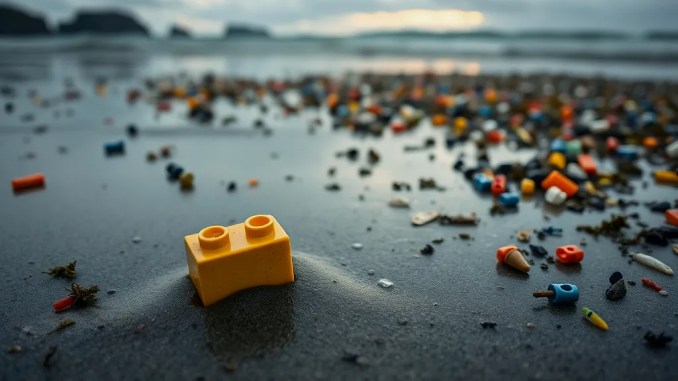
In 1997, a violent wave tore 62 containers from the deck of the container ship Tokio Express, releasing roughly 4.8 million small plastic toys into the North Atlantic. Decades later, hundreds of those toys—miniature life vests, snorkels, octopi, sharks, pirate sabers and green dragons—continue to appear on Cornwall’s beaches, carried by complex ocean currents and held in the marine environment for years.
What happened during the Tokio Express incident and which toys were lost?
The Tokio Express encountered an extreme rogue wave off the coast of England that ripped open multiple containers. One container held thousands of small, sea-themed plastic toys intended for retail. The inventory included identifiable figures: tiny black octopus pieces, neon green dragon figures, shark heads, diving tubes and miniature life jackets. When the container breached, these toys entered the ocean as discrete buoyant items rather than microplastic fragments—an important distinction for how they move across the sea and how long they remain intact.
How do ocean currents move buoyant plastic toys to Cornwall decades later?
Atlantic surface and subsurface currents form conveyor-like pathways that can transport floating items thousands of kilometers. Key mechanisms involved:
1) Ekman transport and wind-driven drift: Wind patterns create a net motion in the top layer of the ocean that carries floating toys along predictable corridors.
2) Gulf Stream and North Atlantic Drift: These strong western-to-eastern flows steer debris toward the British Isles and then down toward southwestern England under seasonal variability.
3) Mesoscale eddies and coastal retention: Rotating water masses temporarily trap and later release items, explaining why toys can appear intermittently over many years rather than in a single pulse.
Why do some toys remain intact and wash ashore years after the spill?
Several material and physical factors explain the longevity of these toys:
Polyethylene and hard plastics: Many of the spilled toys were molded from durable plastics that resist biodegradation and fragmentation compared with softer polymers.
Buoyancy profiles: Hollow or closed-molded pieces sit at the air–water interface, exposed to windage and surface currents rather than remaining submerged where abrasion might fragment them faster.
Seasonal stranding events: Storms and onshore winds temporarily invert local flow, delivering debris from coastal retention zones up onto beaches. A single storm can unearth items buried for years in nearshore sediments.
Where and when are these Lego pieces found on Cornwall’s coast?
Beachcombers, researchers and citizen scientists report finds concentrated on west- and south-facing shores of Cornwall, particularly after winter storms. Typical patterns observed:
– Higher densities at headlands and bay entrances where convergent flows deposit floating debris.
– Increased discoveries in late autumn and winter when storms outrun seasonal gyres.
– Locations near estuary mouths where tidal exchange concentrates floating items.
How are researchers and volunteers tracking the debris and what data exists?
Tracking combines systematic beach surveys, photographic cataloging and crowdsourced reporting. Practical elements of current monitoring:
Standardized transects: Researchers walk fixed stretches of beach at regular intervals, recording counts and types of pieces per meter.
Photographic databases: High-resolution images with timestamps and GPS coordinates help identify recurring shapes and color variants, letting teams link newly found items to earlier records.
Citizen science apps and local networks: Enthusiast groups and apps collate sightings, allowing long-term temporal maps that show episodic influxes.
What do these persistent finds tell us about plastic in the ocean?
The Tokio Express toys are a clear, visible example that some plastic items can remain in circulation for decades while retaining recognizable form. Key takeaways supported by this case:
– Not all ocean plastic rapidly fragments into microplastics; certain geometries and materials persist as meso- and macro-debris.
– Transport pathways are complex and temporally variable—debris can re-enter circulation many times before final shoreline deposition.
– Visual, intact debris makes it easier to engage the public, providing tangible examples for education and long-term pollution studies.
How can local communities and researchers respond to these ongoing arrivals?
Actionable steps that balance recovery, data collection and safety:
Organized beach surveys and cleanups: Schedule volunteer efforts around predicted storm windows and establish safe handling protocols for debris that may be contaminated.
Data-first collection: Photograph and log items with GPS coordinates before removal; Prioritize scientific records for unique or rare pieces.
Preservation for study: Retain representative specimens (cataloged) for material analysis to compare degradation states across decades and locations.
What practical lessons and wider implications arise from the Tokio Express legacy?
The long-lived presence of these toys underscores broader issues: marine debris can remain distributed and mobile for decades, ocean circulation connects remote events to distant shorelines, and spill individual events create persistent ecological and cultural artifacts. The case also offers a replicable model for combining volunteer engagement with structured science—data that can improve models of debris transport and inform coastal management decisions.
Hundreds of tiny plastic toys, swept from a single container nearly 30 years ago, continue to chart invisible ocean highways and teach researchers how debris behaves over multiple human generations.








Be the first to comment