Revolutionizing Humanity’s Return from Space: The Artemis II Mission
During the Artemis II mission, NASA pushed the boundaries of space exploration by executing a complex and meticulously coordinated spacecraft re-entry. This journey, which involved flying at speeds exceeding 40,000 km/h through Earth’s atmosphere, tested both technology and human resilience. Such missions are not just about reaching celestial bodies but primarily focus on safety and innovation during re-entry—the most perilous phase of space travel. Understanding this high-stakes process shows how NASA’s precision engineering continues to safeguard astronauts while paving the way for future deep-space exploration.
Pre-Entry Preparations: Equipping Astronauts & Ensuring Safety
Before re-entry, astronauts undergo rigorous protocols designed to maximize safety and comfort. Every detail is vital—from suit integrity to communication systems. Astronauts test their pressure suits, ensuring that the gear can stand sudden shifts in atmospheric pressure and temperature extremes during descent. These suits, acting as their life-support system, must be flawless to prevent injuries or suffocation. Leading up to re-entry, crew members perform comprehensive checks on the spacecraft’s systems, especially those related to heat protection and navigation. This involves simulating re-entry conditions in ground tests, verifying the integrity of heat shields, and updating onboard software to optimize trajectory accuracy. Key Insight: The Artemis II crew also practices emergency scenarios, including abort procedures, in case of unforeseen issues during re-entry, ensuring rapid response capabilities that can save lives in real-time crises.
Precise Re-entry Trajectory and Angle of Entry
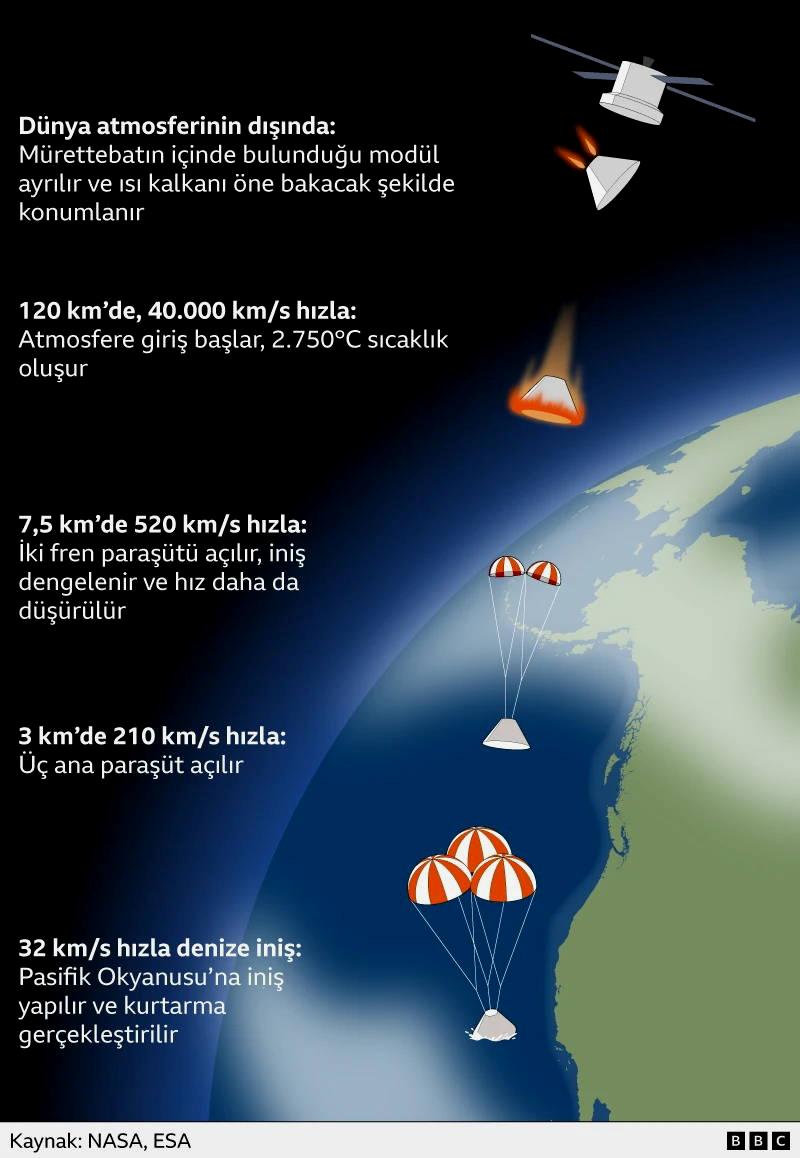
NASA engineers focus on calculating an optimal entry angle, critical for controlling deceleration and heat generation. Entering at an overly steep angle risks the spacecraft burning up or bouncing off the atmosphere, while a shallow angle can cause it to skip off Earth’s atmosphere, leading to loss of control. The ideal angle, typically between 5.5 and 7 degrees, depends on real-time atmospheric conditions and spacecraft velocity. Using advanced models and real-time telemetry, mission control adjusts the spacecraft’s descent path to achieve this. As Artemis II approaches re-entry, onboard sensors continue to feed data back, allowing ground controllers to make last-minute trajectory corrections. Step-by-Step Re-entry Process: – Spacecraft separation from the service module – Entry interface: when the heat shield encounters atmospheric friction – Peak heating point: temperatures can reach up to 2,700°C (4,892°F) – Deceleration and parachute deployment – Final descent and water landing This meticulous planning significantly reduces risks, ensuring crew safety and mission success.
Handling Extreme Heat: The Heat Shield’s Role
The heat shield during re-entry endures one of the most intense conditions in human spaceflight. Designed with ablative materials that absorb and dissipate heat, it stands with temperatures nearly half that of the sun’s surface. How does it work? As the spacecraft slams into the atmosphere, the shield’s surface chars and erodes, carrying away intense heat through controlled ablation. This creates a plasma layer that temporarily disrupts radio communication—a phenomenon called *communications blackout*. NASA’s engineers continually refine heat shield technology, incorporating new composite materials and sensor feedback to enhance thermal protection. During Artemis II, improvements made after previous missions ensured the shield could survive unexpected atmospheric variances, further shielding astronauts from thermal threats. Real-Life Application: The success of the heat shield in Artemis II validated new materials tested in recent prototype flights—an essential step toward safely returning humans from missions beyond lunar orbit.
Controlled Deceleration and Parachute Deployment
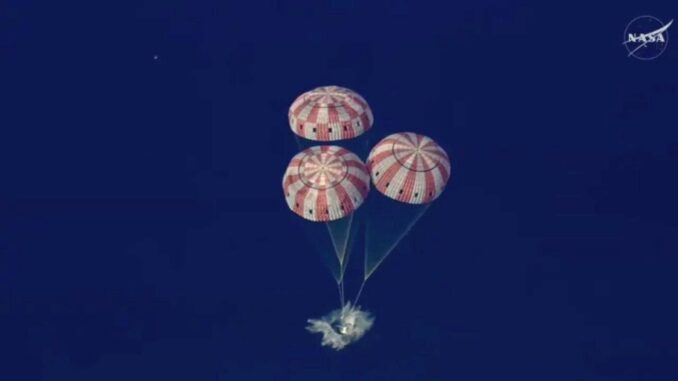
The re-entry phase leverages aerodynamic forces and parachute systems to slow the spacecraft gradually, ensuring a soft landing. Initially, two *frenzy* (flying) parachutes open at around 6.7 km altitude, stabilizing the craft while reducing velocity. These are followed by a set of *main parachutes*, which deploy at approximately 1.8 km altitude, further slowing descent to about 32 km/h (20 mph). Each parachute’s deployment is carefully timed to prevent rapid oscillations or collapse, which could jeopardize crew safety. Modern advancements allow NASA to monitor these systems in real-time, making adjustments as needed. Artemis II, in particular, tested new parachute inflation protocols, ensuring reliability in unpredictable atmospheric conditions. Crucial Fact: This staged deceleration system not only protects astronauts from impact injuries but also ensures landing precision in the Atlantic Ocean—facilitating swift rescue operations.
Water Landing and Retrieval Operations
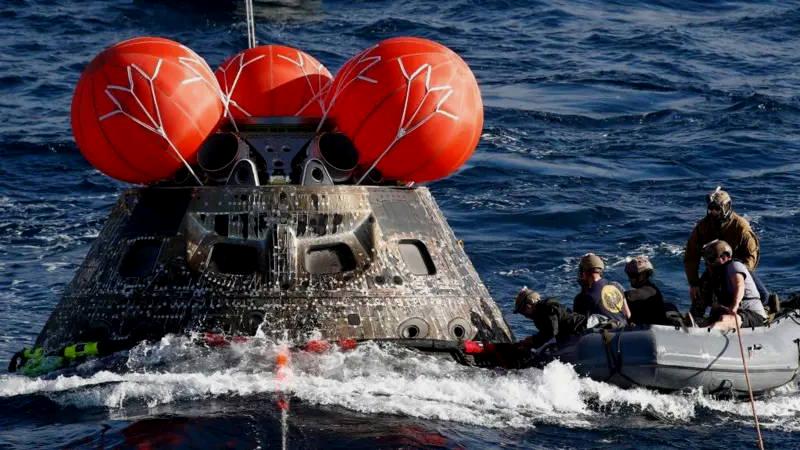
The final stage involves splashdown in designated safe zones, usually in the Pacific or Atlantic. Designed with multiple flotation devices—five inflating airbags—the capsule remains upright and stable during impact, regardless of landing angle or water turbulence. Once the capsule hits the water, rescue teams quickly locate and secure it using ships equipped with helicopters and fast boats. Deployment of quick-response rescue modules ensures crew extraction within minutes, even under adverse weather conditions. Notably, Artemis II’s recovery process showcased cutting-edge techniques: enhanced flotation techniques, rapid medical assessment protocols, and integration of unmanned rescue drones. These innovations streamline the process, reducing the time from splashdown to crew hospital transfer, ultimately safeguarding human life while demonstrating NASA’s advanced crisis management capabilities. Furthermore, all data collected during recovery feeds into future mission planning, reinforcing the continuous cycle of technological improvement seen throughout Artemis II. Implication for Future Missions: Efficient recovery underscores NASA’s commitment not only to astronaut safety but also to operational excellence, setting standards for deep-space explorations like Mars missions.
Conclusion: A New Benchmark in Human Spaceflight Safety
The Artemis II mission exemplifies how decades of technological innovation and rigorous planning culminate in a safe, effective re-entry process. From pre-entry preparations to splashdown, every phase integrates sophisticated engineering, real-time data analysis, and contingency strategies. NASA’s commitment to refining heat shield materials, optimizing descent trajectory, deploying staged parachute systems, and executing rapid recovery processes pushes the boundary of what humanity can achieve in space travel. Each successful re-entry reaffirms that safety remains at the core of exploration—enabling humans to venture further, with the confidence that they can return home safely. With continuous advancements, future lunar missions, Mars expeditions, and beyond will build upon these proven protocols, ensuring every step into the cosmos has a solid foundation of safety, technology, and resilience. This synergy of innovation and experience positions humanity on the cusp of an era where reaching and returning from distant worlds becomes an attainable reality, inspiring generations to come.