In a move that has sent ripples across the geopolitical landscape, the United States has officially authorized a substantial military aid package worth over $6.5 billion to bolster Israel’s defense capabilities. This decision emphasizes the strategic partnership between the two nations, particularly in the context of escalating regional tensions and ongoing conflicts. The approval reflects a targeted effort by the US to strengthen Israel’s military preparedness through the procurement of cutting-edge technology, advanced weaponry, and integrated defense systems.
Demonstrating unwavering support, the US Department of Defense announced the sale, which encompasses a range of sophisticated military assets designed to enhance Israel’s operational effectiveness in complex security scenarios. This announcement not only signals a deepening of military ties but also underscores the importance of maintaining regional stability in a volatile Middle East. The approved package includes major hardware components, operational support, and technological upgrades aimed at ensuring Israel retains superiority in defending its borders.
Significance of the Military Support Package
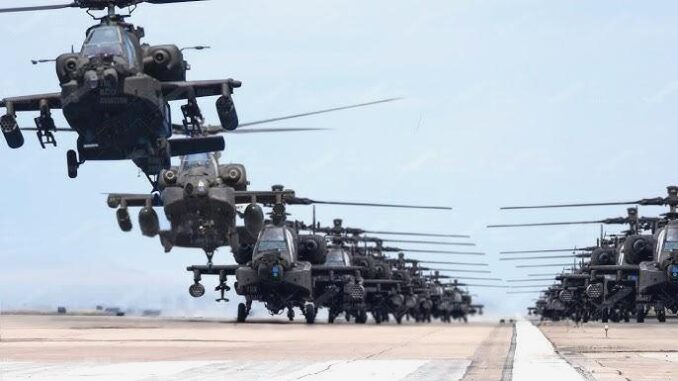
The core of this aid package is centered on the procurement of 30 Apache AH-64 attack helicopters, renowned for their combat versatility and technological superiority. These helicopters serve as force multipliers capable of conducting precision strikes, close air support, and reconnaissance missions in hostile environments. The inclusion of these advanced attack helicopters is a strategic move, permitting Israel to project power more effectively and respond swiftly to emerging threats.
In addition to the helicopters, the package features a wide array of munitions, sensor systems, and electronic warfare equipment. These components are vital for maintaining operational dominance, especially in contested airspace. The integration of modern sensor suites and electronic countermeasure systems enhances Israel’s ability to detect, intercept, and neutralize incoming threats—be they missile-based or aerial assaults. This comprehensive approach ensures a multilayered defense system capable of adapting to multifaceted threats.
Financial Breakdown and Technological Edge
The total cost exceeds $6.5 billion, with approximately $3.8 billion allocated specifically for the Apache attack helicopters and their associated systems. This substantial investment highlights the priority placed on upgrading Israel’s aerial combat fleet with state-of-the-art hardware. The remaining funds cover logistical support, training, transportation, and maintenance, ensuring a seamless integration of these advanced systems into Israel’s existing military infrastructure.
What makes this deal particularly noteworthy is the emphasis on technological superiority. The Apache helicopters are equipped with the latest targeting and navigation systems, allowing for high precision even in adverse conditions. Their multi-mission capability ensures they can be reconfigured rapidly, adapting to evolving battlefield requirements. The US’s commitment to delivering cutting-edge technology reinforces Israel’s edge over regional adversaries and enhances its strategic deterrence.
How This Support Transforms Israel’s Defense Strategy
By acquiring this fleet of Apache helicopters and associated equipment, Israel significantly bolsters its capacity for rapid response and offensive operations. The power projection offered by these helicopters allows Israel to carry out preemptive strikes, border patrols, and deep reconnaissance missions with unprecedented accuracy and efficiency.
Moreover, the synergy of multiple advanced systems results in a more resilient defense architecture. When combined with Israel’s existing missile defense systems such as Iron Dome and David’s Sling, the new assets create a layered shield capable of intercepting threats at various levels. This comprehensive defense approach helps prevent infiltrations, intercept incoming projects, and minimize civilian casualties, ultimately enhancing national security.
Regional Implications of US Support
This large-scale military support not only strengthens Israel but also significantly impacts regional stability. It signals a clear message to potential adversaries that the US remains firmly committed to Israel’s defense, potentially deterring aggressive actions from hostile entities. It could trigger responses from neighboring states keen to match or counterbalance Israel’s enhanced capabilities, thus affecting the broader security calculus in the Middle East.
Furthermore, this deal could influence diplomatic relationships and arms policies across the region. Countries observing the US’s unwavering support for Israel may reconsider their own defense strategies, possibly accelerating arms acquisitions or fostering regional alliances to counterbalance the regional military dynamics.
Impact on International Relations and Future Cooperation
The approval of this package marks a deepening of the United States’ strategic partnership with Israel, emphasizing shared technological innovation and military interoperability. It paves the way for future joint exercises, intelligence sharing, and collaborative defense initiatives. Both countries stand to benefit from synchronized command and control systems, which could serve as a blueprint for broader military alliances.
Additionally, the deal might influence future US arms sales to other allies in the region, setting a precedent for high-value military support packages aimed at maintaining regional military balances. As geopolitical tensions persist, such robust commitments reaffirm the US’s role as a key security guarantor in the Middle East.