
Siemens and SRI Rail Invest agree on a single Vectron Dual Mode locomotive delivery
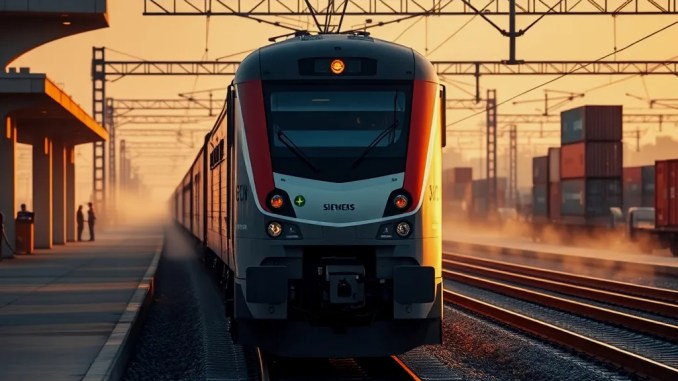
SRI Rail Invest signed a contract with Siemens for one Vectron Dual Mode locomotive, numbered 248 223-0, with delivery scheduled for late 2027 or early 2028. The company announced the order on 26 October 2026 but did not disclose the purchase price, contract signing date, or the specific routes where the unit will operate. SRI published a livery concept showing its corporate colors; the visual was prepared by designer Simon Wijnakker and notes that the background was generated using artificial intelligence.
How Vectron Dual Mode operates and why it matters for leasing fleets
Vectron Dual Mode locomotives switch between electric and diesel traction depending on electrification availability. On electrified sections they draw power from the overhead catenary; on non-electrified stretches they run on diesel. That capability eliminates the need to change locomotives when a train crosses between electrified and non-electrified territory, reducing shunting time and equipment churn for freight operators and lessors.
For a leasing company like SRI Rail Invest, a dual-mode asset delivers three practical advantages:
1) Increased utilization: The same locomotive can serve mixed-route contracts without a second engine. Example: a freight path that runs from an electrified port approach into a non-electrified industrial branch remains intact under a single traction unit.
2) Faster turnarounds: Operators avoid locomotive exchange stops, saving minutes to hours per service and improving on-time performance.
3) Broader market appeal: Dual-mode units appeal to short- and medium-term lessees who require operational flexibility across diverse route networks.
Technical profile and design origins of the Vectron Dual Mode
Siemens introduced the Vectron Dual Mode in 2018 aimed at Germany’s freight market. Early published specifications noted operation on 15 kV AC, a service mass around 90 tons, and a maximum speed of 160 km/h. The Dual Mode variant integrates traction converters and auxiliary systems that allow a seamless switch between pantograph-supplied electricity and on-board diesel generation.
In practical terms, the powertrain and control systems coordinate to avoid traction interruption: the transition sequence lowers the pantograph and starts the diesel prime mover or vice versa, following safety and emissions management algorithms. Leasing firms assessing life-cycle costs weigh additional complexity (service intervals, fuel logistics) against the operational gains described above.
Where the new locomotive fits within SRI Rail Invest’s fleet strategy
As of 2026, SRI’s inventory lists 20 locomotives across classes 146, 151, 185 and 187 plus one double-deck train. Its diesel-capable resources include four units in the 187 TRAXX AC3 subclass, three of which SRI acquired from LTE in 2025 and a fourth (187 323) added to the fleet in June 2026 via a lease from CER Cargo Traction and then subleased to a 1435-gauge operator.
The single Vectron Dual Mode joins this roster as a targeted diversification: unlike the smaller Deutz-equipped TRAXX units used for last-mile duties, the Vectron variant offers sustained diesel-mode performance for longer unelectrified segments while still operating at full mains power on catenary lines. SRI can therefore market a single-traction solution to customers with mixed-route needs, increasing the asset’s days-in-service and revenue potential.
Market context: larger orders and industry adoption
Demand for Vectron Dual Mode units extends beyond SRI. Akiem placed a firm order for 10 units with Siemens in June 2025 and secured options for an additional 40; initial deliveries were scheduled for Q4 2026. DB Cargo secured a framework agreement with Siemens in 2020 that covered up to 400 locomotives, followed by a 100-unit order in September 2020 and a further joint order of 50 units in January 2022 (46 allocated to DB Cargo, 4 to DB Bahnbau Group). Paribus Rail Investment Management signed a framework in 2021 for up to 30 units and followed with an initial seven-unit procurement.
Compared to those large-scale fleet programs, SRI’s one-unit order looks modest numerically but aligns with a targeted strategy: secure at least one high-flexibility asset to prove operational benefit, then scale through additional orders or short-term hires depending on customer uptake.
Operational examples and step-by-step use cases
Two concrete use cases show how lessees will exploit a dual-mode unit:
Example A — Port to inland terminal: Step 1: Electric haul from electrified seaport approach to yard. Step 2: At the yard, the operator confirms safe transition window and initiates mode switch. Step 3: Pantograph lowers, diesel prime mover starts and synchronizes. Step 4: Diesel-mode haul into unelectrified industrial spur; return to electrified mainline follows the reverse sequence.
Example B — Cross-border freight with mixed electrification standards: Step 1: Travel under local electric system on home network. Step 2: Enter a neighboring country with no compatible overhead system or a gap in electrification. Step 3: Switch to diesel to cross the gap without swapping locomotives. Step 4: Reconnect to an electrified section, resume electric operation to final destination.
These workflows reduce logistic friction, shorten transit times, and improve contractual certainty for shippers and operators.
Commercial implications and next steps for SRI Rail Invest
SRI can use the Vectron Dual Mode as a demonstrator asset: lease it short-term to customers with mixed-route profiles to collect utilization, fuel consumption, maintenance interval, and transition-time data. With real-world metrics, SRI can build financially modeled offers (per-kilometer pricing tiers for electric vs diesel operation, transition-hour surcharge structures) and decide whether to exercise additional procurements or to broker similar locomotives from larger lessors.
Given industry activity—Akiem, DB Cargo, Paribus—SRI’s path forward could also include cooperative leasing or swapping agreements to access capacity spikes without committing to bulk purchases. For potential lessees, SRI’s single-unit entry presents a low-barrier opportunity to trial dual-mode operation before committing to larger fleet changes.







Be the first to comment