
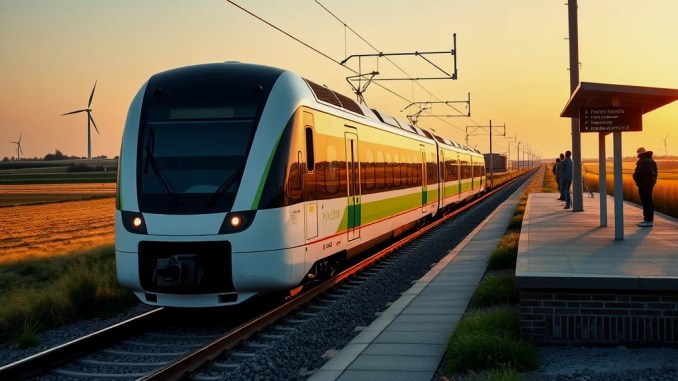
Overview of the NWL–Rock Rail–Siemens Mireo Plus B Program
North Rhine-Westphalia (NWL) has commissioned 61 two-car Mireo Plus B battery-electric trains financed by Rock Rail and manufactured by Siemens Mobility. The fleet will replace diesel regional trains on routes across East Westphalia-Lippe and Münsterland, entering service in stages from December 2029. The program targets about 7.1 million train-kilometres annually, making it one of the largest regional battery-train investments in Germany and positioning the fleet as the country’s second-largest battery-electric regional fleet.
Why NWL Chose a Single, Enduring Design
NWL defined a unified exterior design to create a long-term, recognizable brand identity across the region’s passenger touchpoints. The operator expects consistent visual cues to speed passenger recognition and simplify wayfinding as services, stations and vehicles integrate under one look. NWL will retain a single commissioning authority for the entire fleet so that operator changes will not alter the trains’ appearance. That preserves continuity for passengers and protects the region’s brand investment when service contracts change.
How Rock Rail’s Financing Keeps Trains in the Region
Rock Rail provides long-term financing and retains asset allocation to NWL, ensuring the vehicles remain dedicated to the North Rhine-Westphalia network even if operating companies change. This structure secures regional availability of modern rolling stock and reduces the risk that new operators might substitute other trains. Rock Rail says the investment supports quiet, emissions-free local mobility and long-life service for passengers and communities.
Siemens’ Scope: Manufacturing, Configuration and Delivery Timeline
Siemens Mobility will produce the two-car Mireo Plus B units with battery systems sized for mixed electrified and non-electrified lines. The delivery schedule phases entries into service beginning December 2029 to replace diesel units progressively. Siemens configures the vehicles for regional requirements—short station dwell times, fast acceleration for frequent stops, and battery charging on electrified sections—while integrating regenerative braking and intelligent energy management to maximize range and reduce grid load.
Battery Technology and Operational Strategy
The trains use battery-electric multiple-unit (BEMU) technology. They charge batteries on electrified overhead lines and operate on stored energy through non-electrified stretches. Key technical strategies include:
Regenerative energy capture: braking energy returns to the batteries to extend range and lower net energy use.
Smart energy management: software optimizes charge/discharge cycles, minimizes battery degradation and prioritizes zones for on-board consumption versus feeding grid.
Mixed-line operations: scheduling alignments runs so charging opportunities appear on predictable segments, allowing planners to size batteries for expected daily duty cycles rather than worst-case only.
Passenger Experience: Comfort, Accessibility and Amenities
Operators designed interiors to increase passenger utility and comfort. Features include Wi‑Fi, power sockets and USB ports, dedicated spaces for up to 18 bicycles per train, wheelchair spaces, and large multipurpose areas to support luggage and prams. Low-floor entrances facilitate step-free boarding, reducing dwell times and improving accessibility for mobility-impaired passengers. Interior lighting and acoustic design aim to leverage the quieter drivetrain for a more travel environment.
Operational Benefits: Emissions, Noise and Energy Efficiency
BEMUs deliver immediate local benefits compared with diesel multiple units:
Local emission elimination: zero tailpipe emissions on non-electrified sections, improving air quality in towns along the routes.
Noise reduction: battery-electric operation cuts propulsion noise and pleasant vibration, particularly noticeable at stops and in built-up areas.
Energy efficiency: regenerative braking and route-optimized charging reduce total energy consumption per train-kilometer.
Network Planning and Timetabling Considerations
Planners must integrate charging locations and dwell patterns into timetables to ensure consistent range margins. Typical steps for deployment include:
1. Route energy audits: measure gradients, stop spacing and passenger loading to estimate consumption.
2. Charge-point siting: identify existing electrified segments or depot locations for routine charging.
3. Battery sizing and reserve planning: choose capacity with reserve for delays, degraded battery state and cold-weather performance.
4. Operational rules: define minimum state-of-charge thresholds, charging windows and contingencies for diversion or recovery operations.
Examples and Data Points to Guide Operators
From comparable BEMU deployments in Europe, key lessons include:
Route pairing: grouping services so units can top-up on elect longerrified stretches improves reliability.
Maintenance planning: battery health monitoring and scheduled capacity checks avoid sudden availability losses.
Stakeholder coordination: align infrastructure owners, dispatchers and energy suppliers early to secure charging windows and grid capacity.
What Passengers and Local Authorities Can Expect
Passengers will benefit from quieter, cleaner journeys and improved onboard amenities. Local authorities will see localized air-quality improvements and lower noise exposure. The fleet’s long-term allocation to NWL stabilizes service quality expectations and supports regional climate and mobility goals without immediate large-scale electrification of every line.
Risks and Mitigations for Large-Scale BEMU Adoption
Risk areas and mitigations include:
Battery degradation risk: implement diagnostic telematics and planned mid-life replacements.
Charging infrastructure constraints: coordinate grid upgrades and reserve charging windows in timetables.
Operational disruption: keep a residual diesel or alternative traction pool and contingency shuttles during transition phases.
Expected Impact by 2029 and Beyond
When all 61 Mireo Plus B units enter service, operators expect a marked reduction in diesel vehicle kilometers, localized emissions and noise. The design choice to retain visual consistency across operators should improve passenger familiarity and make the network easier to navigate. The program provides a replicable model for other regions balancing decarbonization goals with phased infrastructure upgrades.



Be the first to comment