
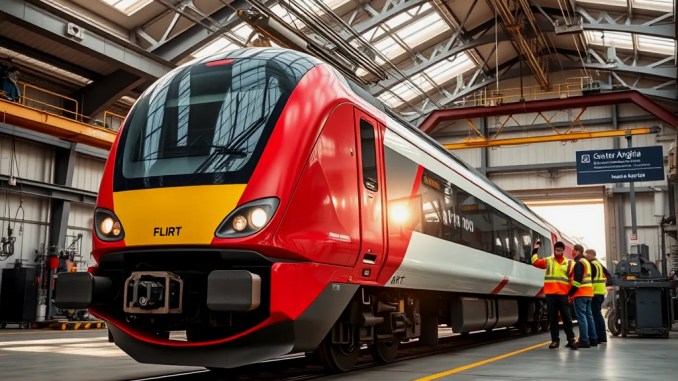
58-train FLIRT fleet maintenance to continue under extended Stadler deal
Stadler Rail Service UK will continue to maintain and provide technical support for Greater Anglia’s 58-unit FLIRT under a two-year contract extension announced on 20 October 2026. The renewed fleet covers both pure electric and bi-mode trains used across intercity, airport-express and non-electrified routes. Neither party declares the contract’s monetary value or the exact termination date beyond the two-year extension.
Which trains are covered and how the fleet breaks down
The extension keeps Stadler responsible for the Class 745 and Class 755 FLIRT units. The full fleet composition is:
Electric 12-car units (20 total) — 10 configured for intercity services and 10 configured for airport-express duties.
Bi-mode units (38 total) — 24 four-car and 14 three-car units able to operate on electrified and non-electrified lines.
Operationally, the mix lets Greater Anglia run high-capacity services on electrified corridors while retaining flexible coverage on branch and regional lines that lack continuous electrification.
Seating capacity, configuration and practical implications
Seating differences by role and vehicle size. Typical capacities reported for the classes are:
12-car intercity — 704 seats (624 standard, 80 first class); 12-car airport-express — 722 seats; 4-car bi-mode — 202 seats; 3-car bi-mode — 144 seats. These configurations influence how Greater Anglia allocates stock by route: higher-seat intercity formations serve peak commuter and long-distance flows, while the bi-mode units deliver frequent regional turns without requiring electrification upgrades.
What Stadler will practically do under the extension
Stadler’s remit covers routine maintenance, scheduled overhauls, fault diagnosis and on-the-spot technical support at depots where the fleet is based. Practical activities include:
1. Planned maintenance cycles: executing mileage- and time-based inspections, wheelset reprofiling, bogie overhauls and braking-system checks to keep units within safety and availability targets.
2. Corrective repairs: triage of faults reported in-service, rapid repairs to return units to traffic, and root-cause analysis to prevent recurrence.
3. Parts supply and logistics: managing spare-parts inventories and supply chains so turnaround times stay low and depot throughput remains high.
4. Technical updates: implementing software updates, passenger-info system upgrades and adaptations required by infrastructure or regulatory changes.
How this extension affects service planning and reliability
Keeping a single maintenance provider for the FLIRT fleet simplifies fault and reduces interface friction between operator and maintainer. Benefits for Greater Anglia include higher predictability in train availability figures, faster troubleshooting on known-class defects and improved lifecycle planning because Stadler retains institutional knowledge of these specific builds.
For timetable planners, predictable availability supports recovery buffer design: when a known maintenance regime shortens mean-time-to-repair, planners can reduce spare train holdings and allocate more vehicles to revenue service, improving cost-per-seat-mile.
Stadler’s presence and depot footprint in the UK
Stadler’s UK operations span Norwich, Newcastle, Liverpool, Glasgow and Cardiff, where the company provides servicing and localized maintenance capability. Having multiple regional depots reduces dead mileage for transfers and enables faster fault response across Greater Anglia’s operating geography. The extension coincides with Stadler’s tenth anniversary of activity in the UK and underscores the company’s strategy of embedding maintenance resources close to operators.
Why the choice fleet (12-car electrics vs bi-mode units) matters strategically
Greater Anglia’s mixed fleet gives operational resilience and route flexibility. The 12-car electrics concentrate capacity where electrification exists and where passenger volumes justify large formations; the bi-mode units act as a hedge against incomplete electrification and allow continuous services over mixed infrastructure without time-consuming loco changes or transfers.
Strategically, this reduces the immediate need for network-wide electrification while keeping service frequency and journey time competitiveness high. It also spreads capital and maintenance risk: large-capacity electrics demand depot capabilities for longer, heavier units, while bi-mode units require both diesel and electric-system expertise.
Relation to the concurrent Alstom agreement for Class 720 Aventra trains
Five days before the Stadler extension, Greater Anglia extended Alstom’s maintenance contract for its Class 720 Aventra fleet. Alstom’s contract, announced on 15 October 2026, runs for 15 years and covers 133 five-car Class 720 units at the Seven Kings depot, including major overhauls, unscheduled repairs and spare-parts provision. The Alstom deal — reported around £800 million — and Stadler’s extension together align the operator’s maintenance strategy across its electric and bi-mode portfolios while consolidating long-term support arrangements with OEMs.
Operational and commercial takeaways for stakeholders
For passengers: continuity of maintenance under an experienced OEM should to steadier performance and translate fewer in-service failures for FLIRT-operated services. For Greater Anglia: the extension reduces procurement churn and preserves technical continuity, simplifying long-term fleet planning. For Stadler: the renewal keeps its UK maintenance meaningful footprint and reinforces its role as a lifecycle partner, not just a vehicle supplier.
Key data snapshot
Fleet total: 58 FLIRT units (20 electric 12-car; 38 bi-mode units — 24 four-car, 14 three-car).
Seating range: 144–722 seats depending on formation.
Contract: Two-year extension for maintenance and technical support, announced 20 October 2026.
Related contract: Alstom 15-year extension for Class 720 fleet, announced 15 October 2026.







Be the first to comment