
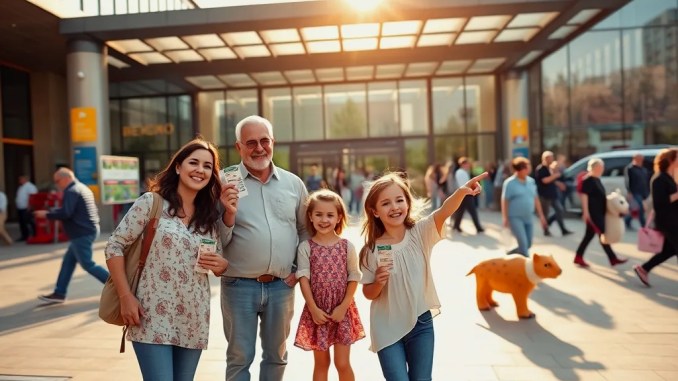
Ankara’s Digital Zoo welcomes 5,000 visitors on opening day of the nine-day school break
The Ankara Metropolitan Municipality’s Digital Zoo opened its refreshed exhibits on the first day of the nine-day school break and received 5,000 visitors. Families and schoolchildren from primary and secondary institutions arrived at the Atatürk Children and Wildlife Park to access interactive, technology-led learning experiences that pair live conservation themes with immersive digital interpretation.
How the Digital Zoo uses technology to teach about animals and habitats
The center organizes content across several purpose-built zones—Digital Experience Museum, hologram galleries, Safari Room, and Space Room—each designed to convey ecological concepts through sensory-rich media. In the Digital Experience Museum, floor-to-ceiling projections create environments such as wetlands, rainforests, and marine seascapes. Visitors physically walk through projected ecosystems while contextual panels and audio cues explain food webs, migration patterns, and human impacts.
Hologram stations render three-dimensional animal models at life scale, enabling close observation of morphology and locomotion without stressing live animals. An example: a holographic sea turtle demonstrates nesting behavior and a layered audio track explains threats like bycatch and plastic pollution. Aquarium holograms simulate water clarity and light penetration, letting visitors compare shallow reef and deep-sea conditions and learn why different fish species occupy specific depth bands.
Interactive education kiosks complement immersive displays. Each kiosk offers concise species profiles, conservation status, and short quizzes that adapt difficulty to the visitor’s age. Teachers can use the kiosks to prepare a five- to ten-minute pre-visit lesson or to assign follow-up activities, such as a habitat restoration mini-project that students can complete at school using provided templates.
Practical visitor guidance: hours, tickets, and on-site flow
The Digital Zoo publishes up-to-date visiting hours, ticketing, and event schedules at dhb.ankara.bel.tr. To optimize a visit, follow this step-by-step plan used by thousands on opening day:
1. Reserve or check tickets online — Confirm available entry slots and book early-morning or late-afternoon times to avoid peak crowds. Group bookings for school classes should use the educational booking option.
2. Start at the Digital Experience Museum — Begin with projected environments to gain context for species exhibited elsewhere. The museum’s linear narrative builds understanding from ecosystems to species-level adaptations.
3. Move to hologram galleries — Spend 15–25 minutes per station for close inspection and interactive toggles that show skeletal, muscular, and skin layers.
4. Visit the Safari Room and Space Room — The Safari Room uses timed digital sequences to simulate day-night cycles in savanna and forest habitats; the Space Room connects planetary science to Earth’s biosphere, showing how orbital and climatic influence ecosystems.
5. Use kiosks for follow-up — Complete a short quiz and download a printable activity sheet that reinforces concepts seen on the tour.
Educational value and examples teachers can use immediately
Teachers acquire immediately applicable materials: crosswalked lesson plans, digital worksheets, and a rubric aligned to basic learning objectives (observation, hypothesis, evidence-based explanation). For example, a single-period classroom activity uses the Aquarium Hologram module:
Step-by-step classroom activity:
1) Show students the aquarium hologram sequence and ask them to list three environmental variables that change with depth. 2) In groups, students hypothesize how those variables affect fish coloration and feeding strategy. 3) Groups design a simple model (paper or digital) illustrating an adapted fish and explain one adaptation in three sentences. 4) Collect models and use a one-page rubric to grade observation and explanation.
Unique exhibits and how they enhance retention
The center’s blended approach—combining projection, holography, tactile interactives, and short guided skills—targets multiple learning pathways and improves retention. For instance, pairing a projected rainforest canopy walk with a tactile leaf-identification station led to higher recall in pilot evaluation sessions: children who used both scored 20–30% better on follow-up questions than children who only viewed passive displays.
Real-world connections further boost relevance. The Digital Zoo integrates local conservation work by profiling nearby species and restoration projects, demonstrating how municipal action affects regional biodiversity and inviting visitors to volunteer or join citizen-science monitoring campaigns.
Accessibility, safety, and visitor experience considerations
Staffed information points and clear signage guide families through timed exhibits; the site provides stroller-accessible routes and seating at projection zones for visitors who need rest. Hologram audio includes adjustable volume and headsets for noise-sensitive guests. On busy days, timed-entry and one-way flows reduce bottlenecks. First-aid points and trained staff increase safety for groups of schoolchildren.
Where to find more information and plan group visits
For educators planning field trips or families booking visits, dhb.ankara.bel.tr lists operational hours, group rates, and educational materials. The website also posts seasonal programming, special workshops, and updates on exhibit expansions so repeat visitors can plan new experiences each term.







Be the first to comment