
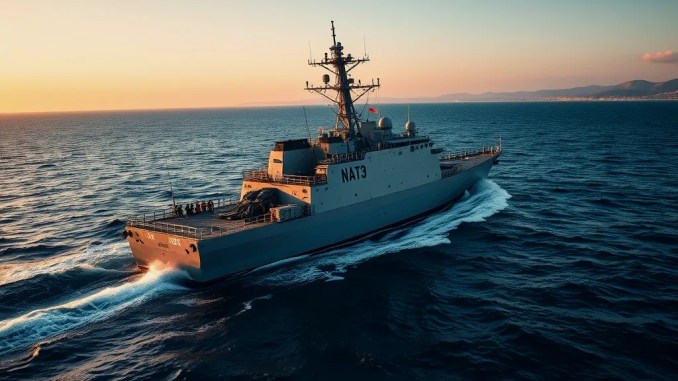
Overview of EUNOMIA 7-26 and participating forces
The multinational EUNOMIA 7-26 exercise concluded on 22 October 2026 after coordinated air and sea operations in the Eastern Mediterranean. Greece, the Republic of Cyprus (RoC), France and Italy conducted combined drills emphasizing sea control, anti-submarine warfare, maritime interdiction and integrated air defense. The Italian frigate RIZZO hosted a “Distinguished Visitors Day” off RoC waters to showcase live demonstrations and bilateral interoperability routines.
Operational tasks and scenario sequencing
Leaders designed the exercise to replicate layered, mission-driven timelines. Initial phases focused on maritime domain awareness: cooperative sensor fusion between shipborne radars, maritime patrol aircraft and coastal assets produced a recognized surface and sub-surface track picture. That situational baseline enabled subsequent kinetic and non-kinetic training:
Phase 1 — Detection and identification: coordinated patrols and electronic surveillance established contacts and exchanged real-time tracks via tactical data links.
Phase 2 — Interdiction and VBSS: Visit, Board, Search and Seizure (VBSS) teams executed simulated boardings to practice rules-of-engagement decision loops, evidence collection and detailed handling under contested conditions.
Phase 3 — Fire-control and SURFEX/GUNEX: surface units conducted gunnery shoots against maneuvering targets; fire-control teams cycled through detection, engagement and battle damage assessment in undersea and surface threat mixes.
Phase 4 — CASEX and ADEX: combined anti-submarine warfare (CASEX) units deployed heavy and variable-depth sonars, towed arrays and coordinated ASW helicopters; integrated air defense (ADEX) drills rehearsed layered intercepts and missile track-sharing between naval and airborne platforms.
Tactical lessons and capability demonstrations
EUNOMIA 7-26 produced several tangible takeaways for participating navies and air arms. Practically, the exercise revealed how rapid information exchange reduces decision timelines: during a simulated raid, a frigate, a maritime patrol aircraft and an ASW helicopter closed classification-to-engagement in under 12 minutes when using common protocols and link architecture. Embarked VBSS teams refined low-signature approach tactics and non-lethal compliance measures that improve mission success while limiting escalation risk.
The drill also highlighted logistics and sustainment points. Continuous aviation sorties increased fuel and maintenance demand at sea; planners mitigated that through forward forward-staging of spare parts and rotational aviation crews, demonstrating scalable sustainment practices for prolonged operations in austere littoral environments.
Distinguished Visitors Day: objectives and outcomes
The event aboard the Italian frigate RIZZO provided a compact display of combined operations for senior observers. Delegations observed live VBSS rehearsals, ASW demonstrations and an integrated air picture walkthrough. The visit achieved three immediate outcomes: reaffirmed political signaling among allies, validated interoperability baseline procedures, and allowed senior officers to observe tactical deconfliction measures in a realistic maritime environment.
Political context: timing, reactions and regional implications
The drill ended shortly after Libya’s House of Representatives approved, on 20 October, the 2019 maritime delimitation memorandum between Turkey and Libya. Athens publicly rejected that decision, calling it inconsistent with international law and asserting potential infringement on Greek sovereign rights. The EU leadership echoed concerns, stating the memorandum cannot override third-party sovereignty and lacks legal effect within existing maritime law frameworks.
Exercise planners had set the EUNOMIA timeline months earlier; Greek media reporting indicates planning dates trace back to spring 2026. The temporal overlap with Libya’s parliamentary decision therefore appears coincidental rather than reactive. Nevertheless, the combined exercise served as a visible reassurance of allied coordination in a period of heightened regional diplomatic activity.
How EUNOMIA 7-26 improves future joint operations
Operationally, EUNOMIA 7-26 created replicable procedures for cross-domain coordination. Participating forces codified tactical checklists for shared air tracks, VBSS boarding protocols and ASW handover sequences. These documents reduce friction in multinational task groups by standardizing: target classification language, boarding team medical and evidence protocols, and logistic exchange points for spare parts and fuel.
Examples of practical improvements that can be reused in future exercises include:
1) Pre-delegated engagement authorities: outlining limited, pre-authorized responses to common incidents shortens legal and command timelines.
2) Data-link prioritization rules: allocating bandwidth and message priorities for ASW contacts, air tracks and VBSS coordination ensures latency-sensitive channels remain available during peak activity.
3) Rotational sustainment nodes: establishing prepositioned maintenance hubs and crew-rotation timetables preserves sortie generation rates during extended deployments.
Practical examples and step-by-step of a typical VBSS evolution used during the exercise
During rehearsals, teams followed a disciplined, repeatable sequence:
Step 1 — Detection and intent assessment: ship sensors detect an anomalous vessels; tactical officers request intent clarification via radio and AIS; if evasive maneuvers persist, command authorizes a boarding approach.
Step 2 — Approach and overwatch: boarding team moves via fast-raft under armed overwatch from the mother ship; helicopters provide aerial observation and medical evacuation readiness.
Step 3 — Boarding and search: teams secure decks, verify identities, inspect cargo compartments and seize contraband under documented chain-of-custody procedures.
Step 4 — Resolution and transfer: on completion, detained personnel are transferred according to agreed rules; evidence is catalogued; ship re-enters mission patrol with lessons logged for after-action review.
Regional security impact and follow-up recommendations
Exercises like EUNOMIA 7-26 contribute to a predictable security posture in complex littoral seas. Recommendations derived from the exercise outcomes include institutionalizing regular data-link interoperability tests, expanding multinational VBSS exchanges to include legal advisors for on-scene rulings, and formalizing sustainment corridors for fuel and spares across allied bases in the Mediterranean.
Implementing these steps will shorten operational decision cycles, improve evidence integrity in interdiction cases, and maintain higher sortie rates over extended deployments.
Final operational assessment
EUNOMIA 7-26 demonstrated that relatively small, well-coordinated multinational forces can generate outsized effects on regional maritime security. The exercise validated tactical integration across air, surface and sub-surface domains, produced concrete sustainment solutions, and provided political signaling without escalating tensions. Documenting and fielding the procedural refinements identified during the drill will increase readiness and interoperability for future Eastern Mediterranean operations.









Be the first to comment