
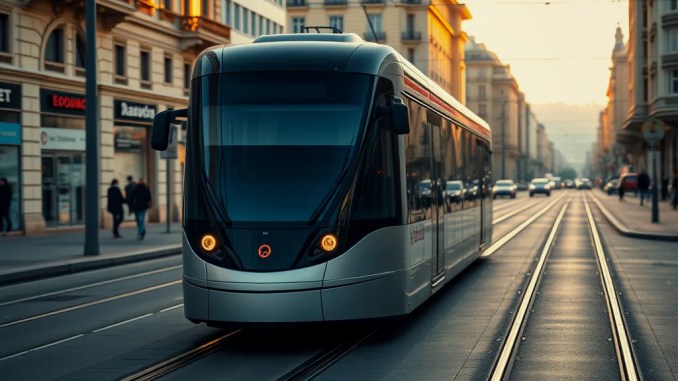
Bozankaya’s Romania Fleet Plan and Strategic Goals
Bozankaya aims to build a 117-vehicle electric fleet in Romania, combining 84 low-floor tramcars and 33 trolleybuses to support municipal decarbonization and resilient public transit. The company structures deliveries and local service to enable rapid deployment: modular tram families tailored to route geometry and battery range paired with trolleybuses that integrate on-board energy storage for catenary-light operation. This mix reduces infrastructure costs for cities while maintaining high utilization and predictable lifecycle expenses.
How Timișoara’s New Trams Operate Off-Wire and Where They Run
In Timișoara, Bozankaya placed battery-equipped trams into daily service to extend sections of existing networks without new overhead wiring. The active fleet of 40 trams includes three-module vehicles that travel up to 70 kilometers on battery power under specific duty cycles; the most recent 10-car batch can run 10 kilometers on batteries between charging events. Municipal planners use these capabilities to bridge wire-free historic districts, cross-road renovations, and short off-wire extensions, reducing construction time and visual impact.
Which Technical Features Enable Long Off-Wire Range?
Bozankaya combines several engineering choices to reach long battery ranges: high-energy density traction packs, regenerative braking with optimized power electronics, lightweight carbody materials, and modular HVAC systems that scale to seasonal loads. The company’s engineering team models route profiles and passenger loads to define the optimal energy buffer—minimizing battery mass while ensuring reliability. Example: on a 12-km suburban loop with frequent stops, simulation showed a 40% energy saving when regenerative settings and coasting strategies were tuned to the route, enabling a smaller battery option without range loss.
Why the Combination of Trams and Trolleybuses Matters for Cities
Deploying both tramcars and trolleybuses lets cities match vehicle capabilities to corridor needs. Trams offer higher capacity and permanence for trunk corridors; battery-capable trolleybuses provide flexible service on feeder lines or routes with constraints on overhead infrastructure. In Timișoara’s case, 33 trolleybuses complement trams by serving neighborhoods where wire installation would require disruptive civil works. The combined approach lowers total cost of ownership through shared depot charging infrastructure and standardized maintenance processes.
Case Study: Iaşi—Early Deliveries and Operational Impact
Bozankaya completed delivery of 34 tramcars to Iaşi ahead of schedule, allowing the city to reassign older vehicles and increase frequency on busy corridors. Operational results in the first months showed a measurable decrease in dwell times due to wider doors and better acceleration: line punctuality improved by double-digit percentage points on peak services. Maintenance teams also reported easier fault isolation because the new modular design segments critical systems into replaceable units, reducing workshop turnaround time.
Research & Development Investments Driving Product Differentiation
Bozankaya invested over €50 million in R&D and product engineering to develop battery safety systems, modular vehicle architecture, and energy-efficiency features. A 150-person engineering staff focuses on testing cell thermal management, fail-safe BMS logic, and system-level simulations. The company actively participates in Horizon Europe projects—HELIOS, EXTENDED, SAFELOOP, SUNTRANS and SOLAR-MOVE—contributing vehicle integration expertise to joint research on e-mobility, solar charging integration and depot energy management.
Practical Example: Depot Charging and Energy Management Strategy
Bozankaya’s recommended depot strategy combines opportunity charging at termini with overnight depot balancing. Step-by-step: 1) model daily energy consumption by route and vehicle; 2) you depot chargers for peak simultaneous charging windows; 3) implement smart charging schedules to flatten grid demand and make use of regenerative energy captured during service; 4) use stationary storage to smooth procurement costs and support islanding during grid disturbances. Cities that tested this approach reported up to 20–30% peak power reduction at depots compared with naive overnight charging.
Implementation Examples and Operational Metrics to Monitor
When cities adopt Bozankaya fleets, key metrics to track include: energy consumption per kilometer, mean time between failures (MTBF) for traction and battery subsystems, door cycle reliability, and passenger throughput per hour. Early Romanian operations highlight improvements in energy efficiency and service regularity—useful benchmarks for operators planning similar rollouts.
What Bozankaya Seeks in the European Market
Bozankaya positions itself as a partner that delivers configurable vehicles to meet diverse urban constraints. The company emphasizes long-term service agreements, local training for maintenance crews, and modular upgrades to extend vehicle lifespans. By targeting fleets above 100 vehicles in markets like Romania, Bozankaya aims to scale production efficiencies while offering cities the operational flexibility needed for phased electrification.
How Cities Can Prepare to Integrate These Vehicles
Cities should align procurement with a clear plan for depot infrastructure, staff training, and data-driven performance monitoring. Practical steps: conduct route energy audits; phase procurement to allow staff learning curves; include performance-based clauses in contracts; and plan for second-life battery use or recycling. These measures reduce risks and accelerate benefits realization from new tram and trolleybus fleets.
Projected Outcomes and Next Steps for Municipalities
With a 117-vehicle target in Romania, municipalities can expect lower operational emissions, reduced street-level disruption compared with full-wire expansion, and modernized fleets that improve passenger experience. Next steps for interested cities include technical site visits, pilot route agreements, and developing a depot charging roadmap synchronized with local power utilities.








Be the first to comment