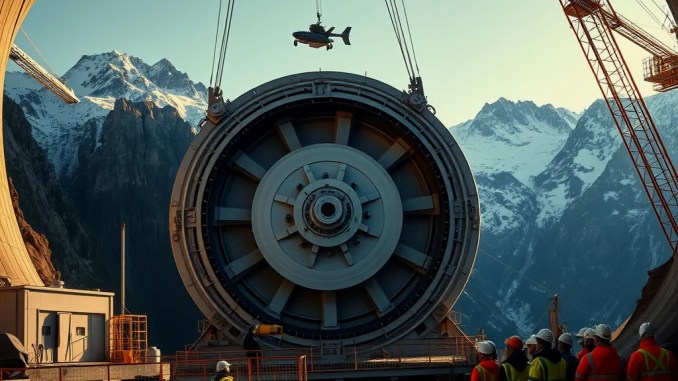
The Brenner Base Tunnel will link Innsbruck (Austria) and Fortezza (Italy) beneath the Alps with a continuous underground rail corridor of roughly 64 kilometers, including approach tunnels. Built as two parallel main tunnels with regular safety cross-passages and an auxiliary service tunnel, the project targets faster passenger and freight transit, reduced road traffic and lower carbon emissions, and higher freight capacity through gentler grades and longer train accommodation.
How travel times will fall and what that means for passengers and operators
Passenger journey times will drop sharply: current Alpine crossings that take around 80 minutes for regional passenger services will be approximately 25 minutes. on the base tunnel alignment. Freight transit time will fall from about 105 minutes to roughly 35 minutes. For operators this translates into more daily rotations per trainset, lower crew and energy costs per trip, and improved timetable because the route avoids steep, weather-sensitive mountain sections.
Why freight capacity increases — technical details and operational gains
The base tunnel’s low gradients and straight alignment allow trains up to 740 meters long, versus the existing limit near 450 meters. That permits single trains to carry substantially more tonnage, reducing the number of trains required to carry the same freight volume. Reduced required locomotive traction and less idling on climbs lower fuel consumption. Example: a 740 m freight train replacing two 370 m trains can halve crew-hours, reduce locomotive wear, and cut per-tonne traction energy by a measurable percentage depending on train load and traction type.
Design features that raise safety and maintainability
Engineers adopted twin single-track tunnels with cross-passages every 333 meters and an undercroft service tunnel. In an emergency, passengers evacuate sideways through the nearest cross-passage into the adjacent tunnel; ventilation and smoke-management systems route contaminants away from evacuation paths. The service tunnel houses pumping, drainage, cables and maintenance access, enabling repairs without closing main bores. This separation shortens maintenance windows and reduces long-term operational disruptions.
Environmental impact: quantifiable reductions and landscape protection
Shifting long-haul freight from road to rail through the tunnel cuts heavy truck kilometers on Alpine roads and reduces local NOx, particulates and CO2 emissions. Tightening gradients and longer trains further improve energy efficiency per tonne-kilometer. Projected outcomes include decrease substantials in Alpine roadside noise and fewer heavy-vehicle incidents on high-elevation passes — preserving sensitive habitats adjacent to road corridors and lowering seasonal congestion peaks.
Operational scenarios and timetable integration across borders
Cross-border operations require harmonized signaling, electrification standards and customs procedures. The tunnel supports interoperable European train control systems and accommodates varying traction voltages via neutral sections or multi-system locomotives. Timetables will prioritize a mix of high-frequency passenger services and scheduled freight routes; operators can optimize night-time freight slots to minimize interference with peak passenger flows, increasing line throughput without sacrificing punctuality.
Construction progress, milestones, and opening schedule
Construction of the main bores and associated approach works aims to conclude around 2033, followed by systems installation and phased testing; full commercial operations are planned for 2034. Key milestones include completion of tunneling, installation of track and overhead lines, commissioning of signaling and safety systems, and cross-border operational trials. Each stage requires coordinated certification by Austrian and Italian authorities prior to opening.
Questions travelers and shippers ask — clear answers
Will travel costs change? Ticket pricing depends on operator policy; faster trains may command premium fares for express services while regional links remain competitively priced. Freight costs per tonne-kilometer can drop because of longer trains and lower energy use.
Can heavy trucks fully move to rail? The corridor enables a large modal shift for long-distance freight, but first/last-mile logistics and local distribution still rely on road transport. Policy incentives and compatible terminal capacity will determine the scale of truck-to-rail migration.
How will safety be ensured in long tunnels? Frequent cross-passages, robust ventilation, dedicated service tunnel, remote monitoring, and emergency response protocols combine to minimize risk and enable rapid evacuations and interventions.
Practical examples and step-by-step freight movement through the tunnel
Step 1: Freight consolidation at an intermodal north terminal of Innsbruck. Step 2: Assembly into 740 m consists of optimized for weight distribution. Step 3: Electric traction engages; low gradient allows steady high cruising speeds with reduced power peaks. Step 4: Transit through the base tunnel with real-time traffic management coordinating slots. Step 5: Arrival at Fortrezza-side terminal, where trains split or transfer to last-mile distribution. Each step reduces handling time compared with mountain-route operations that require additional locomotives or break-of-gauge handling.
Long-term regional and European benefits
The tunnel strengthens the north–south European transport corridor by increasing capacity and reliability, encouraging rail-based logistics strategies, and creating conditions for modal-shift policies. Regions along the route gain predictable freight access and faster passenger links, which can drive tourism, labor mobility and cross-border economic integration while lowering the environmental footprint of transalpine transport.