
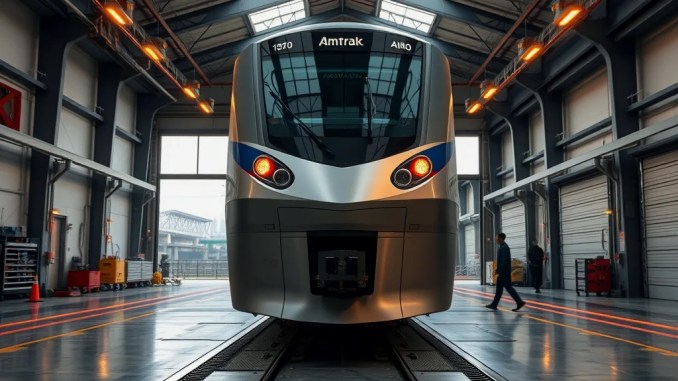
Amtrak opened a new maintenance and inspection facility in Seattle on October 23 to service its next‑generation Airo trainsets. Built for integrated, fleet‑level work, the roughly $250 million complex is the first of six major centers Amtrak is modernizing to support Airo operations across the network.
Facility designed to service an entire Airo trainset in one location
The Seattle building spans about 100,000 square meters and stretches roughly 700 meters along three parallel service tracks. Engineers laid out the interior so an entire Airo trainset — not individual cars moved separately — can enter, be inspected end‑to‑end, undergo scheduled maintenance, and receive heavy repairs without shuffling vehicles between workshops. That single‑set workflow reduces shunting time, shortens maintenance windows and concentrates specialized tooling and crews where they most efficiently serve the fleet.
Why integrated trainset maintenance improves availability
Traditional commuter maintenance often disassembles trains into individual cars for specific shops; the Airo’s integrated design keeps sets intact. By preserving set integrity during service, Amtrak avoids reconfiguration time and reduces alignment and systems retesting after reassembly. In practical terms, this means faster return‑to‑service: crews can complete multi‑system checks — HVAC, braking, train‑control interfaces and passenger amenities — in sequence without repeated vehicle handling. Amtrak projects higher daily availability for Cascades service as a direct outcome.
State‑of‑the‑art equipment and shop systems installed
The Seattle facility includes lifting platforms and rail‑integrated jacks, an overhead bridge crane, monorail hoists, automated sanding and surface preparation stations, and dedicated sanding and vacuum waste systems. Utilities include centralized power cabinets, reel systems for water and compressed air, and a fall‑protection line for technician safety. Those systems let technicians perform mechanical, structural and electrical repairs in parallel and use calibrated test stands for critical subsystems.
Ancillary infrastructure and construction scale
Outside the primary shop, Amtrak built a two‑story 39,000 square meter support platform that provides employee parking and enclosed storage for parts and tooling. The construction program used approximately 4,000 linear feet of track, 16,000 cubic meters of concrete, 2.4 million pounds of reinforcement, and 12 million pounds of structural steel. Foundation work included 439 driven piles totaling 11 miles in length and 132 drilled shafts totaling three miles. The build mobilized over 40 subcontractors and created about 120 construction jobs, most supplied by firms in the Pacific Northwest.
How the facility fits into Seattle station modernization
The new maintenance center continues a multi-stage modernization at Seattle Railway Station that began with smaller shop upgrades in 2013, 2019 and 2025. Recent investments added updated administrative space and a train wash; the current program expands service, cleaning and heavy maintenance capability. Amtrak expects the larger station modernization to complete by 2027 and positions the shop as the operational hub for Cascades fleet servicing.
Operational rollout and deployment timeline for Cascades Airo sets
Amtrak ordered eight Airo trainsets, two new locomotives and a spare cab car for the Cascades corridor. Airo revenue service began September 30 on Cascades routes. The initial rollout assigns two trainsets to run four daily round trips while remaining sets enter service in phases through early 2027. Planners intend to introduce Airo service on the Northeast Regional corridor by late 2027, dependent on maintenance capacity and commissioning schedules.
Planned network of six maintenance centers through 2031
Seattle is the first of six heavy maintenance and inspection centers Amtrak will modernize to support the expanding Airo fleet The other five are located in Philadelphia, Boston, Washington, DC, New York City and Rensselaer, NY Amtrak’s Inspector General estimated a project lifecycle cost for Seattle at $295 million and noted a projected substantial completion of January 2027; Amtrak reported the facility finished on budget at about $250 million.
Estimated completion dates and program costs for remaining centers
According to the IG report, target substantial‑completion dates and estimated costs for the other centers are:
• Philadelphia — May 2027; estimated $463 million
• Boston — February 2029; estimated $583 million
• Washington, DC — August 2030; estimated $705 million
• New York — October 2030; estimated $1.25 billion
• Rensselaer — March 2031; estimated $206 million
The report notes some cost estimates include non‑Airo work at those sites and stresses timely capacity delivery to match fleet growth.
Capacity planning and risk: why timely shops matter
The IG’s analysis highlighted a capacity risk window. Amtrak can operate the first 12 Airo sets without additional heavy maintenance capacity, but fleet growth in the first four years could temporarily exceed shop availability if construction schedules slip. Seattle’s opening is the first step to mitigate that risk; timely completion of the remaining five centers will align maintenance capacity with the planned expansion to roughly 83 trainsets under procurement plans.
What the Seattle facility means for Cascades passengers
Practically, the new shop should deliver more consistent on‑time performance, shorter out‑of‑service times for trainsets and a higher standard of reliability. Dedicated cleaning and service bays reduce turnaround time between trips, while centralized heavy‑maintenance capability lowers the likelihood of prolonged equipment downtime. For passengers, these improvements translate into steadier schedules and fewer service disruptions tied to mechanical or structural repairs.
Lessons and examples for other operators
Several practical takeaways apply to transit and rail operators planning fleet transitions:
1) Design shops around the unit of operation: if trainsets operate as integrated units, design maintenance flow to keep them intact during service.
2) Invest in parallel workstations: equipping a shop for simultaneous mechanical, electrical and interior work reduces fleet idle time.
3) Stage capacity additions to fleet growth: align shop commissioning milestones with introduction of new sets to avoid capacity shortfalls.
These steps reduced lifecycle downtime for the Cascades program and offer a reproducible model for fleets shifting from car‑by‑car maintenance to integrated trainset servicing.
Key takeaways
• Seattle’s new Airo maintenance and inspection facility centralizes full trainset servicing and heavy repairs, improving efficiency for Cascades operations.
• The shop includes modern lifting, hoisting, utility and waste systems and a large support platform for parts and staff.
• Seattle is the first of six major sites scheduled for modernization; completing the remaining centers on time is critical to match maintenance capacity with fleet expansion.







Be the first to comment