In what appears to be the most intense escalation in the Middle East in recent years, fighting has surged across various fronts, prompting fears of a larger regional confrontation. Early morning reports speak of significant military movements along the Lebanon-Israel border, with sources confirming that Israel has launched a comprehensive ground invasion targeting Hezbollah-held territories. The sudden increase in hostilities has led to an influx of civilians seeking shelter and international concern over the possibility of a prolonged war.
The conflict’s explosion into multiple avenues — from air strikes to ground operations — underscores the deteriorating security landscape. As fighting intensifies, both sides sustain heavy casualties, and the civilian population faces devastating consequences. Social media explodes with images of destroyed buildings, fleeing families, and strategic missile exchanges, illustrating a conflict that has quickly spiraled out of control.
This escalation is not isolated but part of a broader geopolitical struggle involving major regional and global actors. Iran’s influence over Hezbollah, US involvement in the background, and Israel’s determined effort to dismantle threats along its borders create a volatile mix, making the future uncertain. With the international community urging restraint yet unable to halt the momentum, the danger of escalation into wider regional warfare grows more imminent each hour.
Strategic Targets and Military Campaigns in Beirut
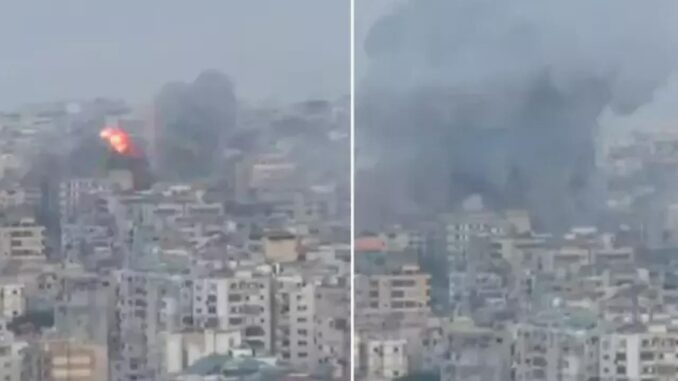
The southern suburbs of Beirut, especially the heavily fortified Dahiyeh district, have become a primary battleground. Israeli military officials claim their air strikes target specific Hezbollah installations, communication hubs, and weapon caches designed to protect militant activities. Reports indicate that the targeted destruction of media infrastructure, such as the al-Menar TV station, was a deliberate effort to cripple Hezbollah’s propaganda and operational commands.
Residents in these areas face a harsh reality, where each explosion not only shatters the building facades but also severs vital communication channels for the militant groups. These strikes aim to weaken Hezbollah’s ability to coordinate defenses, yet they also risk widespread civilian casualties and infrastructure damage. The ongoing campaign exemplifies Israel’s focus on precise targeting, but the dense urban environment makes collateral damage unavoidable, fueling anger and resistance among the local population.
Social Media as a War Tool and Civilization’s Response
In the digital age, conflicts unfold not just with bombs and bullets but also through the networked battlefield of social media. Israeli officials, like Avichay Adraee, utilize platforms such as X (formerly Twitter) to issue warnings, plot strategic bombardments, and communicate directly with civilians. The placement of specific structures on maps — such as red-marked buildings identified as Hezbollah facilities — fuels a narrative of imminent danger, prompting mass evacuations and defensive preparations among civilians.
This coordinated digital messaging serves two purposes: it attempts to mitigate civilian casualties by encouraging evacuations and seeks to shape international opinion by demonstrating operational precision. However, it also complicates the conflict, as social media can spread misinformation, escalate tensions, and lead to panic. Residents in targeted areas, often caught between military actions and propaganda, must make split-second decisions about whether to stay or flee.
Political Crisis and Internal Struggles in Lebanon
The recent flare-up in violence has directly impacted Lebanon’s fragile political landscape. Officially, the Lebanese government condemns the violence, particularly the involvement of Hezbollah, which operates as both a political party and an armed group. Prime Minister Nawaf Salam quickly issued statements declaring Hezbollah’s actions as illegal and demanded disarmament, a stance that sparks internal divisions.
The country is already besieged by past economic crises, infrastructural decay, and widespread crises. Now, with the conflict spilling over its borders, Lebanon’s sovereignty is under threat, and political factions are divided on how to respond. Hezbollah’s military engagement complicates diplomatic efforts, forcing Lebanon into a perilous position where confronting the militant group could lead to internal conflict or further foreign intervention.
Military Engagements and Cross-Border Violence
The southern border remains a hot zone, with Hezbollah and Israeli forces exchanging fire and missile strikes. Reports confirm that Hezbollah launched multiple projects towards northern Israel, prompting ICIV sirens to sound across major cities. Israel responded with extensive air strikes targeting missile storage sites and command centers in Lebanon, aiming to dismantle the group’s supply networks.
The pattern of attacks reveals an entrenched cycle of retaliation and escalation. Civilians on both sides live under constant threat, with many towns and villages reduced to rubble after successive waves of artillery and aerial bombardments. The ongoing conflict exemplifies the high-stakes game where military dominance involves risking civilian lives and destabilizing entire communities.
Each military maneuver is coupled with proxy battles, intelligence operations, and shadow warfare that deepen the conflict’s complexity. As fighters and military assets move across borders, international actors scramble to predict developments and formulate responses to prevent wider regional chaos.
The Broader Impact and Future Outlook
Despite ongoing diplomatic efforts, the likelihood of a swift resolution remains slim. The conflict’s entrenched nature, coupled with entrenched alliances and foreign interests, suggests a prolonged confrontation that could reshape the Middle East’s geopolitical map. Economies are collapsing, diplomatic ties are strained, and regional stability hangs by a fragile thread.
For ordinary civilians, each new wave of violence brings uncertainty, trauma, and dislocation. Humanitarian agencies warn of impending crises — shortages of food, water, and medical supplies, alongside rising refugee flows. As tensions persist and military actions intensify, the international community’s role becomes pivotal in preventing further escalation and fostering a sustainable path toward peace.