
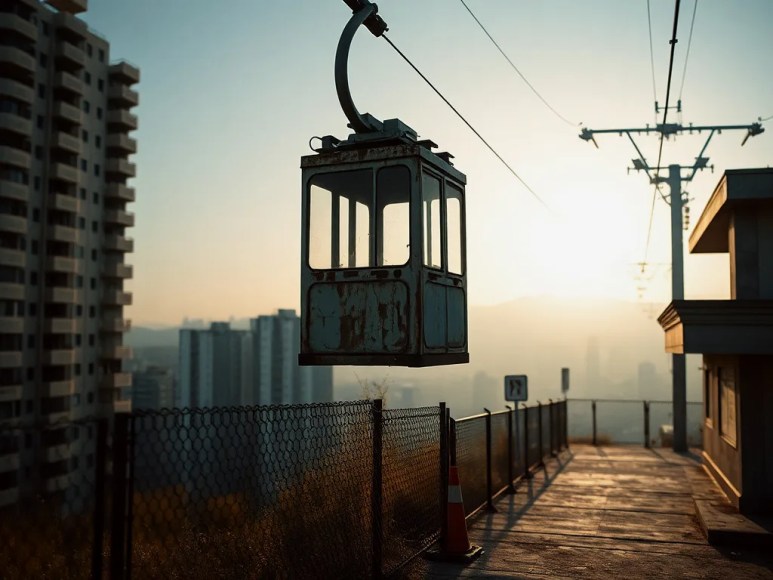
As of November 23, 2026, the Yenimahalle–Şentepe cable car in Ankara remains out of service following a court decision that invalidated key zoning plans and a subsequent municipal decision authorizing removal or relocation of the system. The system closed on April 26, 2024; legal, technical, and financial issues have kept it offline, and no official re-opening date exists.
Why did the Yenimahalle–Şentepe cable car close?
The Ankara Administrative Court annulled the teleferik’s 1/5000 target (master) and 1/1000 implementation zoning plans after a lawsuit filed by the Chamber of Architects in 2013. The operator, EGO General Directorate, announced immediate suspension of service on April 26, 2024, citing the court rulings. That legal cancellation meant authorities could not rely on the prior planning framework to declare the system legally operable.
Practical effect: municipal officials must reconcile the canceled zoning documents with higher-level plans and urban-transportation principles before reinstating operations. This is not a routine maintenance stoppage — it requires legal and planning remediation.
What legal and planning steps must occur to reopen the line?
Reopening requires a sequence of actions across legal, planning and technical domains:
1) New zoning or corrective amendments — Municipal planners must prepare revised 1/5000 and 1/1000 plans or produce formal corrections that withstand judicial review. That process includes public consultation periods, technical impact studies, and alignment with metropolitan spatial strategies.
2) Judicial closure or settlement — Either a higher court must overturn the prior rulings, or the parties can reach a settlement validating new plans. Without resolution of the litigation pathway, operations remain legally vulnerable.
3) Safety and technical certification — Independent inspections (carrier ropes, drive systems, stations, evacuation equipment) must certify the line meets current standards. Past interruptions (eg, 2022 reopening after maintenance and January 2024 cable strand breaks) underscore the importance of updated technical reports.
4) Financial feasibility and operating model update — The municipality must decide whether EGO or a third party will operate the line, and adopt a budget that covers operating shortfalls or introduces subsidies, fare adjustments, or commercial revenue to close gaps.
These steps can run in parallel but require clear municipal leadership and legal closure to reach an operational decision.
What did the municipal council decide about the system?
On July 10, 2024, the Ankara Metropolitan Municipality Council authorized EGO to evaluate options including dismantling, sale, donation, or relocation of equipment. The vote did not itself dismantle the system but gave EGO legal authority to pursue disposal or transfer alternatives.
Key implication: authorization broadens possible outcomes. The council’s vote signals a willingness to consider that the cable car may not return to its original function or location unless new planning and legal work prioritizes reinstatement.
How big is the operating deficit and what does it mean?
During 2024 council discussions, members cited monthly operating costs near 10 million Turkish lira and monthly farebox revenue around 700 thousand lira — a reported shortfall of roughly 9.3 million TL per month. The Council debate also noted that despite a theoretical daily capacity of about 72,000 passengers, actual ridership at times hovered near 6–7 thousand per day.
Interpretation: those figures point to a large subsidy requirement if the line were to operate under the same fare and demand patterns. However, restoring service could change demand dynamics if integrated with revised routes, feeder buses, pricing changes, or targeted promotion. Also, public-transit value cannot be measured only by farebox recovery—connectivity, reduced road congestion, and social access matter in transport appraisal.
What was the line’s history and technical profile?
The line initially opened in stages: the first segment began service in 2014 and the second in 2015, linking four stations — Yenimahalle, Yunus Emre, TRT Seyir and Şentepe. Ten-person cabins provided frequent shuttle-type service to connect Şentepe with the Yenimahalle metro interchange.
The system experienced several interruptions: a pandemic pause in 2020, a maintenance-driven reactivation on April 8, 2022, and partial suspension in January 2024 after strand breaks were found on the second section’s carrying rope. The April 2024 overall halt followed the zoning plan annulment, not a single technical failure.
How are passengers served while the cable car is closed?
EGO adjusted surface transit to compensate. The 271 bus line (Yenimahalle Metro–Şentepe) received extra services to carry displaced riders along the previous aerial corridor. Riders should consult EGO’s official schedules because bus frequencies and stop patterns change with demand and operational constraints.
Will the cable car be removed, relocated or reopened?
No definitive outcome exists as of the stated date. The municipality’s July 2024 authorization permits removal or relocation, but such measures require detailed technical surveys, dismantling budgets, potential buyers or host sites for relocation, and environmental/urban permits. Reopening requires plan- and court-level remedies plus renewed safety certification and financial commitments.
Scenarios with realistic timelines:
Short term (6–18 months) — Technical inspections and planning studies; Temporary service remains suspended while EGO prepares options and public consultation occurs.
Medium term (1–3 years) — If new zoning amendments and judicial settlements proceed efficiently and financing is arranged, a phased reopening or repurposing could occur. Relocation would likely take longer given dismantling, transport, and new-installation requirements.
Long term (3+ years) — If municipal priorities shift away from the cable car, the system could be declared surplus and sold or donated; a full rebuild at a new site would extend timelines further.
What should commuters and local stakeholders watch for?
Monitor four concrete items to understand the system’s fate:
1) Municipal plan amendments and public notices — New 1/5000 or 1/1000 decisions posted by the municipality indicate progress on legal standing.
2) Court filings or rulings — Appeals, settlements, or higher-court decisions that affect the Chamber of Architects’ 2013 case will determine whether the original legal obstacle persists.
3) EGO technical reports and procurement notices — Tender announcements for dismantling, maintenance, or third-party operation show which route the municipality pursues.
4) Budget allocations — Inclusion of line-specific capital or operating funds in the metropolitan budget signals political will to restore service rather than liquidate assets.
How can citizens influence the outcome?
Citizens and local associations can affect decisions through targeted, procedural actions:
– Submit formal opinions during public consultation stages for zoning amendments to highlight mobility needs or mitigation preferences.
– Request disclosure of feasibility studies and demand forecasts to evaluate alternatives transparently.
– Organized stakeholder groups (residents, businesses, disability advocates) to present coordinated proposals that balance operational viability with social access.
Concrete, evidence-based proposals (ridership promotion, feeder-bus integration, mixed funding models) tend to carry more weight than general appeals.
Bottom line for readers
The Yenimahalle–Şentepe cable car remains inactive because of a court-ordered annulment of its zoning framework and a municipal decision that opened disposal or relocation options. Reopening depends on coordinated legal, planning, technical and financial actions; removal or transfer remains a parallel possibility. Commuters should use the 271 bus and track municipal, judicial and EGO announcements for updates that will determine whether the line is reinstated, relocated, or decommissioned.