
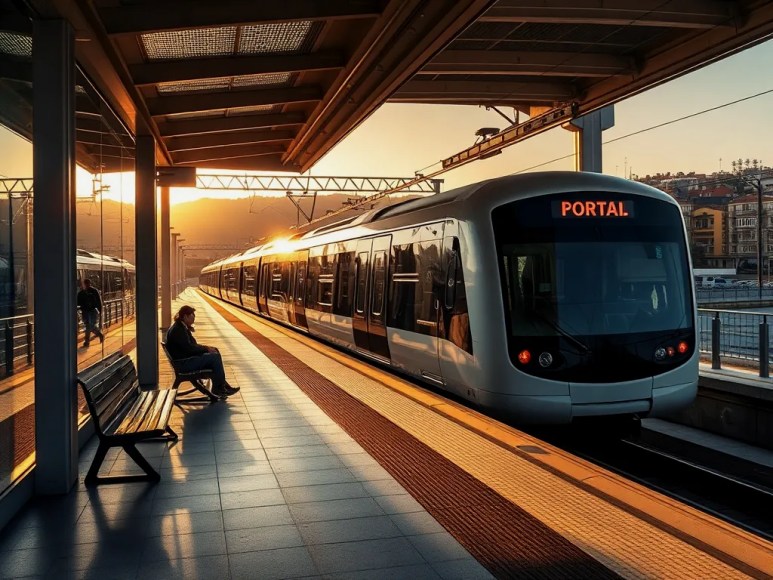
Gondomar metro extension: route, stations and travel time
The government approved a 237 million-euro investment to build a roughly 7 km metro extension from Estádio do Dragão to Souto in Gondomar. The scheme includes nine stations — São Roque, Cerco, Parque Oriental, Lagoa, Valbom, Hospital Fernando Pessoa, Cosme Ferreira Castro, Oliveira Martins and Souto — and combines surface, tunnel and viaduct sections to fit the local geography and urban fabric. Project documents estimate an end-to-end trip time near 20 minutes including station dwell, which implies an operational average speed consistent with urban rapid transit over mixed profiles.
Trofa connection: mixed metro and electric BRT for flexibility
Trofa will receive roughly 184 million euros to link ISMAI to the Trofa interchange across about 10 km using a hybrid approach. The first ~3.1 km (ISMAI–Muro) will operate as light rail/metro while the remaining ~7.2–7.4 km (Muro–Trofa) will run as electric metrobus on a dedicated corridor. Combining modes reduces civil works costs where full rail infrastructure is disproportionate while keeping high-capacity segments where demand is concentrated. Expect transfer facilities at Muro to minimize passenger friction and coordinated timetables to shorten connection penalties.
Why the mixed technology for Trofa makes sense
Choosing rail for the densest section and BRT for lower-density stretches optimizes capital and operating costs. Rail delivers higher throughput and longer vehicle life on constrained urban segments; electric BRT with dedicated lanes provides near-metro frequency at lower initial cost and faster implementation on suburban alignments. This pragmatic mix allows phased delivery, easier rights-of-way acquisition in rural stretches, and later technology upgrades if demand rises.
Environmental review and community input: what changed and what remains
Both projects undertake environmental impact assessments with public consultation. Gondomar’s EIA evaluated tree cover, heritage structures and noise/vibration for underground and elevated sections; Stakeholders influenced alignment refinements to reduce cutting through sensitive green corridors. Trofa’s studies compared multiple alternatives between Serra and Lantemil, yielding trade-offs between land take, slope stabilization needs and travel time. The official investment approval does not mean construction starts immediately — outstanding permits, mitigation measures and final detailed designs will determine timelines and possible alignment tweaks.
Finance plan and funding sources
The funding package foresees a combination of national Environment Fund resources and European Union Sustentável 2030 program contributions. Allocating EU climate and cohesion funding to high-capacity public transport aligns fiscal leverage with carbon-reduction targets: shifting trips from private cars to electrified transit reduces CO2 and air pollution cost-effectively. Authorities plan to sequence spend across 2027–2031 to cover procurement, environmental compliance, civil works and systems integration.
Construction and procurement timeline: step-by-step overview
Officials outline a multi-stage delivery sequence:
1. Pre-construction (2024–2026): finalize EIA outcomes, land acquisition, detailed design and tender packages.
2. Procurement (late 2026–2027): run competitive tenders for civil works, systems (signaling, traction power), stations and rolling stock/electric BRT vehicles.
3. Early works (2027–2028): utilities relocation, preparatory earthworks, viaduct foundations and drainage.
4. Main construction (2028–2030): tunnels, bridges, track, station shells and systems installation.
5. Testing and commissioning (2030–2031): integrated systems tests, driver training, trial operations and safety certification.
Operational impacts and passenger experience
Combined the two corridors will add nearly 17 km of high-capacity routes and 18 stations, improving cross-regional connectivity. Expect shorter inter-district travel times, fewer transfers into the central core for many commuters, and improved access to hospitals and education campuses (notably ISMAI). Design choices such as level boarding, real-time information, integrated ticketing and step-free access will determine whether modal shift from private cars materializes at scale.
Risks, constraints and mitigation strategies
Key risks include permitting delays, complex utility relocations, geotechnical surprises on tunnel sections and community opposition to local impacts. Mitigations cited in planning documents include phased construction through sensitive areas, tree replanting programs, targeted noise-abatement walls, and contingency budgets for unforeseen ground conditions. For the Trofa corridor, ensuring high-quality transfer facilities at the rail–BRT interface is essential to preserve journey-time competitiveness.
Examples from comparable projects and lessons learned
Comparable European schemes that mixed rail and BRT or used phased roll-out show faster delivery and cost containment when strong corridor governance exists. For example, hybrid corridors in smaller metro regions prioritized integrated timetables and single-ticket fares to sustain ridership across mode changes. Applying those lessons in Porto’s context — strict interchange design standards, unified passenger information systems and coordinated operations — will increase the chance of meeting the stated 2027–2031 delivery window and ridership targets.
What to watch next and likely follow-up decisions
Watch for published tender notices, final EIA approvals, and procurement awards. Key signals that project delivery will progress on schedule include: rapid completion of utility relocation contracts, early procurement of signaling and power supply systems, and clear planning approvals for the most environmentally sensitive stretches. Local authorities may later propose additional station infills or park-and-ride facilities to maximize access.