
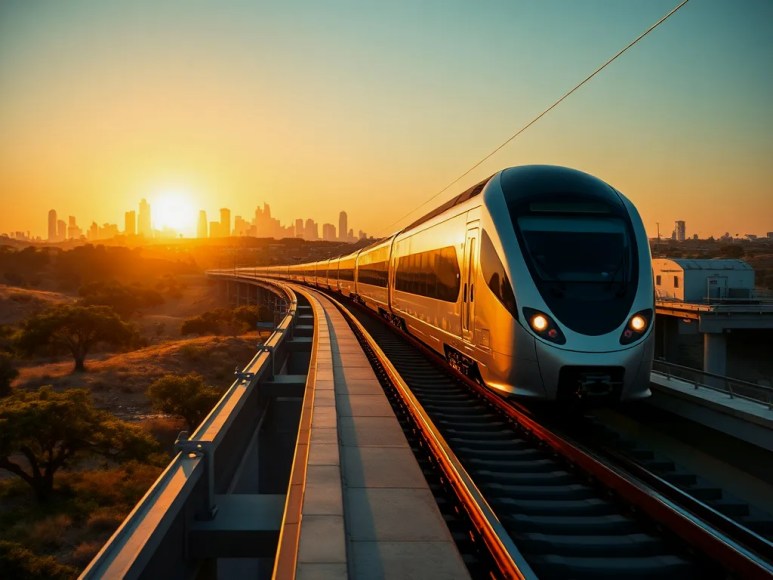
San Antonio seeks regional partnership to study passenger rail
San Antonio city leaders asked on 16 November 2026 for a coordinated regional planning effort to assess passenger rail between San Antonio and Austin. The request, filed as CCR 2026-0049, directs the city to explore collaboration with Bexar County, VIA Metropolitan Transit, regional planning agencies and rail advocacy groups. The motion explicitly asks staff to coordinate with jurisdictions along the Interstate 35 corridor and to evaluate how an eventual line might connect northward toward the Dallas–Fort Worth region.
Two distinct feasibility studies outline sharply different investments
Two separate studies produced in 2026 form the basis for current discussion. One, prepared for the Texas Department of Transportation, analyzes using the existing Union Pacific freight corridor for passenger trains. The other, produced for Travis County by HNTB, examines an independent passenger-only alignment that routes via Austin–Bergstrom Airport, SH 130 and I‑10 to San Antonio.
Existing freight corridor: lower capital cost, operational trade-offs
The TxDOT study models service using the Union Pacific right-of-way with potential stops at Austin, San Marcos, New Braunfels and San Antonio. Capital cost estimates vary by service frequency and alignment alternative. For one alignment the study estimates:
• 2 daily round trips — $810 million
• 4 daily round trips — $1.38 billion
• 8 daily round trips — $1.89 billion
For a second alignment variant the costs are higher at comparable frequencies: $1.20 billion, $1.48 billion and $1.82 billion respectively. Because the freight corridor limits top speed to about 127 km/h (roughly 79 mph), projected end‑to‑end trip times approach two hours. A critical operational uncertainty remains Union Pacific’s willingness to host passenger service on freight-owned infrastructure; joint operations and dispatching constraints could limit capacity and on-time performance.
Independent passenger alignment: faster trips at much higher cost
The Travis County/HNTB concept envisions a purpose-built passenger alignment that minimizes shared track with freight. Its 2026-dollar estimate is roughly $13.5 billion. That investment supports a mix of at‑grade and elevated sections—about 35.9 miles at grade and 53.7 miles elevated in the proposed corridor—and design speeds up to 125 mph (≈201 km/h).
At maximum operating speeds the plan anticipates nonstop trips in about 55–65 minutes; at lesser operating speeds travel time could increase to 80–90 minutes. Annual operating and maintenance costs are estimated at $140–$190 million. The cost driver is extensive elevated structures and largest viaducts required by the routing and right‑of‑way constraints.
How financing and law will shape next moves
San Antonio’s council motion envisions a blended funding approach that could include federal grants, state allocations, local contributions and private investment, but it does not identify committed sources. The city’s next steps include ridership forecasting, environmental review scoping, and developing initial funding strategies. Meanwhile, a November 2026 Texas House bill (HB 270) proposes enabling private-sector development agreements for a potential high‑speed corridor linking Dallas, Waco, Austin and San Antonio; legislative outcomes could expand financing and procurement options.
Ridership, operations and station placement matter
Project viability depends on realistic ridership modeling and station choices. Using existing corridor stations at Austin, San Marcos and New Braunfels prioritizes lower capital cost and better access to existing population centers, but yields slower trips. An airport‑oriented route serving Austin–Bergstrom improves regional connectivity for air travelers and can drive higher premium ridership but requires longer elevated segments and larger capital outlays. Service frequency scenarios in the TxDOT study show capital needs scale with the number of daily round trips, while the independent alignment uses costlier civil works to cut travel time and increase appeal for choice riders.
Operational examples and trade-offs to consider
Look at comparable US corridors for practical analogies. The Northeast Corridor achieves high-frequency, high-speed service by purpose-built infrastructure and significant public investment; by contrast, corridors that retrofit shared freight track—such as some Midwest intercity services—often accept longer schedules and more service variability to reduce capital cost. For San Antonio–Austin, a phased approach could start with limited daily round trips on the freight corridor to build ridership and political support, then evaluate later investment in a dedicated alignment if demand and funding materialize.
Step-by-step checklist for local decision-makers
1. Commission an integrated ridership and revenue study using multiple demand scenarios (commuter peak, choice intercity, airport flows).
2. Complete a National Environmental Policy Act (NEPA) or state equivalent screening and an early scoping process to identify major environmental, permitting and community impacts.
3. Secure early agreements or letters of intent with Union Pacific if the shared-corridor option is pursued to clarify operational feasibility.
4. Develop a finance plan that layers federal grants, state funds, local contributions, and private capital where allowable; quantify gaps and contingency funds.
5. Pilot service on existing infrastructure if feasible to test demand and refine operational assumptions before committing to a dedicated alignment.
When could service start?
No fixed construction start or service launch date existed as of late 2026. A shared‑track starter service could advance fastest because of lower upfront capital needs, subject to track access agreements and regulatory approvals. A new, fully grade‑separated alignment would likely require many years for planning, environmental clearances, right‑of‑way acquisition and construction—hence a longer before revenue service.
What to watch next
Monitor the city’s committee actions following the CCR 2026-0049 referral, any formal response or participation commitments from Union Pacific, the outcome of HB 270 in the state legislature, and horizon announcements regarding federal grant solicitations that align with corridor objectives. Each of those items will materially influence alignment choice, timeline and the share of public etc. private funding.