
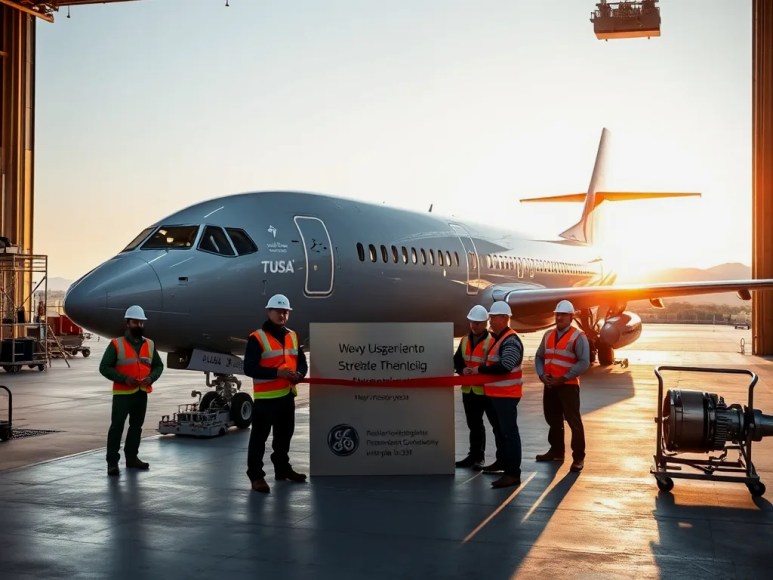
New $90 million production plant to make high‑value aircraft engine components in Plovdiv
TUSAS and GE Aerospace will open a $90 million joint‑venture production facility in Plovdiv (Plovdiv), Bulgaria, focused on manufacturing precision, high‑technology components for aircraft engines. The plant targets complex parts such as compressors, turbine casings, and precision‑machined components that feed global engine assembly lines. Local and regional supply chains will be integrated to shorten lead times and reduce logistics costs for European engine programs.
Employment, skills and timeline: who will work there and when
The project is expected to create roughly 170 skilled jobs across machining, quality engineering, metrology, and production management. Recruitment will prioritize technicians with five‑axis CNC, additive‑manufacturing finishing, and nondestructive‑testing experience. The build‑out follows a phased plan: site preparation and tooling in phase 1, pilot production and qualification in phase 2, then ramp to full‑rate production. While exact commercial start dates were not published, typical qualification cycles for engine components run 9–18 months from commissioning.
Why Bulgaria and Plovdiv: cost, talent and euro adoption
Bulgaria’s adoption of the euro on 1 January 2026 makes Plovdiv more attractive to Western investors by removing currency volatility and simplifying intra-EU procurement. The city combines competitive labor costs with a growing pool of engineering graduates and proximity to established aerospace clusters in Central and Eastern Europe. The plant positions TUSAS’s first production footprint outside Turkey to tap EU industrial programs and offset lead times by locating components closer to final assembly customers.
What the plant will produce — clarifying scope versus complete engines
The announced scope specifies engine component manufacture, not full engine assembly. That means the facility will deliver modules and subcomponents—precision‑machined rotors, housings, bearing supports, and heat‑treated parts—rather than complete, certified engines. This distinction keeps turbine testing, final assembly, and type‑certification activities within existing GE and OEM facilities while allowing the JV to specialize in high‑value discrete manufacturing and metrology-driven quality control.
How the JV supports HÜRJET and other Turkish projects without relocating core programs
The cooperation between TUSAS and GE Aerospace already includes agreements for supplier Turkey’s HÜRJET program. Producing components in Plovdiv can support HÜRJET supply chains through controlled deliveries of standardized parts, but it does not imply that HÜRJET engines will be fully built there. The JV model preserves program integrity by keeping critical engine assembly, testing, and certification in established centers while using the new plant for volume production of certified parts that meet program specifications.
Operational best practices: quality, certification and supplier integration
To reach engine‑grade quality, the plant will implement layered controls: inline metrology, statistical process control (SPC), heat‑treatment traceability, and a delegated inspection plan synchronized with GE’s global quality systems. Step‑by‑step typical workflow: (1) CAD/CAM transfer and process qualification; (2) prototype machining and first-article inspection; (3) metallurgical testing and heat‑treatment validation; (4) pilot runs with full dimensional and functional testing; (5) lot release under enterprise quality governance. Local suppliers will be qualified through supplier development programs to meet aerospace NADCAP and EN/AS standards.
Economic and regional impact: multiplier effects and export potential
The plant will have direct and indirect economic effects: direct skilled employment, downstream demand for precision toolmakers and surface‑treatment firms, and increased export volumes from Bulgaria to EU and global engine manufacturers. With a $90 million capital base, procurement and construction alone typically generate multiple‑times that value in local economic activity; once certified, the plant can capture recurring export contracts that strengthen Bulgaria’s aerospace industrial base.
Risks, mitigation and what to watch next
Key risks include qualification delays, supply‑chain bottlenecks for specialty alloys, and workforce upskilling timelines. Mitigation steps include parallel qualification streams, dual sourcing for critical materials, and accelerated training partnerships with local technical universities. Watch for updates on the plant’s commissioning schedule, certification milestones (first‑article approval), and announced customer contracts—those will indicate when the facility moves from pilot to volume production.