
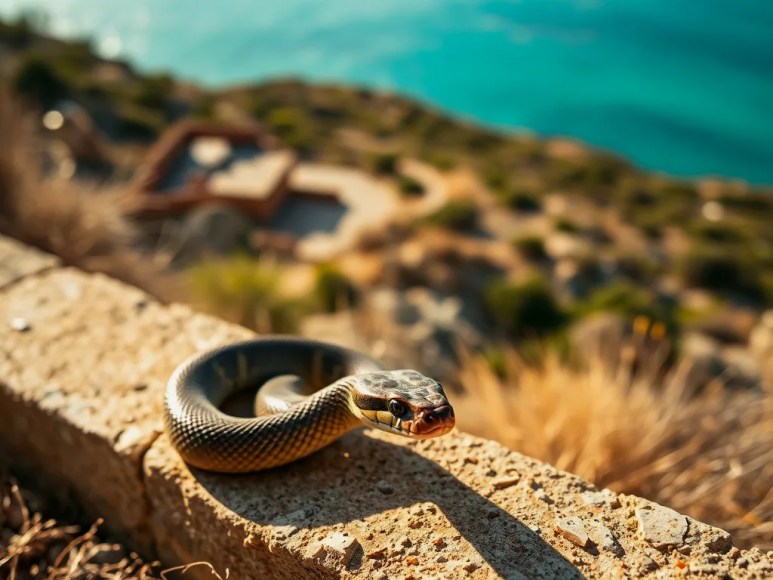
Overview of the invasion and current distribution
The horseshoe snake (Hemorrhois hippocrepis) has rapidly established across more than 90% of Ibiza’s land area, creating direct predation pressure on native fauna. Field surveys and citizen reports show concentrated populations along coastal and peri-urban zones where prey density and shelter are abundant. Rapid colonization follows a pattern of initial coastal foothold, exponential inland expansion along riparian corridors, and founder events on nearby islets.
How did the snakes arrive — evidence and transport routes
Genetic studies and trade records point to two primary introduction routes: intentional or accidental transport with ornamental olive tree shipments from mainland Spain and North Africa, and short-distance overwater dispersal. Wood-packed root balls and containerized plants can conceal juvenile snakes; Quarantine inspections have historically focused on pests, not reptiles. Documented cases on small islets correspond with times and routes of nursery deliveries and with seasonal storms that increase floating debris carrying animals.
Why Ibiza’s ecosystems are vulnerable
Island ecosystems have high densities of endemic, naïve prey species with limited anti-predator behaviors. The Ibiza wall lizard (Podarcis pityusensis) evolved without snakes as common predators and therefore lacks avoidance strategies. Small islands also concentrate food resources, allowing introduced predators to attain higher local densities than on the mainland, compounding impacts on prey populations and disrupting pollination and invertebrate population control that lizards previously provided.
Documented ecological impacts and species at risk
Field stomach-content analyses, camera traps, and carcass records confirm predation on Podarcis spp., ground-nesting birds, and amphibians Populations of the Ibiza wall lizard show local declines where snake encounter rates exceed a critical threshold; In several coastal sites lizard densities have fallen by over 60% in three years. Cascading effects include increases in herbivorous insects and changes in seed predation, altering plant recruitment patterns in dune and scrub habitats.
Which snake species are present and how they differ
Besides Hemorrhois hippocrepis, surveys report Natrix maura, Zamenis scalaris, and the Montpellier snake. Hemorrhois is an active forager with climbing ability, enabling it to hunt in scrub and trees. Natrix maura favors wetlands and preys on amphibians, while Zamenis scalaris occupies rockier inland habitats. Management must therefore account for habitat-specific behavior rather than treating all sightings uniformly.
Detection and monitoring: practical step-by-step protocol
Implement a standard protocol to detect and track snake populations:
1. Habitat prioritization: Map coastal scrub, riparian corridors, nurseries, and ports. Prioritize sites with high lizard densities and recent plant imports.
2. Passive monitoring: Deploy standardized arrays of artificial refugia (roofing felt, corrugated tins) and record occupancy weekly; Use motion-triggered cameras at likely feeding sites.
3. Active surveys: Conduct timed visual encounter surveys along transects at dawn and dusk, noting microhabitat, behavior, and approximate size class.
4. Genetic and stomach analysis: Collect tissue or shed skins for population assignment; Analyze gut contents or feces to quantify diet breadth.
5. Citizen science: Build a verified report app with mandatory photo and GPS; triage reports to prioritize response.
Rapid response and control options with pros and cons
Control requires a toolbox approach:
Targeted removal: Trained teams can remove snakes using traps and hand capture in focal zones. Effective for small populations but labor-intensive and expensive.
Trapping arrays: Funnel traps baited with reptile scent or live-capture of preferred prey reduce numbers where deployed intensively. Risks include bycatch and stress to non-target animals.
Habitat modification: Reduce shelter by clearing dense ground cover and managing rock piles near high-value lizard habitats. This lowers carrying capacity but can affect other native species if done broadly.
Biosecurity at nurseries and ports: Physical inspection of plant root balls, mandatory quarantine, and heat-treatment or cold storage protocols can stop future introductions; This is the most cost-effective long-term approach.
Public engagement: Education on not translocating plants, pets, or wildlife reduces accidental spread and increases report rates.
Successful examples and lessons learned
A neighboring Mediterranean island implemented a combined strategy: strict nursery inspections, a trained rapid response team, and community reporting. Within five years they reduced new colonization events by 80% and stabilized several endemic lizard populations where early removal occurred. Lessons: act early, target habitat corridors, and integrate molecular monitoring to detect cryptic introductions.
Policy and management recommendations
Adopt an integrated island-wide plan that includes:
– Mandatory inspection and certification for all traded plants and root-balled trees entering the islands;
– Establishment of a funded rapid response unit with legal authority for humane removal and containment;
– Long-term ecological monitoring with public dashboards reporting lizard and snake indices to guide adaptive action;
– Community incentives for nursery compliance and reporting, such as reduced fees or recognition schemes.
How residents and visitors can help — clear actions
Report sightings with photos and precise locations, avoid moving firewood or ornamental plants between islands, inspect boats and equipment after landings, and support local programs. When encountering a snake, keep distance, photograph from a safe space, and provide the report to authorities rather than attempting removal.
Outlook: containment vs eradication and realistic timelines
Eradication becomes unlikely once snakes occupy large parts of an island and reach multiple islets. Containment, suppression in high-value conservation sites, and strict biosecurity to prevent further spread provide the realistic path. With sustained investment and coordinated actions, managers can halt new introductions, reduce predator pressure in priority refuges within 3–7 years, and allow some endemic populations to recover over subsequent decades.