
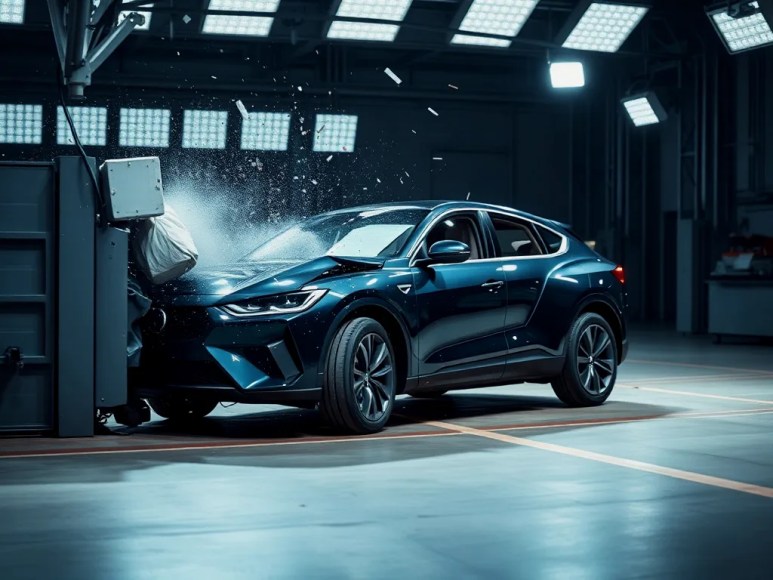
Geely staged a high-speed cliff crash to test body strength
Geely deliberately drove a production Lynk & Co 07 GT off a ramp at roughly 70 km/h to evaluate the car’s structural resilience. The vehicle launched into an uncontrolled trajectory, rolled multiple times and came to rest while the manufacturer filmed the entire sequence in Zhangjiakou. This live demonstration focused on real-world deformation patterns rather than controlled laboratory impact points, showing how energy distributes across the shell when a wagon bodyshell endures repeated high-angle impacts and roof loading during rollovers.
All four doors remained operable after the test
After the incident, technicians confirmed that every door could still open. Front and side glazing retained much of their integrity, and although the panoramic roof cracked, it did not collapse into the passenger compartment. Geely reported that the side-curtain airbags preserved pressure for more than six seconds, which indicates the restraint system sustained enough containment time to protect occupants in a prolonged tumble. Keep in mind the demonstration was self-conducted by the manufacturer and not supervised by an independent crash-test agency, so outcomes do not replace formal safety ratings.
How this scenario differs from standard crash tests
Conventional crash testing (eg, frontal, side, and rollover tests run by independent bodies) uses precise, repeatable conditions and instrumented dummies to quantify injury risk. This cliff-and-roll demonstration instead reveals qualitative behavior: how doors, glazing, roof rails and internal airbag systems behave under chaotic, multi-impact loading. For engineers, such tests help identify weak load paths and validate reinforcement strategies—examples include strengthening A- and B-pillars, improving roof ring stiffness, and optimizing side-sill energy management to keep occupant space intact.
What the preserved door function implies for occupant egress and rescue
Doors that remain operable after severe impacts reduce entrapment risk and simplify extrication. Emergency responders and designers prioritize survivable space and access points; This test suggests the 07 GT’s door apertures and hinge/lock assemblies kept tolerances within usable range after multiple impacts. In practical terms, that can shorten rescue times and lower secondary injury risk from vehicle cutting or occupant extraction.
07 GT’s safety systems and observed performance
Key observations from the demonstration include intact glazing behavior, sustained curtain airbag pressure, and an uncompromised passenger cell envelope despite roof damage. These results point to effective load distribution across the body-in-white and to airbag tuning that maintains occupant protection during extended roll events. However, without instrumented measurements (deceleration pulses, dummy injury criteria, intrusion distances) from an independent laboratory, the data remains indicative rather than definitive.
Model and powertrain details: a 530-hp EM-P hybrid wagon
The Lynk & Co 07 GT is a station-wagon–bodied model that premiered in Europe at the Paris show. Under the bonnet, a 1.5-liter turbocharged gasoline engine pairs with two electric motors and a 28.3 kWh battery pack in an EM-P hybrid layout. Geely states a combined output of about 530 hp and 764 Nm of torque. That powertrain positioning targets high-performance buyers seeking a practical body style with strong electric assist and meaningful all-electric capability for urban driving.
What buyers should watch for before judging safety
Prospective customers should wait for independent rollover, offset frontal and side impact ratings from organizations like Euro NCAP or similar regional bodies. Those tests provide instrumented, repeatable metrics such as head injury criterion (HIC), chest deceleration, femur loads, and intrusion distances. Until such data appear, the filmed cliff test serves as a useful engineering snapshot but not as a comprehensive safety endorsement.
How manufacturers use extreme demonstrations
Automakers sometimes stage extreme events to highlight specific structural traits or to stress-test new designs beyond standardized protocols. When done responsibly, these demonstrations can reveal failure modes that standardized tests miss—such as multiple sequential impacts that produce cumulative damage. Engineering teams then iterate reinforcements: adding reinforcements to roof rails, improving weld patterns, or revising energy-absorbing structures to preserve occupant space across complex crash sequences.