
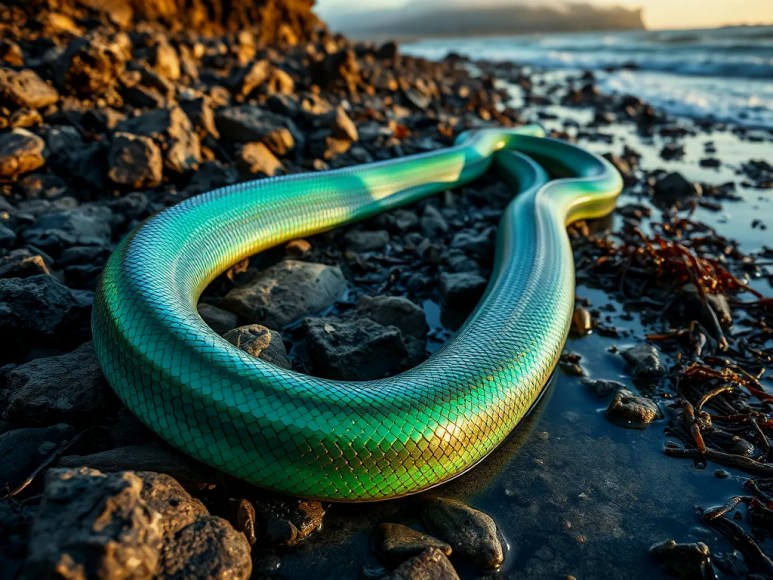
Incident summary: venomous sea snake found at Bolsa Chica on November 22, 2026
On November 22, 2026, beachgoers discovered a yellow-bellied sea snake (Hydrophis platurus) washed ashore at Bolsa Chica, California. Authorities confirmed this as the eighth documented specimen in the region, prompting immediate public-safety notices from local lifeguards and marine biologists. Teams secured the site, documented the specimen with photos and measurements, and transported the body to a lab for species confirmation and toxin analysis.
Why tropical sea snakes appear far from home
Yellow-bellied sea snakes are pelagic but tied to warm tropical and subtropical waters. Shifts in ocean conditions—notably El Niño–associated warming, anomalous current patterns, and storm-driven drift—can push these snakes into temperate zones. When warm-water anomalies exceed seasonal norms by 1–3 °C, satellite-tracked sea surface temperatures and drifter buoy data show expanded habitable corridors that allow surface-dwelling species to travel northward along the California Current System. For example, during strong El Niño years, records of tropical fish, jellyfish, and turtles in Southern California increase by 40–60% compared with neutral years.
How to identify a yellow-bellied sea snake
Recognize this species by its combination of a dark dorsal surface and a bright yellow or pale underside. Adults typically measure 0.7–1.5 meters; the head is small and the body is laterally compressed for swimming. Unlike coastal terrestrial snakes, adult yellow-bellied sea snakes possess a paddle-shaped tail for propulsion and nostrils positioned dorsally. If you see a stranded specimen, keep at least 20 meters away — even dead snakes can retain active venom in their glands and fangs.
Medical risks and what to do after a bite: step-by-step
Yellow-bellied sea snake venom is primarily myotoxic and neurotoxic. Clinical manifestations range from localized pain and muscle tenderness to systemic muscle breakdown (rhabdomyolysis), paralysis, and respiratory failure. Follow these steps immediately if a bite occurs:
1) Stay still and call for help. Immobilize the bitten limb and seek emergency medical services without delay. Rapid transport to a facility capable of administering antivenom improves outcomes.
2) Limit movement but do not apply a tourniquet. Keep the patient calm and horizontal; Excessive activity accelerates venom spread. Modern guidance discourages tight tourniquets because they can cause ischemic injury.
3) Record time and take photos if safe. Note time of bite and photograph the snake from a safe distance only if it can be done without delaying care; images assist with species identification.
4) Hospital care and treatment. Emergency departments will monitor respiratory function, electrolytes, creatine kinase (CK) for muscle injury, and urine output for myoglobinuria. Antivenom targeting sea snake toxin families is the definitive therapy; administration depends on clinical signs, laboratory markers, and local availability.
Practical safety measures for beach visitors
Follow these practical actions to reduce risk and report sightings:
– Maintain distance. Do not touch or attempt to move any sea snake, alive or dead.
– Mark and report location. Use GPS or a landmark and call local lifeguards, park rangers, or the municipal non-emergency line. Provide photos and precise coordinates when possible.
– Supervise children and pets. Keep pets leashed and children within sight; Dogs may investigate carcasses and risk envenomation.
– Avoid handling marine debris and wrack lines. Sea snakes and other wildlife can hide in kelp mats and washed-up seaweed; scan visually before stepping into dense wrack.
What researchers learn from each specimen
Every washed-up snake provides data: DNA for population connectivity studies, isotopic signatures for diet and migration inference, and toxin profiles to track venom variation. That information helps model climate-driven range shifts and informs public-health preparedness. For example, sequencing from a recent California sample showed haplotypes matching populations in coastal Mexico, indicating long-distance passive drift rather than local breeding.
Local authority guidance and contact points
Lifeguard stations, state parks, and local public-health departments coordinate responses. If you encounter a sea snake in Southern California:
– Call the local lifeguard or beach patrol immediately.
– Contact the California Department of Fish and Wildlife (CDFW) for biological reporting.
– For bites, call emergency services (911) and alert nearest hospital about potential marine envenomation.
What to expect next in Bolsa Chica and nearby beaches
Authorities will likely increase signage at impacted beach access points, issue social media advisories, and coordinate monitoring along the coastline for additional strandings. Drone or foot surveys can detect more carcasses, and collaborators may deploy tide-line inspections during low tides. Public compliance with reporting and distance recommendations reduces human risk while enabling rapid scientific response.
Bottom line: stay informed, keep distance, report sightings
Yellow-bellied sea snakes are rare visitors in California but carry potent venom. Treat any encounter seriously: do not touch, note the location, report to authorities, and seek immediate medical care for any bite. Proper reporting and specimen handling by trained personnel both protect public safety and advance scientific understanding of how changing oceans influence marine species distributions.