
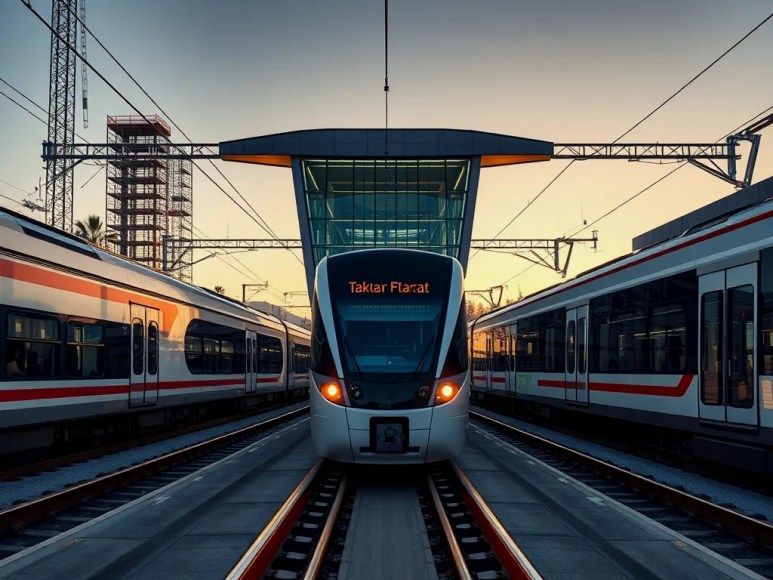
52 percent of transportation investments to railways
The 2027 investment plan allocates 52% of funds to rail infrastructure. The ministry proposes 774.4 billion TRY in investments, directing a majority share to rail projects to accelerate freight connectivity and reduce intercity travel times. This allocation prioritizes capacity, electrification, and signaling upgrades, reflecting a strategic shift from road-dominant spending toward higher-capacity, lower-emission transport corridors.
Adapazarı–Karasu Railway: scope, timeline, and network integration
Project scope and technical design. The Adapazarı–Karasu railway spans 65.64 km and will be built as a double-track, electrified, and signalled mainline. It connects Karasu Port and surrounding industrial zones directly to Turkey’s national rail network, enabling unit and intermodal freight movements without transshipment delays.
Planned benefits and measurable outcomes. Expected outcomes include: a) increased freight throughput at Karasu Port by enabling direct rail shuttles; b) modal-shift potential from road to rail reducing heavy truck kilometers and emissions; c) reduced unit transport cost for bulk and container freight through economies of scale on rail. Forecast modeling used line-haul speed, axle-load, and assumed daily train paths to estimate a 25–40% cost per tonne-kilometer improvement versus current road transport for typical industrial flows.
Timeline and financing status. Authorities target 2029 for commissioning. The project’s estimated budget of ~66.8 billion TRY appears in the investment program with phased funding; However, specific 2027 appropriations were not yet published. Implementation tasks remaining include final land acquisition, detailed engineering for tunnels and bridges, and contracting of electrification and signaling packages.
Adapazarı–Serdivan Tram: route, stations, and ridership effects
Route characteristics and service model. The tramway covers 15.2 km and includes 19 stations, linking Adapazarı city center to Serdivan. The low-floor tram alignment emphasizes accessible boarding, frequent all-day services, and integration with local bus networks and park-and-ride nodes to capture commuter flows.
Procurement and construction milestones. The procurement completed on 28 April 2026; contract signing occurred on 25 August and site handover on 27 August. With construction underway, the delivery schedule focuses on staged opening of sections to accelerate ridership benefits and manage traffic impacts during works.
Operational impacts and local mobility examples. Predicted effects include travel-time reductions within the corridor (by consolidating multiple bus services into a high-capacity tram line), improved service reliability, and increased commercial activity around stations. Example: a typical 8-km commuter trip that now relies on buses with multiple transfers could see a 20–35% in-vehicle time savings and predictable headways that improve commuter planning.
Doğançay Ripaj and T26 Tunnel: cutting Ankara–İstanbul high-speed travel times
What the works deliver. Completing the Doğançay Ripaj and the T26 Tunnel shortens the high-speed alignment between Ankara and İstanbul, enabling a 30-minute reduction in current high-speed journey time down to 3.5 hours for certain services. When combined with the ongoing Ankara–İstanbul Super High-Speed Train (SHT) corridor upgrades, planners intend to further reduce travel time toward an 80-minute objective for premium SHT services.
Technical levers used to cut travel time. Time savings come from: higher permissible line speeds through straightened alignments and new tunnels, removal of speed-limiting gradients via ripage works, and elimination of bottlenecks by adding dedicated tracks for different service types (freight, regional, high-speed). Signaling upgrades (ETCS-level systems) will permit closer train headways and safer operation at higher speeds.
How these projects interact and amplify regional benefits
Network synergies. The three projects complement each other: Adapazarı–Karasu increases freight throughput to ports and industry; the Serdivan tramway improves urban accessibility and feeder flows to intercity rail nodes; Doğançay Ripaj shortens intercity and high-speed travel times. Combined, they boost Sakarya’s attractiveness for logistics, commuter residence, and manufacturing investment.
Economic and modal-shift example. Consider a manufacturer in Sakarya exporting via Karasu Port: direct rail access reduces time-in-port and enables scheduled daily block trains to mainline terminals. For commuters, the tram increases the effective labor catchment area for employers near Adapazarı and Serdivan by shrinking door-to-door commute times.
Risks, mitigation, and what to watch next
Primary risks. Key risks include land-acquisition delays, cost escalation from input-price volatility, and coordination mismatches across contractors for adjacent works (eg, interfaces between tram and municipal utilities or mainline rail and port operations).
Mitigation steps authorities can take. Authorities should sequence works with clear interface agreements, ring-fence contingency budgets for foreseeable price swings, and accelerate early utility relocation and social-consent processes to avoid stoppages. Transparent milestone-based payments to contractors tied to verified delivery reduce adversarial delays.
Practical timeline for stakeholders
Short-term (2026–2027). Complete procurement, finalize land take, start primary earthworks and structures for tram and rail sections that have site handover.
Medium-term (2028–2029). Deliver main civil works, install electrification and signaling systems, and begin testing phases; target Adapazarı–Karasu commissioning by 2029 as listed in the program.
Long-term (post-2029). Achieve full operational integration across tram, regional, and high-speed services, monitor ridership and freight volumes, and iterate service patterns to maximize asset utilization.