
Project overview and timeline
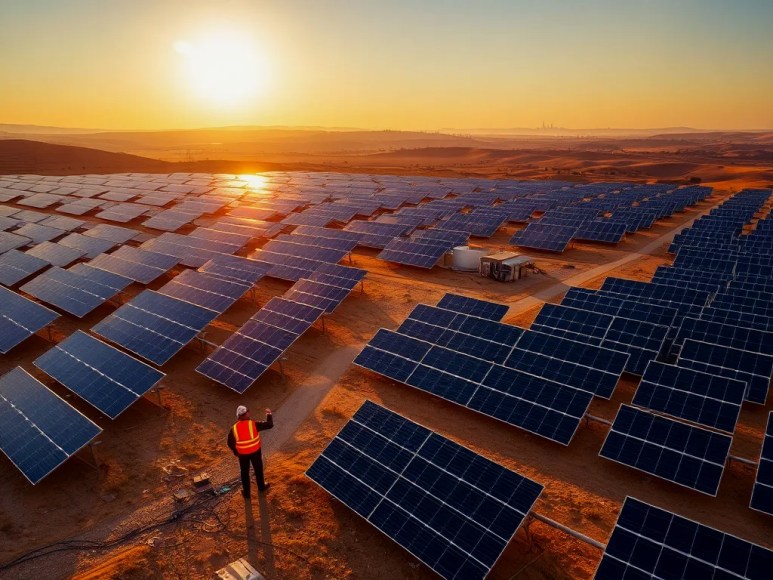
Ankara Metropolitan Municipality will construct a 50 MW solar power plant in Beynam neighborhood of Balâ district on an approximately 810,000 m² site. The municipality plans to hold the construction tender on 30 November 2026. The project targets rapid deployment of utility-scale photovoltaic infrastructure to increase the city’s renewable energy output and reduce reliance on non-renewable grid supply.
Design and specific equipments
The installation will use about 93,500 TOPCon solar modules, each rated at 620 W, and 163 inverters with 300 kW nominal power TOPCon (Tunnel Oxide Passivated Contact) cells are chosen for higher conversion efficiency and stronger low-light performance. The plant layout includes 20 transformer stations and two distribution centers to step up voltage for grid connection and to manage internal power routing.
Energy transmission infrastructure
To deliver generated electricity to the distribution network, the project will install approximately 10.5 km of overhead lines and 9 km of underground cabling, totaling roughly 20 km of energy transmission route. Overhead segments reduce civil works cost across open terrain; underground sections protect lines through populated or environmentally sensitive stretches. The design balances capital cost, maintenance access, and visual/environmental impact.
Operational control and monitoring
The facility will operate under a SCADA system that collects real-time data on irradiance, temperature, string-level performance, inverter diagnostics, and energy yield. Remote monitoring enables condition-based maintenance: technicians receive targeted alerts for faults, reducing mean-time-to-repair and improving availability. The control strategy will incorporate anti-islanding protection, reactive power support, and curtailment schedules to meet distribution operator requirements.
Performance features and expected output
Using modern TOPCon modules and centralized inverters, the plant is expected to achieve higher specific yield compared with older technologies. Panels will be mounted at optimized tilt and row spacing to minimize inter-row shading and to capture reflected radiation from the ground surface. Combined with terrain-specific irradiance data for the Balâ region, preliminary estimates indicate an annual generation in the range consistent with utility 50 MW sites in the region (typical capacity factor and local solar resource determine final MWh figures during feasibility).
Construction phases and site works
Construction will follow staged milestones: site preparation and fencing; civil foundations for panel rows and transformer pads; electrical trenches and duct banks for buried cable; erection of overhead poles and conductor installation; module mounting and stringing; inverter and transformer installation; and commissioning tests (protection coordination, SCADA integration, performance verification). Phased commissioning allows partial commercial operation as blocks reach readiness.
Maintenance strategy and lifecycle considerations
Planned maintenance will use a combination of scheduled preventative inspections and condition-based interventions driven by SCADA alerts. Typical tasks include periodic cleaning (as needed by dust deposition rates), thermal imaging surveys of electrical cabinets, torque checks on bolted connections, and inverter firmware updates. A lifecycle plan will incorporate module degradation rates (TOPCon typically shows lower degradation) and replacement timelines for inverters and transformers, producing a long-term financial model for levelized cost of energy.
Environmental and local impact measures
The project minimizes land disturbance by concentrating infrastructure and using ducts only where necessary. Vegetation management, erosion controls, and drainage structures will protect local soils. Overhead segments are routed to avoid nesting sites when feasible; Environmental monitoring during construction will track dust, noise, and habitat impacts. Community engagement typically accompanies municipal projects to address access, traffic during construction, and potential benefits such as local job opportunities.
How this plant integrates with Ankara’s energy goals
By adding distributed generation capacity, the municipality increases local clean energy production and supports grid resilience. The plant can provide predictable daytime generation that reduces daytime demand on centralized thermal plants and lowers transmission losses for local loads. When coordinated with demand-side programs and future energy storage, the facility can support peak shaving and voltage regulation.