
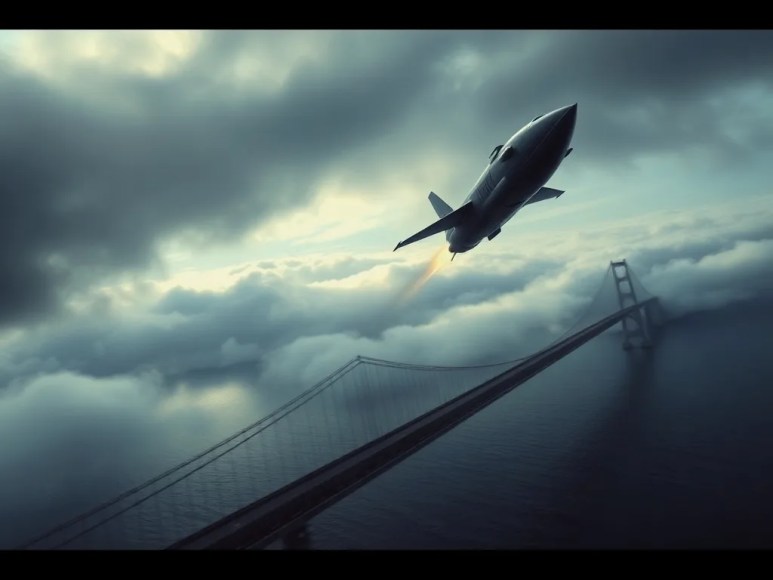
Destinus, a Netherlands-based defense firm, confirmed launch of nine Ruta Block 1 cruise missiles during the multi-phase strike on the Kerch (Crimean) Bridge on 17 November 2026, reporting seven impacts on the structure. The company’s CEO, Oleksandr Danyliuk, told Reuters that Ruta missiles formed a key segment of the strike package. Ukrainian authorities said the action represented the final stage of an extensive, weeks-long operation coordinated across intelligence, electronic warfare, and long-range strike elements.
How the combined strike targeted road and rail links on the Kerch Bridge
Ukrainian leadership described the operation as a seven-step plan executed jointly by the Security Service of Ukraine and the General Staff. Planners assigned different weapon classes to distinct structural targets: road segments, rail spans, radar and air-defense nodes, and electronic warfare arrays. In the final wave, Palianytsia munitions focused on the road deck while a mix of Neptune, Ruta and FP-5 systems attacked rail sections. The operation also included Flamingo cruise missiles to saturate and complicate Russian air-defense responses.
This multi-axis tasking illustrates a modern method for striking dual-use infrastructure: pair precision anti-ship or land-attack cruise missiles (Ruta/Neptune family) with standoff loitering munitions and UAVs to suppress point-defenses, then sequence high-probability-of-kill weapons against critical load-bearing spans.
What Ruta Block 1 contributes to Ukraine’s long-range strike mix
Ruta Block 1 is a cruise missile produced by Destinus’ Ruta family. Operational use on the Kerch Bridge highlights three capabilities: range sufficient to reach the Kerch Strait from Ukrainian launch zones or forward basing, warhead and terminal guidance tailored for infrastructure strikes, and integration with cooperative platforms (UAVs and electronic warfare assets) to increase mission assurance. Danyliuk’s claim that nine were fired and seven hit suggests either careful aiming and targeting data or that attack timing exploited windows when passive and active air-defense coverage was degraded.
Examples from the operation show how an arrayed approach increases effectiveness: a Da Vinci UAV sortie provided real-time reconnaissance and battle damage assessment while other airframes executed diversionary or suppression roles. That combination reduced the need for extremely large salvo sizes and instead emphasized synchronized effects from mixed inventories.
Destinus confirms Da Vinci UAVs participated; why that matters
Destinus also confirmed deployment of its Da Vinci unmanned aerial systems in the strike. These UAVs filled multiple roles—persistent ISR to refine terminal targeting, electronic support measures to map and jam local radars, and in some profiles direct delivery of smaller kinetic effectors. Using UAVs alongside cruise missiles converts a single-capability strike into a multi-function campaign, increasing the chance of mission success even when facing layered air-defense systems.
Operational example: a Da Vinci drone overflies a radar cluster to locate emitters and feed coordinates to a command node; routes for Ruta missiles are updated in flight to exploit gaps; simultaneous Flamingo salvo creates radar clutter and forces engagement decisions by defenders. This kind of orchestration shortens the sensor-to-shooter loop and defender compounds workload.
Sequence and logistics: how Ukraine staged the operation
Ukrainian forces appear to have followed an explicit sequencing plan: 1) reconnaissance and emitter mapping by UAVs and SIGINT teams; 2) electronic attack and suppression to blind local air-defense; 3) targeted strikes on radar and integrated air-defense nodes to reduce reaction time; 4) salvo launches of cruise missiles (Ruta, Neptune, Flamingo) timed to penetrate remaining gaps; 5) follow-up strikes on mobility and repair assets to prevent rapid restoration. This step-by-step approach preserves munitions by concentrating effects where they matter—load-bearing spans, signal relays, and repair yards—rather than dispersing fires across noncritical targets.
Supply and production considerations also informed the plan. Destinus’ CEO emphasized the necessity of production capacity and reliability for operational tempo. Fielding dozens of long-range munitions within a requires sustained manufacturing, secure logistics, and redundancy so attrition or single-line failures do not stall future operations.
Implications for European defense industry involvement
The use of European-developed systems like Ruta brings new attention to private defense firms’ roles in extended conflicts. European supply of long-range precision weapons alters operational balance by providing Ukrainian platforms capable of reaching strategic infrastructure inside Crimea. The outcome of the Kerch Bridge strike will drive further discussion about export controls, oversight, and integration of commercial defense technology into national-level campaigns.
Real-world effect: a measurable strike on a critical bridge imposes immediate operational friction—rerouted logistics, longer transit times for materiel, and increased reliance on alternate supply corridors. Policymakers and procurement planners will assess whether wider adoption of systems similar to Ruta accelerates diversification of strike options available to states facing contested zones.
Why the Kerch Bridge remains a high-value target
The Kerch Bridge links Russia’s mainland to occupied Crimea by road and rail and functions as both a logistic artery and a political symbol. Disabling sections of the bridge degrades troop movement, complicates heavy-equipment transfer, and raises repair burdens that tie up engineering assets. Targeting rail elements specifically strains the most efficient long-haul mode for bulk military logistics, forcing reliance on slower, lower-capacity alternatives.
Historic pattern: prior Ukrainian operations have repeatedly aimed at chokepoints and transport nodes that yield outsized operational effects. The recent engagement aligns with that logic, focusing scarce long-range munitions on targets whose loss amplifies operational cost to the opponent.
Verification, attrition, and open-source reporting limits
Destinus’ assertion that seven of nine Ruta missiles struck relies on company-sourced data and wartime reporting from Ukrainian officials. Independent verification in contested environments is difficult: on-the-ground access is restricted, imagery can be degraded or filtered, and combatant claims may be influenced by operational security. Open-source analysts corroborate strike effects using satellite imagery, social-media geolocation, and radar/telemetry fragments where available, but gaps commonly persist.
For analysts, the appropriate approach is layering evidence—commercial satellite imagery showing structural damage, signals intelligence where accessible, and cross-checked visual feeds—rather than treating any single source as conclusive. The reported hit ratio, if accurate, suggests high mission planning quality, but independent confirmation remains limited at publishing.
What to expect next and operational lessons
Short-term: Russia will prioritize bridge repair, alternate routing for logistics, and reinforcement of air-defense around critical transport nodes. Expect rapid engineering teams, temporary ferries or pontoon solutions, and increased patrols in adjacent maritime approaches. Medium-term: both sides will iterate—defenders harden critical infrastructure, while attackers refine multi-platform coordination and seek new standoff options.
Operational lessons from this strike include: synchronize ISR and EW with kinetic fires to force difficult engagement choices; allocate mixed weapon sets (missiles + loitering systems + UAVs) to reduce dependence on single-system mass; and ensure industrial throughput matches attrition rates to sustain campaigns. These principles guided the Kerch Bridge operation and will influence future long-range strike planning in the region.
Be the first to comment