
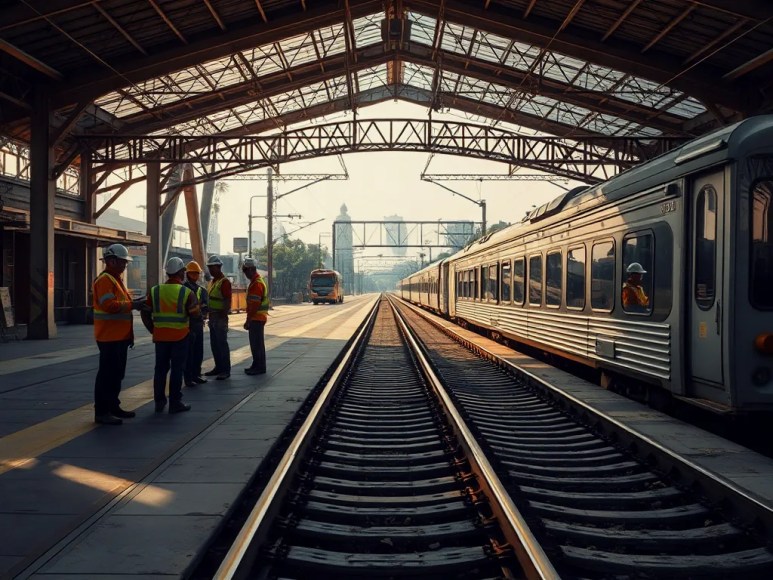
Hanoi Railway Reconfiguration: Proposed Move of Hanoi Station to Ngoc Hoi and Phu Xuyen Temporary Operations
The Hanoi metropolitan plan proposes relocating the central Hanoi Train Station to Ngoc Hoi and establishing temporary operations through Phu Xuyen to enable National Highway 1A expansion while maintaining continuous passenger and freight service Vingroup’s submitted proposal aims to create work zones for road widening between the Ring Road 1 and Cau Gie interchange while shifting key rail functions and upgrading adjacent rail links to support both current metre-gauge traffic and future standard-gauge/high-speed corridors.
What the relocation would change and why it matters
Moving the city’s primary station reconfigures land use across central Hanoi, frees linear corridor space for highway expansion, and creates a staging area for integrating conventional rail with future high-speed alignments. Practically, relocation reduces conflicts between long-distance rail operations and dense urban street grids. It also allows coordinated engineering: tracks, yards, and passenger transfer facilities can be redesigned to serve mixed-gauge operations (1,000 mm and 1,435 mm) and to anticipate multimodal interchange hubs.
How Phu Xuyen will operate as a temporary corridor
Phu Xuyen is proposed as a temporary diversion route for north–south traffic. Implementing that diversion requires phased steps:
Step 1 — Assessment and staging: survey existing right-of-way, identify critical bottlenecks, and mark sites for temporary stations, sidings, and crossovers.
Step 2 — Track and signaling upgrades: reinforce or relay track where speed and axle load standards dictate, install temporary signaling interlocks compatible with existing rolling stock, and provide transitional speed restrictions where geometry differs.
Step 3 — Passenger flow arrangements: build modular platform facilities, ticketing points, and sheltered waiting areas; integrate free shuttle bus links to Hanoi center to preserve accessibility.
Step 4 — Freight continuity: create temporary freight handling yards with crane and forklift capacity, maintain gauge-transfer or transshipment points depending on rolling stock availability.
These steps keep service levels acceptable while permanent realignment proceeds. The model mirrors international precedents where urban highway projects required temporary rail diversions (examples include London’s Crossrail pre-construction diversions and parts of Japan’s station relocations where temporary tracks maintained through services). safety clearances for modern rolling stock; overpasses and level crossing eliminations should be prioritized to increase line throughput; Drainage and embankment strengthening are essential to meet heavy freight loads. Where integration with standard-gauge systems is planned, expectations fall into two categories:
Option A — Dual-gauge or parallel tracks: install mixed-rail sleepers or adjacent standard-gauge tracks along critical sections to enable shared corridors and staged conversion.
Option B — Dedicated conversion: fully convert selected corridors to 1,435 mm while retaining feeder meter-gauge branches, using transshipment nodes to handle gauge breaks.
Operationally, the project must define train dispatching rules for mixed-gauge interfaces, timetable padding during the transition, and contingency routing for freight surges. Projected timelines reported in the proposal suggest engineering milestones aimed at early 2027 for Ngoc Hoi–Phu Xuyen works, though those dates remain indicative pending approvals.
Passenger access solutions and transfer logistics
Maintaining passenger access ranks high in the proposal. The plan proposes free bus shuttles connecting temporary Phu Xuyen and Ngoc Hoi stations to central hubs. A pragmatic implementation requires:
– Dedicated bus lanes and queue management at temporary stations to ensure predictable connections;
– Integrated ticketing or validated transfer passes to eliminate double-queue friction;
– Real-time wayfinding displays and staff-assisted transfers for first weeks of operation while travelers adapt;
– Load-balancing schedules that stagger train arrivals to match shuttle frequencies and avoid platform overcrowding.
These measures preserve ridership and limit modal shift pressures onto urban road networks during construction.
Financing and delivery: PPP structure and build-transfer options
The project contemplates public–private partnership (PPP) models and build-transfer (BT) contracts. Key contract elements to include:
– Clear scope definitions for temporary versus permanent works to avoid cost overruns when scope moves from provisional to permanent;
– Performance-based payment milestones tied to service continuity, not just construction completion;
– Risk allocation that matches technical risks (ground conditions, utility relocations) to contractors and demand/revenue risks to the public sponsor or guaranteed mechanism;
– A sequenced handover plan in BT contracts with precise acceptance tests for track geometry, signalling, and station facilities.
These contractual frameworks accelerate capital delivery while retaining public control over strategic assets.
Integration with Hanoi’s future rail network and urban plans
The relocation is not an isolated change; it forms part of a broader plan to align conventional, urban, and high-speed networks. Tactical priorities include reserving corridor widths for future additional tracks, protecting right-of-way for elevated or tunneled urban lines, and zoning surrounding land for transit-oriented development. Specifically, authorities may reserve Ngoc Hoi–Yen Vien segments for eventual urban rail adaptations, converting intercity alignments into local rapid transit where ridership patterns support that transition.
Operational risks and mitigation
Main risks include disruption to long-distance services, construction-driven delays, and interoperability challenges between gauges. Mitigations involve:
– Robust contingency timetables and spare rolling stock allocations;
– Early procurement of signaling and temporary station systems to avoid lead-time slippage;
– Stakeholder coordination forums with national rail operator, city planners, and emergency services to fast-track utility relocations and permits.
Transparent phased public communications and trial operations before full cutover reduce passenger confusion and risk events.
Key dates, program realism, and next steps
Proposed milestones referenced in the plan aim for highway widening completion by July 2027 and targeted Ngoc Hoi–Phu Xuyen works by March 2027. Those timelines require accelerated approvals, committed financing, and concurrent utility work. Immediate next steps to make the program realistic are:
1. Final technical feasibility and environmental impact reassessments for the diversion and station sites.
2. Formal PPP procurement documents and risk-sharing frameworks issued to prequalified bidders.
3. Pilot test of temporary passenger transfer operations (shuttle buses and modular platforms) over a multi-week period to validate flow assumptions.
4. Establishment of a single program management office to coordinate rail and highway contractors, land acquisition, and community engagement.
Practical example: a phased implementation timeline
Phase 1 (0–6 months): detailed surveys, temporary facilities design, bus-shuttle routing, and early works on embankments.
Phase 2 (6–12 months): install temporary track segments, modular platforms, signaling interfaces, and launch pilot shuttle services.
Phase 3 (12–24 months): progressive transfer of long-distance services to temporary route, full service handover, and commence permanent corridor construction for highway expansion.
Each phase should include measured performance targets: on-time reliability, passenger transfer times under 30 minutes, and freight throughput targets sustaining baseline volumes.
Conclusion: balancing mobility and urban development
Relocating Hanoi Train Station and operating Phu Xuyen as a temporary corridor provides a pragmatic avenue to expand Highway 1A while preserving north–south rail connectivity. Success depends on tight program governance, clear contracting approaches, and passenger-centric transfer arrangements such as free shuttles and integrated ticketing. If implemented with staged engineering and risk-aware PPP contracts, the plan can unlock central urban land and prepare Hanoi’s rail corridors for future high-speed and multimodal integration.