
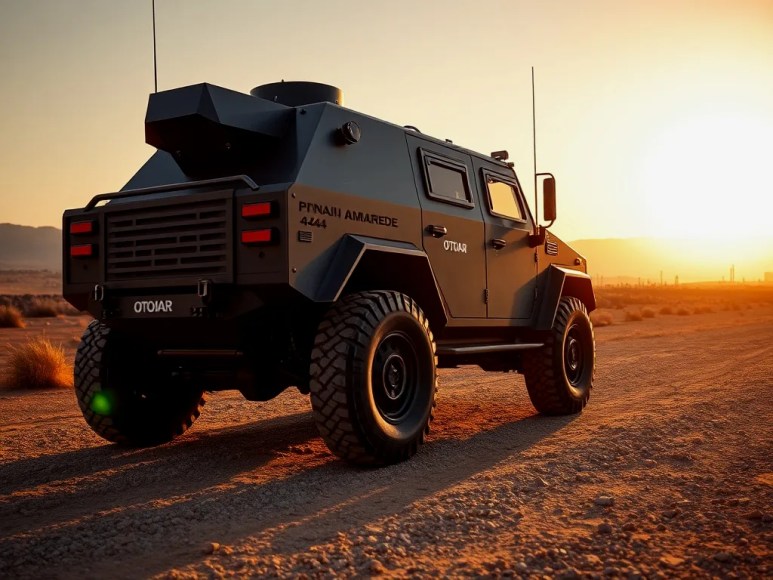
Delivery is targeted for the end of 2028
Otokar signed a development and delivery contract with the Presidency of Defense Industries (SSB) to provide 4×4 tactical wheeled armored vehicles for the Turkish Land Forces, with deliveries targeted to finish before the end of 2028. The company will provide after-sales support covering maintenance, technical assistance, and spare parts management across the vehicles’ service life. Public details such as the exact vehicle variant, quantities, procurement value, and the detailed technical configuration were not disclosed, so assessments of platform choice or equipment fit must await official specification releases.
Program scope and schedule — what the contract implies
The contract establishes a program that covers engineering, prototyping, qualification testing, production and fielding, and post-delivery sustainment. Typical program phases that Otokar is expected to execute include:
1) Design finalization and modular configuration: refine protection, mobility, and mission equipment interfaces to match Turkish Land Forces mission sets.
2) Prototype build and trials: produce prototypes, conduct ballistic, blast, automotive and environmental trials, and iterate designs to meet performance thresholds.
3) Production ramp-up: set up production lines, secure supply chain for armor, powertrain, electronics and weapon interfaces, and execute serial deliveries.
4) Fielding and training: deliver vehicles, provide crew and maintainer training packages, and implement initial spares provisioning.
5) Sustainment: deliver long-term logistics support, repairs, upgrades and obsolescence management under the after-sales package Otokar committed to provide.
What to expect from the vehicle family — protection, modularity, mobility
Otokar’s existing 4×4 tactical armored family emphasizes modularity and scalable protection. Expect design features such as add-on applique armor and engineered underbody blast protection that can be scaled for mine and IED threats, ballistic armor packages to meet different threat levels, and mission modules that allow rapid role changes (patrol, reconnaissance, command-and-control, ambulance, or weaponized variants). Mobility will focus on cross-country performance: independent suspension, centralized tire-pressure management, and powertrain choices that balance payload and range for long logistic lines.
Operational examples and likely mission sets
Vehicles of this class typically perform the following missions, and the program will likely emphasize these capabilities:
– Convoy escort and patrol: sustained road and mixed-terrain patrol with elevated protection against small arms and roadside threats.
– Reconnaissance and surveillance: sensor and comms integration for ISR roles while maintaining low logistical footprint.
– Command and control: mobile command nodes with secure radios, data links, and power generation.
– Medical evacuation and casualty care: modular ambulance interiors that reduce turnaround time for role conversion.
Manufacturing, export footprint and Otokar’s experience
Otokar reports more than 33,000 military vehicles produced and fielded to roughly 50 countries with more than 80 end users. Those production and export credentials suggest mature supply chains, export compliance processes, and experience integrating NATO- and UN-compatible systems. The new contract builds on this base and leverages Otokar’s R&D investment—approximately 4% of revenue in recent years—into vehicle design and systems integration.
After-sales support: sustaining operational availability
After-sales support in armored vehicle programs determines force readiness more than initial delivery. Otokar’s declared responsibility for sustainment implies they will supply structured services such as:
– Depot and field-level maintenance programs with spare parts kits matched to expected failure rates and mission tempo.
– Technical assistance and software support for vehicle electronics, communications, and vehicle management systems.
– Training packages for operators and technicians, including interactive maintenance trainers, operator manuals, and conversion courses.
Detail on contract length for sustainment, performance metrics (eg, equipment availability targets) or penalties/incentives were not made public.
Why modular 4×4 designs remain relevant
Smaller, modular 4×4 tactical vehicles retain relevance because they provide a cost-effective, logistically lean platform that adapts to many mission profiles. They reduce strategic lift burden, support expeditionary operations, and permit rapid reconfiguration for asymmetric threats. Their value increases when manufacturers provide growth margins for future electronic and protection upgrades—an approach Otokar has applied across its product family.
Key uncertainties and what to watch for next
To track program maturation, monitor for the following disclosures and milestones:
– Official specification sheet: protection levels (STANAG/NIJ equivalencies), engine and transmission details, suspension type, power-to-weight ratio, and range.
– Quantity and production schedule: number of vehicles per year, initial delivery batch size, and serial production start date.
– Integration partners: suppliers for sensors, radios, weapon stations and armor packages; these names indicate intended capability levels.
– Test results and qualification events: ballistic, blast, EMI/EMC, climatic and automotive trials and their pass criteria.
Implications for Turkish defense industrial base
This contract reinforces in-country design and production competence by funding engineering and production activities through an indigenous supplier. It also creates subcontracting opportunities across Turkey’s supplier base for armor, electronics, and mechanical components. If Otokar localizes key subsystems, the program will increase domestic technical depth and reduce long-term dependence on foreign suppliers.
Bottom line
Otokar’s contract with the Presidency of Defense Industries sets a clear delivery target—end of 2028—and folds sustainment into the company’s responsibilities. The program promises modular 4×4 tactical armored vehicles aligned to multi-mission fleet concepts, but the absence of published technical details (variant, quantities, and price) leaves important capability questions open until the company or SSB publishes formal specifications and production milestones.
Be the first to comment