
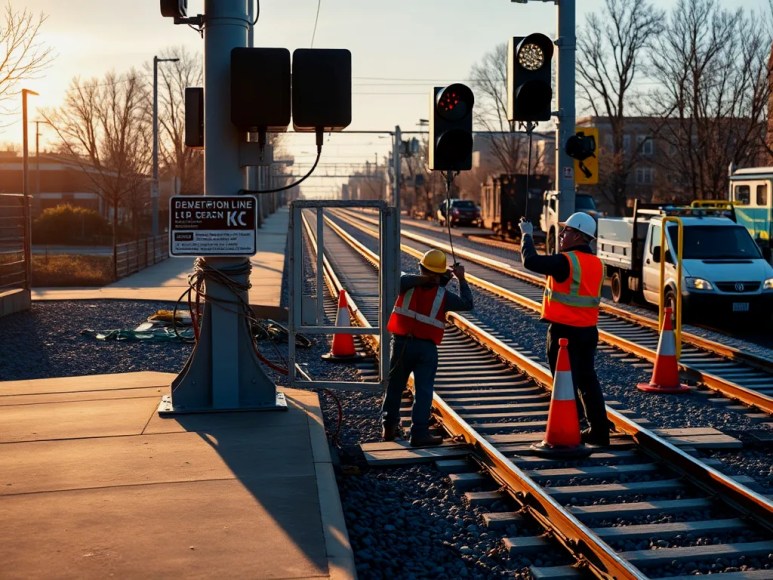
Federal and state fund the $7.7M Hartford Line design package
Connecticut Department of Transportation (CTDOT) secured a combined $7.7 million for pre-construction work on 35 grade crossings along the Hartford Line between New Haven, Hartford and Enfield. The grant breaks down into a $6.16 million Federal Railroad Administration (FRA) award through its Grade Crossing Elimination program and a $1.54 million state match. CTDOT will use the money to complete preliminary engineering, project development and final designs so those crossings become construction‑ready.
What engineers will design and why it matters
Design teams will evaluate options that include installing four-arm gate systems at 21 crossings and closing the riskiest crossings where feasible. Four‑arm gates block both vehicle entrance and exit lanes, reducing the opportunity for drivers to drive around lowered gates. CTDOT estimates these systems could reduce vehicle collisions at protected crossings by up to 95% in modeled scenarios. The work will also quantify local traffic impacts, identify detour needs and document changes to pedestrian access so closures or new barriers do not create unintended safety or mobility problems.
How the sealed corridor approach changes protection strategy
The project applies the FRA’s sealed corridor concept: create continuous physical protections along a rail corridor and remove or substantially upgrade crossings that remain high risk. That approach emphasizes systemwide consistency (gates, fencing and road alignments) rather than piecemeal fixes at individual crossings. For the Hartford Line, sealed‑corridor design will align crossing geometry, signage, and train detection systems so enforcement, maintenance and traveler expectations match along the full corridor.
Daily use, population exposure and why those numbers drive prioritization
The 35 crossings together serve about 108,000 vehicles per day and sit within a one-mile radius of approximately 203,000 residents, including more than 57,000 children. CTDOT will use traffic volumes, collision histories and demographic exposure to prioritize which crossings receive four‑arm gates, which require full closure or grade separation studies, and which can rely on upgraded passive measures. High vehicle counts and proximate vulnerable populations raise the benefit side of the cost‑benefit ledger for more robust interventions.
Projected safety outcomes and operational benefits
CTDOT projects that full implementation of the design concepts would prevent more than 29 train‑vehicle collisions over 20 years and avoid over 1,836 vehicle‑vehicle crashes through improved road layouts and barrier controls. Reduced collisions lower derailment and service‑disruption risks, which improves on‑time performance for passenger trains and reliability for freight operators—benefits that translate into economic gains for commuters, schools and businesses served by the corridor.
What the $7.7M does — and does not — fund
This design package pays for scoping studies, environmental screening, right‑of‑way mapping, engineering specifications, and final construction documents. It does not provide construction dollars for installation of gates, closures, or grade separations. CTDOT will return to federal and state funding sources (or pursue public‑private partnerships) to finance actual construction once designs are complete and costs are established.
Typical design steps CTDOT will follow for each crossing
The program will follow a consistent, step‑wise engineering workflow to move crossings from concept to bid‑ready status:
1. Data collection and crash analysis: compile traffic counts, train movements, crash history, sight lines and adjacent land use to create a risk profile for each crossing.
2. Alternatives development: generate options ranging from passive improvements to four‑arm gates, full closures, overpasses/underpasses, and fencing or channelization.
3. Community and agency coordination: model traffic diversions, hold local meetings, and coordinate with police, schools and transit agencies to test impacts.
4. Environmental and right-of-way assessment: screen for wetlands, historic resources and property needs; prepare mitigation plans where required.
5. Final design and cost estimating: produce construction documents, specifications and robust cost estimates to support funding requests for build phases.
Examples and practical tradeoffs the project will evaluate
Installing four‑arm gates at a suburban crossing with heavy commuter traffic likely yields the greatest collision reduction per dollar. By contrast, closing a low-volume crossing in a dense neighborhood can create longer detours that harm pedestrian access and emergency response times unless accompanied by new local connections. For some sites, a short roadway realignment plus fencing and active warning devices will achieve most safety benefits at a fraction of full grade separation costs.
How CTDOT will measure success during and after design
During design success metrics include completing environmental clearances on schedule, delivering 30%, 60% and 100% design milestones within budget, and securing right‑of‑way determinations. Post‑construction metrics (for later build phases) will center on collision reductions, train delay minutes saved, emergency response time changes and community acceptance indicators such as complaint volumes and survey responses.
Next steps and timeline expectations
CTDOT has not announced construction start dates or final budgets. The current funding accelerates engineering and community engagement so the state can submit competitive construction funding requests. Typical schedules for similar corridor design programs show 12–36 months for design completion across multiple crossings, followed by a separate construction procurement sequence once capital funding is obtained.