
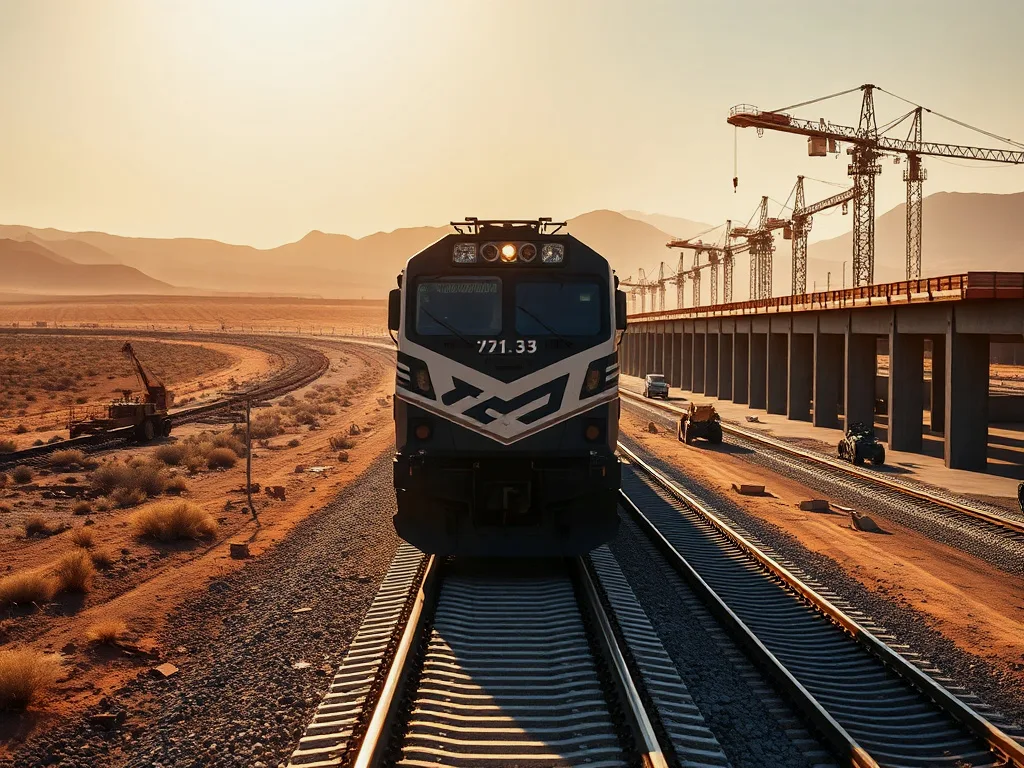
Overview of the Trans-Kalahari corridor and funding approach
Namibia is preparing a call for private-sector investors to build an 1,850-kilometer Trans-Kalahari Railway linking Botswana’s mining heartland to the Atlantic port of Walvis Bay. Authorities published a project development cost of $2.859 billion and confirmed the government will not provide direct development funding; instead, the state will invite proposals from concessionaires and private financiers to design, construct, operate and maintain the line under commercial terms.
Why the rail matters: trade flows, modal shift and regional integration
The corridor targets three measurable outcomes: increase coal and mineral export throughput from Botswana and northern Namibia; shift freight off long-haul roads to reduce unit transport cost and road wear; and deepen Southern African trade links by offering a shorter, lower-cost sea gate to Asia and Europe. For example, routing 5–8 million tonnes per year of combined bulk and containerized freight through Walvis Bay could cut transit times to Asian markets by several days compared with Durban or Cape Town and reduce per-tonne freight costs by an estimated 10–20% for selected commodity flows.
Project scope, route logic and key technical choices
The line will link major coal and base-metal producing markets in eastern Botswana to Walvis Bay via a Namibia entry point Route selection balances three constraints: minimizing grade and curvature to support heavy mineral trains, reducing distance to port, and avoiding environmentally sensitive zones. Track gauge, axle load capacity and signaling will be selected to prioritize heavy bulk throughput (high axle loads) while allowing mixed traffic. Typical design choices for comparable African corridors call for 25–30 tonne axle loads and continuous welded rail on concrete sleepers to maximize speed and reduce lifecycle maintenance costs.
Trans-Zambezi project: purpose, progress and connection to Copperbelt
Separately, Namibia advances an approximately 800-kilometer Trans-Zambezi Railway to connect Grootfontein, Rundu and Katima Mulilo and create a continuous link to Zambia’s Copperbelt. Feasibility studies report roughly 20% completion so far and envisage a public-private partnership (PPP) model to share construction risk and mobilize capital. The Trans-Zambezi provides the Copperbelt with an alternative Atlantic export route and opens northern Namibia to increased transit traffic and regional logistics development.
Modernization and staged works: Kranzberg–Otjiwarongo example
Namibia is also upgrading existing lines. The 207-kilometer Kranzberg–Otjiwarongo upgrade, financed by the African Development Bank and the Namibian government at an estimated $162 million, targets rail renewal and capacity uplift. Track renewal and ballast work are scheduled to begin around mid-2027. Sequencing these works enables network resilience: prioritize rehabilitation on pinch-points first, then integrate new corridor links to avoid idling newly completed sections.
Reconciling cost figures: development cost vs total capital expenditure
Published figures differ sharply. A 2025 investment plan estimated capital expenditures of $11.2–$11.9 billion for a 1,617-kilometer configuration depending on alignment options and service standards. The more recent $2.859 billion figure appears to represent initial development costs—land studies, environmental and social impact assessments, detailed design, permitting and early-stage procurement—rather than full construction capital. Treat the $2.859 billion as project development expenditure (pre-construction) and the $11–12 billion range as eventual build cost under high-specification scenarios; mixing them yields misleading comparisons.
Implementation timeline, procurement and contractor selection
Botswana aims to select contractors in the 2027–2028 fiscal year for its section; Namibia plans its investor solicitation following completion of final feasibility in July 2026. Typical multi-stage procurement will include: 1) request for qualifications to shortlist developer-financiers; 2) request for proposals with performance-based output specifications; 3) competitive bid evaluation with technical, financial and environmental scoring; 4) concession negotiation and financial close. Investors should expect requirements for state guarantees, traffic risk-sharing mechanisms, and availability payments or minimum revenue guarantees in mixed-traffic scenarios.
Revenue models, traffic forecasts and financial sensitivity
Viable revenue streams include bulk mineral haulage fees, containerized livestock and agricultural exports, and cross-border transit charges. Financial models must test traffic sensitivities: low-case (3–5 Mtpa), base-case (6–10 Mtpa) and high-case (>12 Mtpa) throughput scenarios. Each scenario alters payback and debt-service coverage ratios significantly. Project sponsors typically combine project finance debt (60–75% of capex) with equity, concessional loans and export-credit agency support to strengthen debt service capacity at lower interest rates.
Environmental, social and operational risks—and mitigation steps
Key risks include community resettlement, biodiversity impacts in sensitive habitats, water crossing design challenges and security for long remote stretches. Mitigation measures: comprehensive ESIA with participatory consultations; biodiversity offsets for unavoidable impacts; robust stakeholder benefit-sharing agreements; engineered wildlife crossings and drainage; and integrated security plans for protecting rolling stock and personnel. Early, transparent grievance redress mechanisms reduce schedule delays from social disputes.
How private investors can structure participation
Private investors can participate as equity sponsors in a special-purpose vehicle (SPV), as engineering-procurement-construction (EPC) contractors with deferred payment structures, as rolling-stock lessors, or via concessionaires operating under long-term contracts. Blended finance models—combining commercial equity, concessional loans and guarantees—improve bankability. Structured offtake agreements with mining companies or minimum throughput guarantees from governments further de-risk revenue streams.
Operational examples and comparable corridors
Look to precedents such as the Maputo Corridor and the Serete–Lobito corridors for lessons on tariff setting, cross-border regulatory alignment and port-rail interchange design. For instance, successful corridors locked in concessional financing early, standardized gauge and signaling across borders, and created joint rail-port operating companies to streamline transshipment at terminals.
Actionable next steps for stakeholders
For governments: finalize feasibility and environmental approvals, publish transparent PPP procurement documents, and coordinate cross-border customs and rail regulation harmonization. For investors: prepare a technical and financial bid team, commission independent traffic forecasts, and line up blended finance partners and export-credit support. For miners and major shippers: engage early to negotiate long-term haulage contracts that underpin project bankability.
What to watch next
Key near-term milestones include completion of final feasibility in July 2026, Namibia’s formal investor solicitation, and Botswana’s contractor selection in 2027–2028. Monitor traffic studies, confirmed axle-load and speed specifications, financing commitments from multilateral lenders, and concession terms—these elements will determine whether the corridors deliver the forecast economic and logistical benefits.