
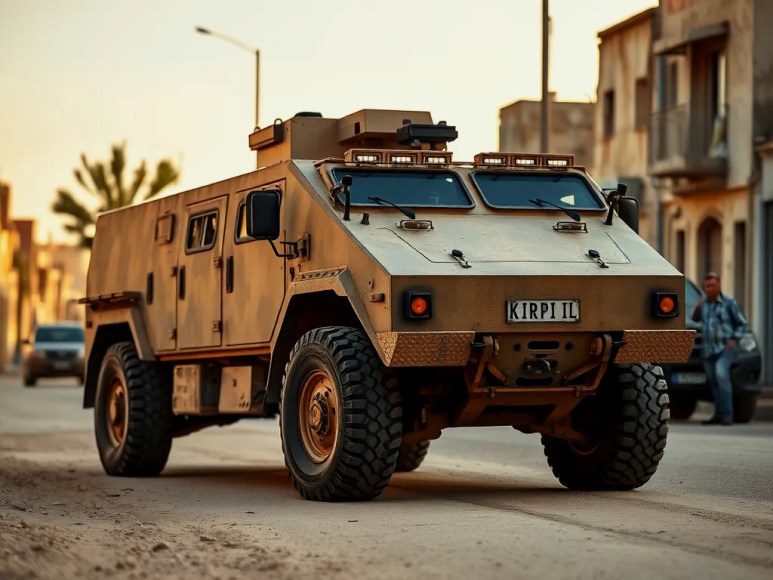
Turkish-made TUNA engine appears in frontline KİRPİ II vehicles
The TUNA engine, developed and serial-produced by BMC Power in Sakarya’s Arifiye facility, now powers BMC’s VURAN and KİRPİ II 4×4 armored platforms spotted in Syria. Images and reporting indicate these vehicles use the indigenous 400-horsepower powerplant, marking a concrete milestone in Turkey’s push to replace imported propulsion systems for tactical wheeled armored vehicles.
How TUNA reached series production and integration onto vehicles
BMC Power completed design validation, endurance testing and production ramp-up before integrating TUNA into vehicle platforms. The step-by-step path included: 1) prototype design and bench validation, 2) extended test-center endurance runs exceeding 6,500 hours, 3) vehicle-mounted trials covering more than 140,000 km under diverse terrains, 4) NATO-standard durability tests, and 5) transition to serial manufacturing in February 2023. Early production batches were fitted into 90 VURAN and 10 KİRPİ II units to validate assembly-line processes and field performance.
Technical profile: what the TUNA engine delivers
TUNA is an inline-4, 8.4-liter diesel designed for tactical wheeled armored vehicles. Key specifications include a rated output of 400 hp, a compact inline cylinder layout for ease of packaging within armored hulls, and test-proven durability that meets NATO endurance benchmarks. Engineers emphasized torque-band tuning for low- and mid-speed responsiveness to improve mobility in off-road and high-mass configurations common to mine-resistant, ambush-protected (MRAP) geometries.
Operational advantages and design trade-offs
Using a domestic engine reduces lead time for spares and enables tighter lifecycle cost control through localized maintenance cycles. The inline-4 architecture simplifies servicing compared with larger V configurations, while the 8.4-liter displacement provides a favorable torque-to-weight ratio for heavy armored variants. Trade-offs include packaging limits for heavier armor packages and the engineering effort required to certify cooling and filtration systems for extreme desert and cold conditions—issues BMC addressed through climate-specific validation runs.
Evidence of export and field use: implications of sightings in Syria
Photographic evidence of KİRPİ II fitted with TUNA engines in Syria suggests either direct supply or transfer to partner forces. While official delivery counts and timelines remain undisclosed, visible field deployments demonstrate that the engine moved beyond laboratory and prototype phases. For export prospects, an engine with proven field data, NATO durability certification and a domestic supply chain creates a more attractive package for countries seeking lower lifecycle costs and sovereign maintenance options.
How the TUNA program reduces external dependency step-by-step
Transitioning to indigenous propulsion followed a deliberate process: first, identification of critical imported components that constrained operational autonomy; second, concentrated R&D to meet those performance corridors; third, establishing a certified local production line; fourth, phased integration into in-service platforms; and fifth, institutionalizing logistics and training for maintainers within armed forces. Each step closed a gap: sourcing, qualification, production, fielding and sustainment.
Delivery to Turkish Armed Forces and disposition of the first 100 vehicles
Beginning in early 2025, BMC delivered 100 TUNA-powered tactical wheeled armored vehicles to Turkish services. The allocation from the initial batch broke down as follows: 50 VURANs to the Land Forces, 40 VURANs to the Gendarmerie and 10 KİRPİ II units to the Land Forces. Centralized acceptance and handover events included military and industry leadership overseeing operational verification and transfer of maintenance documentation and spare parts kits.
Maintenance, logistics and lifecycle considerations
Local production allowed immediate rollout of tailored maintenance training and spares provisioning. For fleet managers the benefits are: reduced lead times for critical components, simplified technical data packages in the national language, and the ability to plan depot-level maintenance cycles around known test-derived endurance thresholds (6,500+ hours and 140,000+ km validation). BMC’s warranty and supply agreements reportedly include initial spares packages sized for first-line and second-line support.
Export potential and market positioning
TUNA strengthens BMC’s market proposition for countries that require robust off-road mobility, simple maintainability and independence from western engine suppliers subject to export controls. A locally produced 400 hp engine with NATO durability test results can accelerate procurement decisions among nations seeking MRAP-style survivability paired with proven propulsion endurance. The next steps for exportability include type-certification in buyer countries, engine integration kits for local assembly and training packages for maintenance ecosystems.
Risks, unknowns and factors to monitor
Open questions include the exact supply chain for critical subcomponents, long-term reliability across large fleets, fuel compatibility across regions, and the extent of warranty-backed global support. Monitoring field performance data, warranty claim rates and the frequency of depot rebuilds will provide objective measures of in-service reliability as the fleet ages.
Practical example: decision checklist for an army evaluating TUNA-powered vehicles
1) Confirm mission profiles and whether 400 hp meets the mobility envelope for fully-kitted variants. 2) Review local fuel standards and confirm filtration and tuning are compatible. 3) Inspect spares support packages and local training offerings. 4) Request field trial access or technical exchange to validate maintenance intervals. 5) Evaluate total cost of ownership including logistic-tail setup and potential offsets via local industrial cooperation.
Conclusion: strategic impact of indigenous engines on armored vehicle programs
TUNA’s deployment on VURAN and KİRPİ II platforms demonstrates a concrete capability shift: propulsion sovereignty that shortens supply lines, lowers sustainment risk and creates export leverage. As operational data accumulates from both domestic service and observed abroad, the engine’s measured reliability and logistics performance will determine whether it becomes a standard choice for Turkey’s tactical wheeled armor and a competitive offering for international buyers.