
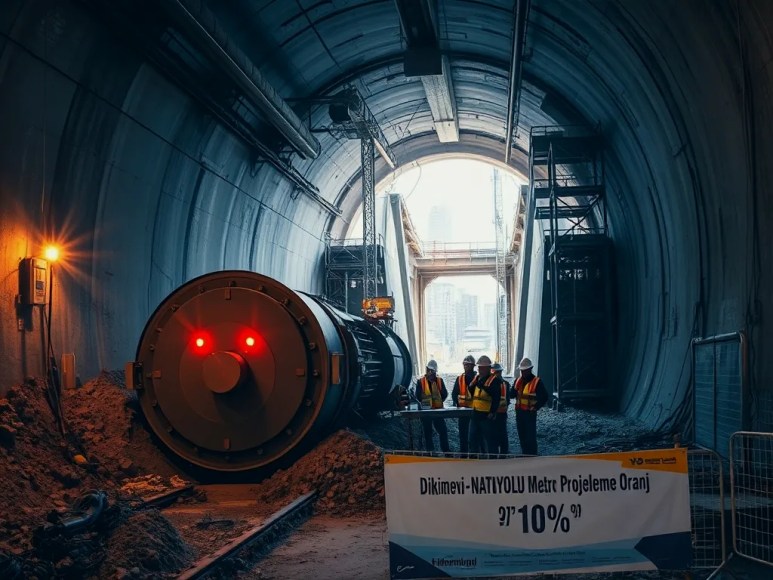
Project status and measurable progress
The Dikimevi–Natoyolu extension of the A1 ANKARAY corridor has advanced beyond preliminary works and now reports a consolidated physical progress exceeding 10%. Construction teams led by Gülermak Ağır Sanayi have mobilized at multiple work fronts: excavation at Natoyolu station, initial installations in the Söğütözü depot area, and early-stage signal and supply-line works. Field crews operate on four station sites simultaneously, using sequenced short-interval work packages to keep the critical-path items—tunnel excavation, track formation and depot fit-out—on schedule.
Contract value, procurement timeline and responsibilities
The main construction and systems supply contract was signed on 13 May 2025 at a value of 14,084,200,000 TL. That contract assigns Gülermak responsibility for civil works on the Dikimevi–Natoyolu alignment plus procurement, installation and commissioning of all electromechanical systems (power, overhead contact, signaling, telecoms and SCADA). Separately, on 22 November 2024 Yüksel Proje won the supervision, consultancy and engineering control package for 299,999,377 TL; their scope covers quality assurance, design verification, testing oversight and final acceptance procedures.
How tunnelling is staged and TBM deployment
Project sequencing places tunnel-boring-machine (TBM) activities after completion of critical station excavations. The first CPC has already been lowered into the site compound; Teams will complete the Natoyolu station cavern and then commence TBM assembly and launching. This staged approach reduces rework risk and concentrates geotechnical monitoring during the most sensitive phases—cut-face support, grout injections and lining segment installation. Expected daily advance rates are set in contract baselines and will be monitored against instrumented convergence and settlement readings.
Electromechanical systems: scope, phases and testing
Electromechanical delivery follows three distinct phases: supply and prefabrication, on-site installation, and integrated testing & commissioning. Systems listed in the contract include catenary and traction power substations, station HVAC and ventilation, platform screen doors where specified, signaling and interlocking, passenger information systems and depot equipment for stabling and maintenance. Integrated testing plans require progressive factory acceptance tests (FAT), site acceptance tests (SAT) and staged trial operations before revenue service; Yüksel Proje will witness each milestone and verify compliance with performance curves in the technical annexes.
Depot works, logistics and operational readiness
The Söğütözü depot site is active for trackwork, maintenance building foundations and auxiliary systems such as washing plants and wheel-lath pits. Logistics planning stages materials flow to minimize double-handling: precast segments, rail panels and power transformers are scheduled with just-in-time delivery windows to optimize limited urban staging areas. Operational readiness includes crew training, maintenance protocol development and spare-parts provisioning; the contract requires documentation handovers and maintenance-training packages to ensure predictable lifecycle performance from day one of operation.
Budget control, contingencies and risk allocation
The original contract sum of ~14.08 billion TL includes defined provisional sums and contingency lines for unforeseen ground conditions and utility diversion. Yüksel Proje’s supervisory role includes certifying interim payments against measured works and validating claims tied to geotechnical surprises or design changes. Typical risk-allocation measures active on this baseline project are: geotechnical reports (GBR) that limit contractor exposure for concealed conditions, time-impact analyzes for significant events, and structured variation pricing templates to avoid protracted disputes.
Community impact and traffic management during construction
Construction teams implement staged traffic diversions, night-shift intensive activities and temporary pedestrian corridors to limit disruption. Noise-attenuation measures (temporary acoustic panels), dust suppression (spray systems) and vibration monitoring at sensitive structures are in use around active excavation areas. The extension is designed to increase transit capacity and connectivity to eastern districts, targeting modal shift from private cars to public transit and reducing peak-hour congestion once revenue service begins.
Planned milestones to completion and commissioning steps
Key upcoming milestones: complete Natoyolu station excavation and TBM launch; complete tunneling drives between stations; lay track and install depot connections; complete electromechanical installations and run integrated systems tests; initiate trial operations and progressive timetable insertion. Commissioning steps are sequenced as factory acceptance → installation → site acceptance → systems integration tests → simulated service runs → final safety certification and revenue service authorization.
What to watch for next: indicators of schedule health
Monitor these leading indicators to judge project momentum: TBM assembly and launch date attendance; weekly delivered-meters of tunnel lining; percentage of electromechanical packages passing SATs on first attempt; measured settlement levels versus thresholds; and timeliness of interim payments tied to certified progress. Consistent reporting on these items from the contractor and Yüksel Proje will clarify whether the baseline completion window is achievable.