
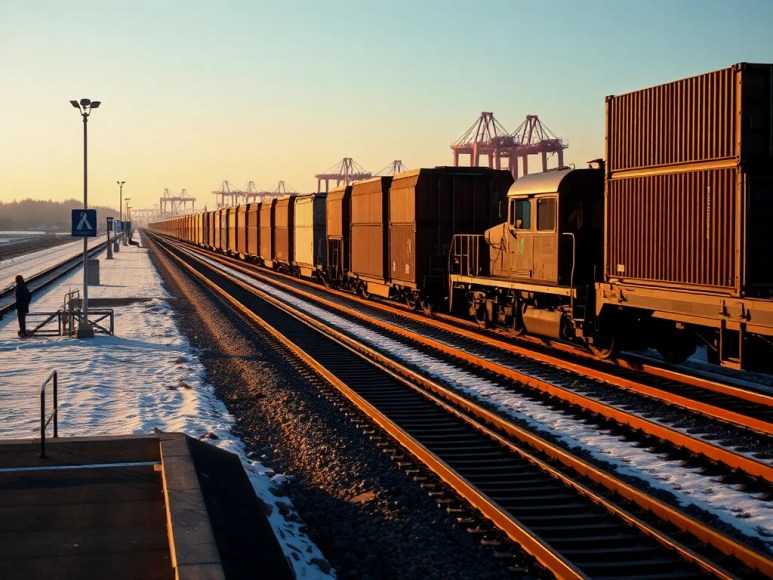
Suifenhe Railway Port hits 5,000 China–Europe freight trains
Suifenhe Railway Port celebrated a measurable operational milestone when it handled its 5,000th China–Europe freight train since launching international services in 2018. Located on the eastern corridor linking Northeast China with Europe, Suifenhe functions as a customs, transloading, and logistical hub that shortens transit time, reduces handling layers, and concentrates cross-border rail expertise in a single gateway.
Why this milestone matters for international rail logistics
Reaching 5,000 train movements signals system maturity rather than a one-off statistic. Each train represents a bundled set of savings: lower unit cost compared with air freight, more predictable lead times than maritime schedules in some lanes, and the ability to move containerized industrial goods, consumer products, and intermediate inputs on a fixed timetable. For exporters and importers using the eastern corridor, Suifenhe provides a repeatable, auditable flow that supports inventory planning and shortens cash-to-cash cycles.
Operational capabilities and infrastructure that enabled growth
Suifenhe expanded capacity and operational scope incrementally. Key elements include upgraded border inspection facilities that speed customs clearance, additional marshalling tracks to manage simultaneous arrivals and departures, and specialized cranes and gantries for swift gauge changes and container handling. Local rail operators coordinated schedules to minimize idle locomotive time, while the port invested in digital manifests and electronic customs pre-clearance to reduce dwell time by hours per train.
Typical cargo profiles and export-import examples
Common outbound cargoes from Northeast China through Suifenhe include machinery parts, electronics components, automotive components, and upstream chemicals. On the inbound side, the corridor moved European machine-tools, precision equipment, and high-value intermediate goods. A concrete example: a manufacturing cluster near Harbin shifted a mix of 40-foot containers of semiconductors and precision housings to Suifenhe; rail transit shaved 7–10 days from their previous sea route and reduced inventory buffer requirements at the factory floor.
Transit times, costs, and modal comparisons
Typical transit times from Northeast Chinese origin points to Central European logistics nodes via Suifenhe range between 12 and 18 days, depending on final destination and how many transshipment points the route requires. Rail costs sit between maritime and air freight: roughly 2–4x maritime rates but 1/4–1/6 of air freight for comparable door-to-door services. For time-sensitive bulk shipments that cannot justify air rates, rail through Suifenhe strikes a practical middle ground.
Customs, gauge change, and handling process — step by step
1) Arrival and pre-clearance: Trains submit electronic manifests before arrival; customs inspects high-risk shipments using risk-based selection.
2) Gauge change and transload: Where necessary, containerized cargo undergoes transloading between broad-gauge and standard-gauge wagons or uses adjustable bogies; specialized cranes lift containers onto domestic wagons.
3) Documentation and tariff processing: Exporters and importers coordinate tariff classification and duty deferment; bonded zones immediate reduce cash outlay.
4) Departure and onward routing: Cleared trains depart on fixed windows coordinated with international rail operators to maintain connection reliability.
Challenges and practical mitigation strategies
Operational challenges include seasonal weather impacts in the Far East, intermittent bottlenecks during peak harvest or production cycles, and complex paperwork between multiple national agencies. Practical mitigations that operators adopted include winterized handling yards with snow-clearing protocols, dynamic train scheduling to smooth peaks, and bilateral agreements for electronic data exchange that reduce manual processing delays.
What this means for shippers and supply-chain planners
Planners can treat Suifenhe as a reliable node for predictable lead times and inventory reduction. Use cases that gain most: component flows with moderate value density where time savings justify higher freight cost than maritime, and finished goods that benefit from reduced sea congestion exposure. To integrate Suifenhe effectively, align production cycles with rail sailing windows, secure slots on preferred rail operators, and adopt bonded or tariff-deferral mechanisms to avoid port-side cash strains.
Future outlook and capacity expansion signals
Growth to 5,000 trains suggests market acceptance and warrants further investment. Expected next steps include additional automated handling equipment, deeper digital integration with European rail partners for real‑time tracking, and targeted expansion of bonded storage to support just-in-time manufacturing. If demand continues, operators may increase frequency or add dedicated block trains to high-volume trade lanes.
Actionable checklist for companies evaluating Suifenhe routes
– Map origin and destination windows to current rail schedules.
– Compare landed cost and lead time etc. air and sea for representative SKUs.
– Confirm customs procedures and whether bonded handling applies.
– Negotiate capacity commitments or slot allocations with rail operators.
– Pilot one or two consolidated trainloads to validate transit performance before scaling.