
21 November: Yamagata–Shinjo services suspended after trees fall onto Ou Line
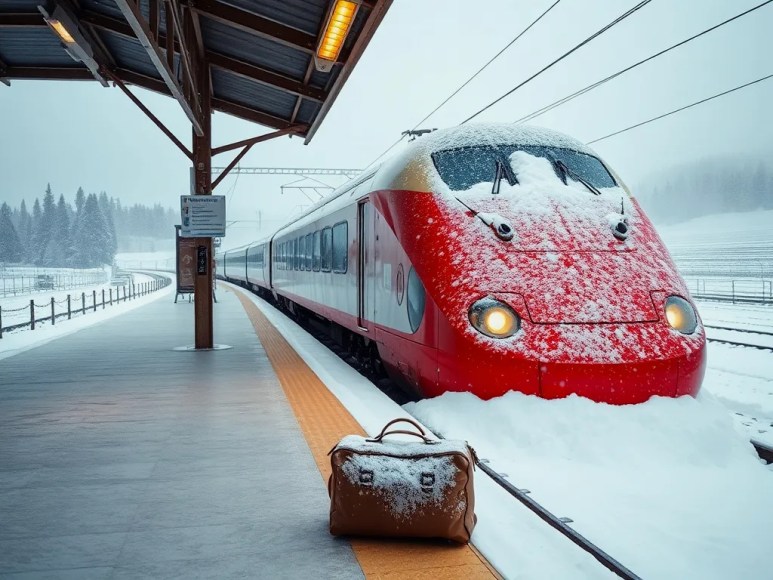
Heavy, wet snow knocked down trees along the Ou Line north of Fukushima, forcing JR East to suspend Yamagata Shinkansen operations between Yamagata and Shinjo for the remainder of 21 November. Crews prioritized clearing fallen timber and completing safety inspections of track, overhead line equipment, and signaling before any passenger trains could run. Regional services also faced restrictions: some local trains between Shinjo and Murayama were halted while limited services continued on Yamagata–Murayama.
Why operators paused all movement and how they assessed risk
JR East used a standard, active incident-control checklist: secure the scene, remove immediate hazards, inspect continuous welded rail for buckling, test overhead catenary tension, verify circuits and points, and track confirm no damage to bridges or tunnels. Teams applied portable thermal cameras to detect hidden stresses in switch heaters and used chain-saw crews to cut and remove trees section-by-section to avoid secondary rail damage. The company prioritized passenger safety over schedule recovery, which led to a full suspension rather than staged single-track operation.
22 November cancellations: Tsubasa 122 and 171 affected
Post-snow inspections continued early the next day and disrupted scheduled services on 22 November. Tsubasa 122 did not operate over Shinjo–Yamagata, and the early-morning Tsubasa 171 departing Yamagata at 06:59 was canceled. JR East warned that other Tokyo–Shinjo Yamagata Shinkansen runs could face delays due to ongoing checks along the mixed-traffic section and urged travelers to confirm train status before departing.
How common are winter disruptions on the Yamagata Shinkansen and the underlying causes
The Yamagata Shinkansen runs on a converted conventional alignment between Fukushima and Shinjo, exposing it to mountain weather and infrastructure vulnerabilities not found on purpose-built high-speed lines. Between fiscal years 2014 and 2022, prefectural analysis recorded more than 170 annual cancellations or delays on average, with roughly 40% traced to the Fukushima–Yonezawa mountainous section. Causes include heavy snow loading, fallen trees, slope failures, and animal incursions; Together these create a concentration of risk on older right-of-way with constrained drainage and limited avalanche protection.
Operational examples and step-by-step incident response that restored safe running
Typical step sequence JR East follows after a storm event:
1. Initial hazard mitigation: Patrol units confirm track obstructions and cordon off affected spans. Emergency crews remove large debris in short, manageable cuts to prevent track damage.
2. Detailed infrastructure checks: Track geometry cars or manual gage-and-tie checks detect rail deformation. Overhead line technicians measure catenary height and inspect pantograph sweep zones.
3. Systems verification: Signaling engineers test track circuits and axle counters; communications links are verified for dispatcher control.
4. Trial movements: A light engine or empty test train moves slowly over the cleared section to validate safe running before normal passenger services resume.
These steps can take hours or extend into days when extensive vegetation or slope stabilization is required.
Longer-term fixes under consideration: the Yonezawa Tunnel proposal
To reduce exposure to severe mountain weather, JR East and Yamagata Prefecture have evaluated a roughly 23-kilometer tunnel between Niwasaka and Yonezawa. Estimated at about 230 billion yen and with a projected construction span near 19 years, the tunnel aims to shorten travel time by more than 10 minutes on the Yamagata Shinkansen route and bypass the most weather-prone corridor. The project remains in study and environmental review phases; it would not cover the Yamagata–Shinjo stretch that closed during the 21–22 November event, though it would materially improve resilience on the Fukushima–Yonezawa segment.
Rolling stock and limits of vehicle-based mitigation
The E8 series joined the fleet in March 2024 to raise operational performance and comfort; In some corridors operators increased permitted speeds from 275 km/h to 300 km/h where track and signaling allow. Modern trains contribute to punctuality and passenger experience, but they cannot offset vulnerabilities rooted in aging infrastructure and exposed mountain alignments. Snowdrifts, fallen trees, and slope failures still require civil-engineering countermeasures, vegetation management, and drainage upgrades to materially reduce incident frequency.
Practical advice for travelers and contingency planning
If you must travel on routes that traverse exposed mountain segments in winter, apply these practical steps: check operator service notices within two hours before departure; allow extra time and flexible connections; book refundable or rebookable tickets; carry essential supplies (warm clothing, a power bank, water); and identify alternative ground transport corridors in advance. For rail planners, focus areas are improved slope protection (retaining structures and catch fences), increased vegetation-clearing cycles, enhanced early-warning meteorological sensors, and targeted tunnel investment where justified by risk and benefit analysis.
What the November suspension reveals about rail resilience
The 21–22 November interruption highlighted how mixed-traffic, converted lines remain more vulnerable than dedicated high-speed corridors. Quick, well-practiced incident response limited exposure and prevented injuries, but repeated seasonal disruptions point to a need for structural investment. The combination of operational procedures, better weather forecasting, and strategic civil works—like the proposed Yonezawa Tunnel—offers the clearest path to reducing future travel impacts while keeping safety central to recovery decisions.