
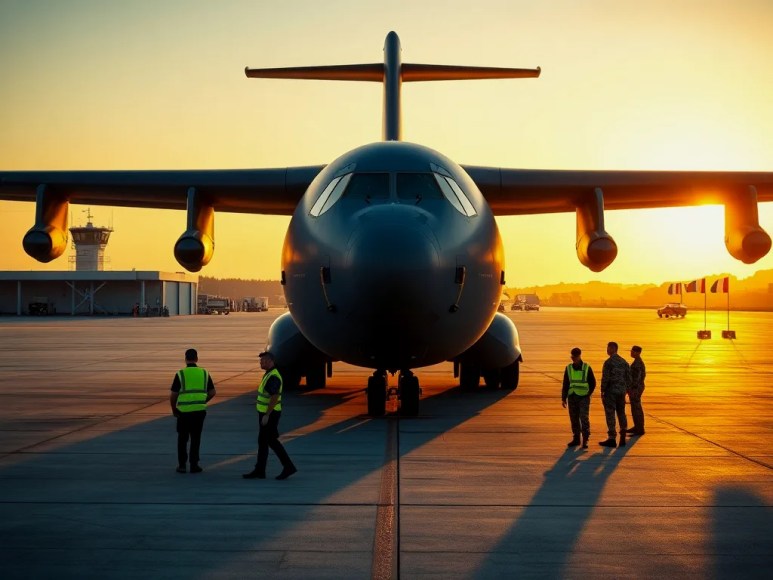
Airbus Defense and Space delivered the 27th A400M Atlas transport to the French Air and Space Force, reinforcing France’s tactical and strategic airlift capacity while the global A400M fleet surpassed 280,000 flight hours. The aircraft departed Airbus’s Sevilla final assembly line and arrived at Orléans-Bricy (BA 123), where it will join the 61st Transport Squadron to support personnel movement, equipment rotation and mission logistics across metropolitan and overseas theaters.
What this delivery changes for France’s airlift capability
The new A400M increases France’s operational flexibility by adding a platform that performs both short-field tactical insertions and long-range strategic transport France’s fleet now totals 27 A400Ms out of the 50 on order, giving planners more available lift for simultaneous missions: air-to-air refueling, medical evacuation with modular interiors, and heavy cargo moves such as armored vehicles or helicopter components.
Example: when a forward operating base requires rapid resupply on a short, rough runway, the A400M can land with a high payload and offload within minutes. Conversely, for transcontinental redeployments, the same aircraft can be configured with additional fuel tanks or perform air-to-air refueling to extend range without compromising cargo volume.
Why 280,000 fleet hours matters
Accumulating 280,000 flight hours demonstrates broad operational maturity and a wide mission set in varied climates and theaters. That milestone provides several concrete signals: supply chains have supported sustained operations, avionics and engines have accumulated reliability data for predictive maintenance, and crews across partner nations have standardized operating procedures that reduce sortie turnaround times.
Data point: at that scale, operators can analyze component life cycles statistically—allowing airlines and militaries to align depot maintenance windows and spares provisioning, which lowers unscheduled downtime and optimizes fleet availability.
How Orléans-Bricy will use the new A400M
Orléans-Bricy operates as a national hub for French strategic mobility. The 61st Transport Squadron will use this airframe for:
– Rapid personnel rotation: short-notice troop movement within mainland France and to overseas territories.
– Logistics sustainment: scheduled cargo lifts of spare parts, rations and fuel bladders.
– Aeromedical evacuation: modular litter systems convert cargo space to patient bays for casualty repatriation.
Operational example: during a humanitarian response, the A400M can deliver heavy engineering equipment to austere airstrips, then return as an aeromedical evacuation platform—reducing the number of different aircraft types required in theater.
Ongoing upgrades and new capabilities under development
Airbus and program partners continue to expand the A400M’s mission set. Recent agreements aim to add intelligence, surveillance and reconnaissance (ISR) kits to select aircraft, enabling them to conduct persistent oversight of ground operations while retaining their transport role. Additional capability lines under evaluation include electronic warfare suites, expanded aerial delivery options for unmanned systems, firefighting retrofit kits and higher payload configurations.
Step-by-step integration approach commonly used:
1. Requirements capture with operator stakeholders to define mission priorities.
2. Modular kit design to avoid intrusive structural changes.
3. Ground test and flight envelope validation with incremental certification milestones.
4. Fleet retrofit scheduling to minimize operational downtime.
How multinational procurement shaped the A400M program
The A400M is a pan-European program built around pooled production volumes and shared requirements. Major orders include Germany (53), France (50), Spain (27), the UK (22) and Turkey (10). That multinational base created economies of scale in development and sustainability but required harmonizing differing national mission sets—some prioritize tactical battlefield logistics, others strategic lift and refueling.
Result: common airframe architecture with nation-specific avionics, defensive aids and mission equipment, which allows partners to undertake joint operations while retaining national customizations.
Operational lessons and best practices from current A400M operations
Operators have refined procedures that improve sortie rates and reduce risk when operating from unprepared fields. Key practices include pre-deployment runway assessments, rapid on-site cargo rigging teams, and standardized palletization for fast load/unload cycles. Maintenance teams use condition-based monitoring fed by flight-data analytics to schedule component changes before failures occur—extending mean time between removals (MTBR) for critical parts.
Example maintenance workflow:
– Pre-flight data sync: download engine and systems logs.
– Predictive threshold check: compare trends against baseline fleets.
– Targeted intervention: replace or service items flagged as approaching limits during a single scheduled depot visit.
What to watch next for the A400M program
Key indicators of program momentum include additional orders from NATO or partner states, rollout of ISR and electronic warfare kits into operational squadrons, and advances in interoperability doctrine enabling pooled-lift tasking across allies. The French 27th delivery signals steady throughput from the assembly line and underscores ongoing investment in multirole mobility to meet diverse 21st-century mission demands.
Bottom line: The new A400M at Orléans-Bricy and the 280,000-hour fleet milestone both reflect a transport fleet moving from initial operational capability towards mature, multi-mission utility—supporting national and allied operations with a single, flexible platform.