
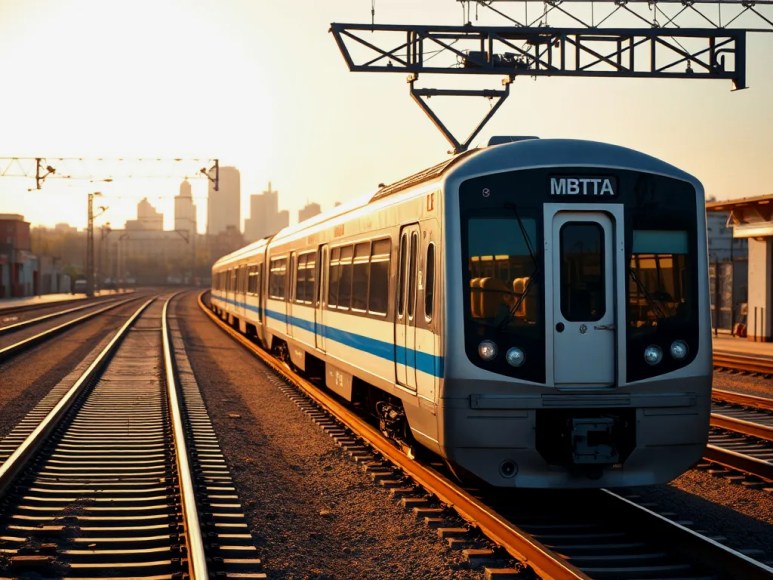
Massachusetts Bay Transportation Authority (MBTA) set a $687 million operating budget for its commuter rail in fiscal 2027, reflecting a strategic shift in renewal fleet and operator selection that will shape Boston-area regional rail service for years.
Commuter rail budget increase and what it buys
MBTA increased the commuter rail operating appropriation to $687 million for FY2027, a 14.7% rise over the prior budget and roughly $88.2 million more than FY2026’s authorized figure. That allocation represents 20.2% of MBTA’s estimated $3.4 billion operating budget and remains the agency’s second-largest expense after personnel. The raised funding covers day-to-day operations, maintenance, depot functions, and preparations tied to a change in operating contractor and the introduction of new locomotives.
Recent spending trends and budget pressures
Actual commuter rail spending has trended above initial budgets. MBTA reported roughly $621 million in commuter rail expenditures through October 2026, exceeding the $599 million plan by about $22 million. Fiscal 2025 expenditures were $581.4 million. These overruns highlight operational cost drivers—fuel, maintenance, crew overtime, and parts supply—that matter when evaluating competitive bids for a new operator and for structuring performance incentives and risk-sharing in the next contract.
Who’s competing to run commuter rail starting July 2027
MBTA shortlisted three consortia to succeed the current operator, Keolis Commuter Services, when its contract ends 30 June 2027. The finalists are:
Keolis–Alstom JV Partners: Keolis America teamed with Alstom Transport USA, combining operator experience with rolling-stock and systems capabilities.
Mass Regional Rail: Alternate Concepts, TransitAmerica Services and RATP Développement propose a blend of US regional-rail operations and European urban-rail know-how.
Transdev–Transport UK: Transdev North America paired with Transport UK Holdings brings global operator scale and practices to the bid.
The new contract will cover train operations, maintenance, depot management, and the launch of battery-electric services on the Fairmount Line. MBTA expects to select a preferred operator by late 2026 and present a recommendation to its board in December, with implementation starting 1 July 2027.
Siemens locomotives: specifications, role, and phased replacement
Separately from the operating concession, MBTA’s board awarded Siemens a contract worth about $310.4 million on 22 October 2026 for 20 locomotives. The order splits into 10 Tier 4-compliant diesel-electric locomotives and 10 dual-mode units that can operate from overhead catenary and onboard batteries. Contract options allow procurement of up to 50 additional units if funding and need align.
MBTA intends the new units to replace aging GP40 and F40-series locomotives. Dual-mode locomotives enable cleaner operation on electrified corridors and battery-powered movements in non-electrified or emissions-sensitive segments. The procurement improves fleet reliability, reduces per-mile maintenance costs by replacing end-of-life equipment, and advances lower-emission service goals without a full-system electrification up front.
Farebox recovery and the structural budget gap
Commuter rail fare revenues have climbed steadily: $80.8M (FY2022), $112.8M (FY2023), $133M (FY2024) and $145.2M (FY2025). Those receipts covered roughly 25% of FY2025 commuter rail operating costs (based on $581.4M outlays) but do not reflect other revenue sources or indirect subsidies. For FY2027 MBTA projects a structural gap of about $546 million across its entire budget. That shortfall attention focuses on federal/state grants, capital-to-operating transfers, and contract structures that can limit operating cost increases tied to a new operator or new rolling stock financing.
Operational implications of an operator transition
Switching operators affects labor integration, performance metrics, and transition risk. Practical steps MBTA and any incoming operator will need to implement include: 1) detailed staffing transition plans honoring collective-bargaining terms and ensuring crew availability; 2) maintenance knowledge transfer and parts inventory alignment to avoid service drops; 3) phased acceptance tests for Siemens locomotives and interface checks with MBTA signaling and depot equipment; and 4) contingency schedules to preserve peak-period capacity during cutover. Bidders typically price those transition activities and operational risk differently, so contract evaluation must weigh short-term transition costs against long-term performance and cost control.
How the Siemens locomotives and battery trains interact
The Siemens dual-mode locomotives and the Fairmount Line battery-electric multiple-unit (BEMU) plans complement each other. Dual-mode locomotives provide flexibility on mixed routes where catenary exists on only portions of the network or where battery ranges cover station-to-station moves. BEMUs on the Fairmount Line allow zero-emission operation without full corridor electrification. Coordinated deployment could: reduce diesel-only miles, lower station-area emissions, and simplify depot maintenance when charging infrastructure and battery-servicing facilities are centralized.
Metrics MBTA should monitor to judge success
To evaluate whether higher spending produces better service, MBTA should track a compact set of KPIs and publish them for transparency: on-time performance by line and peak/off-peak, mean distance between failures (MDBF) for locomotives and rolling stock, percentage of scheduled trips operated, customer complaints per 100,000 passenger trips, farebox recovery by service and ridership trends, and lifecycle cost per vehicle including energy and maintenance. Comparing these against pre-transition baselines will clarify whether the additional $687M is improving reliability and rider outcomes.
What riders and taxpayers can expect in the short term
In the coming 12–24 months expect phased actions rather than immediate service transformation: the operator procurement process will finalize, Siemens locomotive deliveries and acceptance testing will begin, depot modifications for battery charging will start where required, and trial battery-electric services on the Fairmount The line will roll out gradually. Riders should see targeted reliability improvements as new locomotives enter service, while full-network emissions benefits will accrue over a longer horizon as fleet renewal and battery fleets scale.
Bottom line: Fiscal 2027 marks a pivotal year for MBTA commuter rail—larger operating allocations, a competitive operator selection, and a significant Siemens locomotive purchase together position the system for improved reliability and lower emissions, but outcomes will hinge on contract terms, transition planning, and disciplined capital-to-operating alignment.