
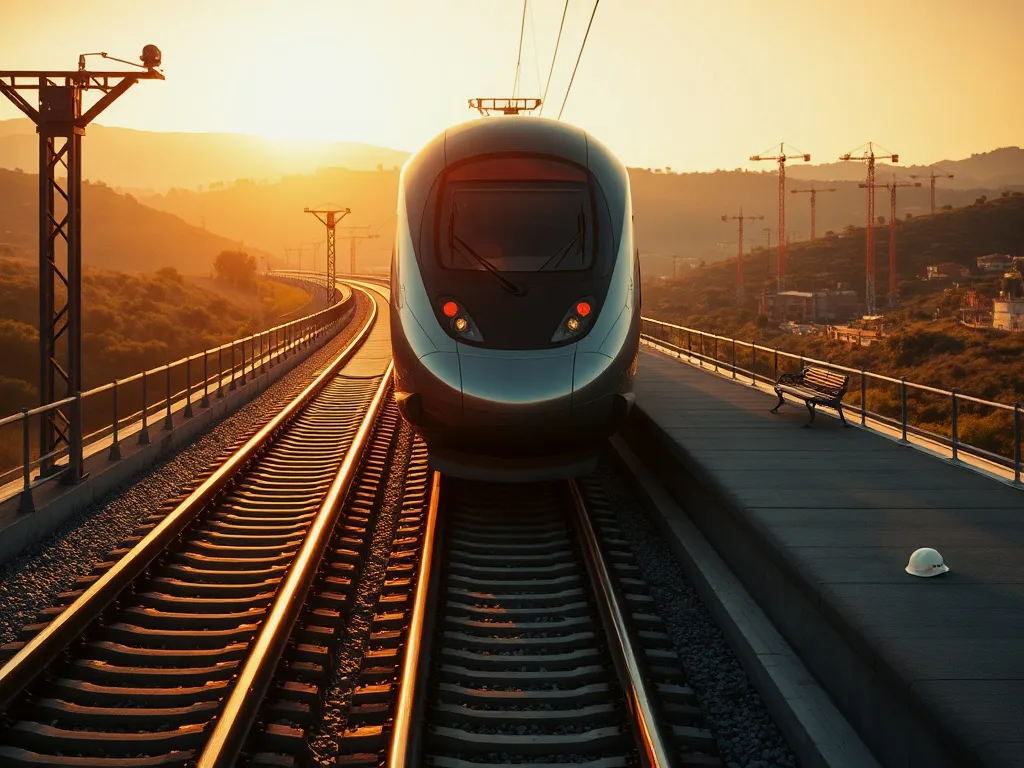
Bursa High-Speed Rail Project: 2012 Foundation to 2027 Service Target
The Bandırma–Bursa–Yenişehir–Osmaneli high-speed rail project began construction in December 2012 and has progressed through multiple revised completion targets. Authorities restarted momentum with full infrastructure and track works on the Osmaneli–Bursa section, moved into systems testing in late 2026, and now plan to begin passenger operations in the first half of 2027 once certification is complete.
How the Project Timeline Evolved — Key Milestones
Project scheduling aimed shifted several times: initial completion later for 2016, revised to 2021, then 2023, and again to 2025. The Osmaneli–Bursa segment was scheduled to finish by the end of 2026 and entered the test phase in 2026. Concrete milestones that matter now are completion of signaling and electrification acceptance, successful rolling-stock test runs under revenue-like conditions, and formal certification from national railway safety authorities.
What Tests Are Underway on the 106 km Osmaneli–Bursa Section
After finishing track, ballast, and overhead line works, test runs began across the 106-kilometer section. These tests include:
Sequential system verifications — powering the catenary and confirming voltage stability under load; validating interlockings and centralized traffic control interactions; and checking track geometry against planning tolerances.
Rolling-stock integration — running trains at incremental speeds to verify braking distances, pantograph behavior, and ride comfort at intended operating speeds for timetabling.
Communications and safety checks — end-to-end testing of GSM-R or ETCS-equivalent radio links, testing axle counters and track circuits, and performing failover drills for signal and power losses.
Example: Typical Test Sequence Before Passenger Service
Test programs often progress in phases that mirror the on-site activity:
1. Static acceptance — documentation review and component-level bench tests for equipment such as point machines, transformers, and signal cabinets.
2. Dynamic commissioning — low-speed runs to confirm alignment and vehicle-track interaction, increasing to line speed while collecting performance data.
3. Interface validation — integrated tests between train-borne systems and wayside systems, including emergency braking chains and passenger information systems.
4. Safety certification — completion of prescribed test matrices, anomaly resolution, and issuance of a safety verification report that permits commercial operations.
Expected Travel Times and Operational Benefits
When the line opens, timetable modeling projects travel times that significantly shorten intercity journeys: Istanbul–Bursa and Ankara–Bursa trips are expected to approach 2 hours 15 minutes under optimal service patterns. Intermediate travel-time reductions include Bursa–Bilecik in about 45 minutes, Bursa–Eskişehir in roughly 60 minutes, and Bursa–Konya in about 2 hours 50 minutes. Those times assume express services with limited intermediate stops and modern high-speed rolling stock operating at designed line speeds.
Bandırma Link and Remaining Workstreams
Construction toward Bandırma continues independently of the Osmaneli–Bursa test corridor. That western extension has carried a later target date (previously cited as 2028), and its completion will integrate the port and ferry connections at Bandırma into the high-speed network. Coordinating signaling standards, timetable interfaces, and depot access between segments remains essential to unlock full network benefits.
When Will Passengers Ride? Practical Opening Outlook
Authorities scheduled passenger services for the first half of 2027, contingent on final test results and formal certification. Practically this means: if the test campaign completes without major defects, the line can enter staged commercial operation within weeks of receiving approvals. Any significant systems nonconformity would extend the pre-revenue phase while corrective works and re-tests proceed.
What Travelers and Stakeholders Should Watch Next
Key indicators to monitor that determine the opening timeline:
• Completion and acceptance reports from signaling and electrification contractors that confirm no outstanding nonconformities.
• Independent safety authority sign-off — publication of the safety verification document opens the path to operations.
• Timetable and rolling-stock availability — confirmed trainsets, crew training completion, and published timetables indicate readiness for ticket sales.
Impacts Beyond Faster Travel: Economic and Modal Shifts
Once operational, the line will reshape regional connectivity: faster business day-return possibilities, stronger links between Bursa and national economic centers, and modal shift from road to rail for medium-distance trips. The Bandırma integration will also strengthen freight and ferry interchange potential, offering a resilient corridor for passengers and logistics between the Marmara coast and inland cities.
Quick Summary
The Osmaneli–Bursa section completed major works and entered testing in late 2026. Authorities aim to launch passenger services in the first half of 2027 pending final certification. Travel times to Ankara and Istanbul are projected near 2 hours 15 minutes, with staged integration to Bandırma continuing on a slightly later schedule.