
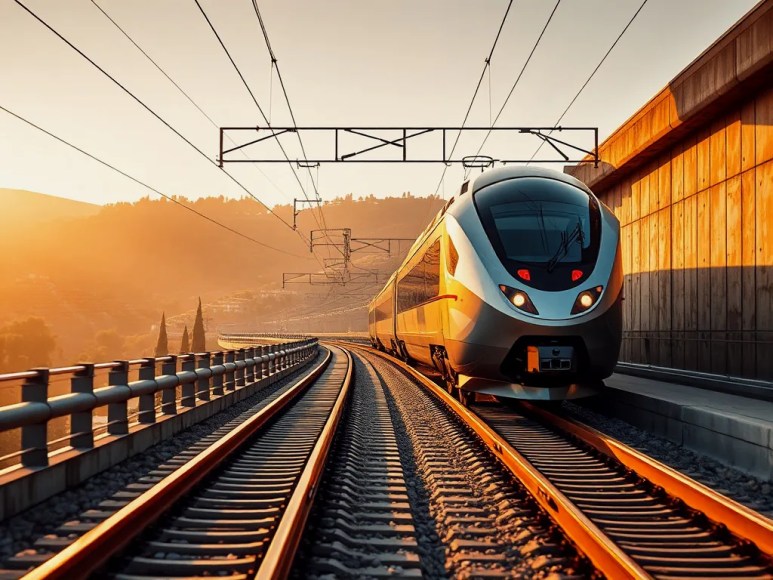
Portugal directs €736 million to rail investments in 2027 budget proposal
Portugal’s draft 2027 state budget channels €736 million to rail projects, up about 15% from the €639 million proposed for 2026. The increase concentrates mainly on the Northern International Corridor, while road investment allocations fall sharply from €229 million to €107 million. The government frames this reallocation as a move to modernize the national network and strengthen cross-border freight and passenger links.
Why the Northern International Corridor receives the bulk of funding
Infraestruturas de Portugal (IP) will see its annual allocation for the Northern International Corridor jump from €139 million in 2026 to €431 million in the 2027 proposal. That single reallocation makes up roughly 59% of the total rail envelope for 2027. The corridor funding covers track upgrades, signaling, border interoperability works and capacity increases meant to support higher axle loads and longer freight trains. The budget report lists the corridor’s total project scale at about €10.893 billion, but that figure describes program scope rather than one year’s spend.
How other rail programs change in the 2027 proposal
Not all rail lines gain in 2027. CP — Comboios de Portugal’s rolling stock and train investments fall from €212 million to €129 million. Funding for complementary corridors drops from €104 million to €68 million. The North–South Corridor declines slightly from €63 million to €61 million, while the Southern International Corridor edges up from €43 million to €44 million. Local systems see steeper cuts: Mondego Mobility System annual allocation falls from €18 million to €1 million and Metro Mondego vehicle investments from €9 million to €1 million. The draft also omits a distinct line-item for digitalization that previously showed €50 million for 2026.
Quick reference: headline investment figures for 2026 vs 2027 proposal
The budget documents present the following comparable items (values in million €):
Railway total: 2026 = 639 → 2027 proposal = 736
Northern International Corridor: 139 → 431
Complementary corridors: 104 → 68
North–South Corridor: 63 → 61
Southern International Corridor: 43 → 44
CP train investments: 212 → 129
Mondego Mobility System: 18 → 1
Metro Mondego vehicles: 9 → 1
Road investments: 229 → 107
What drives the large corridor increase and how it affects totals
Elevating the Northern International Corridor is a targeted strategic decision: improving terminal capacity, rectifying bottlenecks near border nodes, and enabling higher‑speed freight flows. However, the net transfer does not expand the combined transport budget — total rail plus road investment falls slightly from €868 million in 2026 to €843 million in the 2027 proposal. In short, the rail uptick largely comes at the expense of road works and selected regional rail programs rather than growing the overall envelope.
Lisbon–Porto high‑speed line: construction and timeline details
Work on the first concession segment linking Porto‑Campanhã to Oiã began on 12 October 2026. That section comprises roughly 71 km of new high‑speed infrastructure with a targeted completion in 2030. The second stretch, Oiã–Soure (~61 km), returned to tender in early 2026. When the full corridor opens, the stated objective is to cut Lisbon–Porto travel time to about 1 hour 15 minutes — a project target rather than an in‑service guarantee. The budget also assigns roughly €440 million in 2027 to the high-speed line, a third Tagus crossing, and rail access to a new airport; these items may overlap with other program totals and should not be double counted against the €736 million rail total.
Public‑private partnership (PPP) payments rise to €312 million in 2027
The draft separates PPP obligations from capital investment appropriations. It specifies €312 million for PPP payments in 2027 versus €190 million in 2026, covering commitments such as Metro Sul do Tejo, Metro do Porto, the Lisbon–Porto high‑speed concession and Fertagus. These payments reflect contractual service and financing liabilities rather than direct new‑build cash outlays. Projections in the government’s multi‑year table show PPP flows declining to €228 million in 2028 and €41 million in 2029 before rising again in later years.
Road investment reduction and immediate implications
Road allocations fall by approximately 53% year‑on‑year, from €229 million to €107 million. The report points to ongoing reconstruction from storm damage in early 2026 and a focus on completing urgent repairs and priority projects. The dramatic reduction suggests the government prioritizes rail modernization and cross-border connectivity over additional road expansion in 2027.
How the draft budget affects project sequencing and procurement
Shifting funds into the Northern International Corridor accelerates procurement for large civil works, signaling upgrades and international interoperability contracts. Expect procurement timelines to compress for corridor tenders and increased pre‑qualification activity among rail civil engineering firms. Conversely, smaller local systems and domestic rolling stock programs may face delayed tenders, reduced fleet renewal cadence and rephased maintenance schedules unless restores or reallocates funds during budget debates.
Key questions people ask — concise answers
Q: Is €736 million the final approved amount of parliament?
A: No. It is the government’s proposal; the final figure depends on parliamentary amendments and the 24 November 2026 vote.
Q: Will the Northern corridor funding speed international freight?
A: Yes. The upgrades target capacity, interoperability and axle‑load increases that facilitate longer, heavier freight trains and faster cross-border services.
Q: Do PPP payments fund construction?
A: PPP payments mainly cover contracted service and financing liabilities linked to past and ongoing concessions; they are not identical to direct capital appropriations for new constructions.
What to watch as the budget moves through parliament
Monitor three items closely: (1) amendments reallocating funds back into rolling stock and complementary corridors; (2) any restoration of digitalization funding that disappeared from the 2027 line items; (3) reconciliation of the €440 million high‑speed/Tagus/airport items with the €736 million rail total to avoid double counting. The parliamentary process on 24 November 2026 will determine whether the government’s strategic tilt toward corridor modernization becomes law or is rebalanced.
Bottom line for operators, shippers and regional authorities
Operators should accelerate capability planning for large corridor works and prepare for intensified procurement windows. Shippers can anticipate improved corridor capacity long‑term but should plan for phased delivery and transitional network constraints during works. Regional authorities facing funding cuts must prioritize essential maintenance and explore alternative financing, including EU funds and targeted PPPs, to avoid service deterioration while national-level corridor projects advance.