
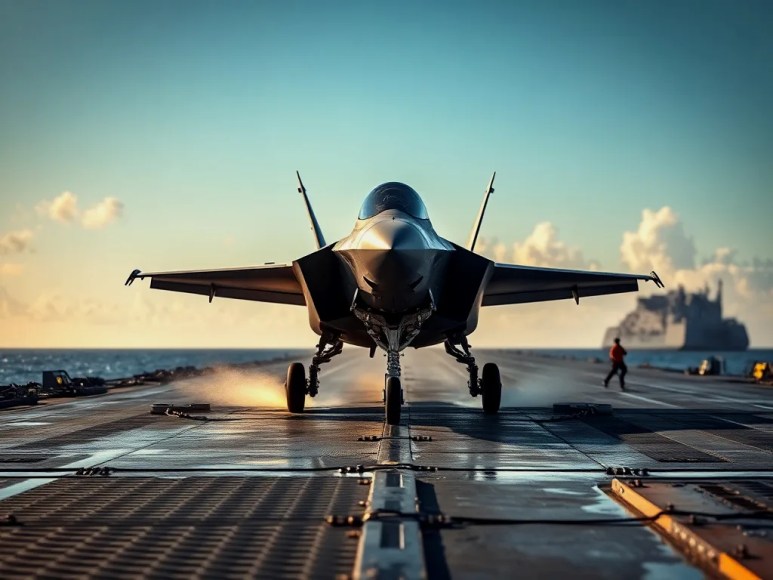
F-35C carrier compatibility trials conclude aboard USS John F. Kennedy
Two F-35C Lightning II jets completed an 11-day compatibility campaign aboard the Ford-class carrier USS John F. Kennedy, conducting 34 flights, 122 catapult launches and 122 arrested recoveries to validate operations with the ship’s EMALS and AAG systems. Test engineers performance envelopes for launches and recoveries, flight-deck handling, and integrated systems behavior recorded under representative operational cycles.
How and when the first arrested landing occurred
On 13 October 2026, technicians aboard the Kennedy achieved the first arrested landing by an F-35C on a Ford-class deck. VX-23 test pilots executed the approach using standard carrier-landing profiles while shipboard operators monitored AAG engagement timing, arresting gear forces, hook dynamics and energy absorption. The next day the jets completed the first EMALS-assisted catapult launches, which logged launch acceleration curves, shuttle speed profiles and aircraft pitch/trim responses at launch.
What EMALS and AAG testing measured
EMALS tests captured continuous engine current, shuttle traction, and applied thrust-to-weight ratios across repeated cycles to ensure the system supplies precise, repeatable acceleration for the F-35C’s mass and required takeoff speed. AAG evaluations focused on engagement timing, arresting cable peak loads, block travel distance and residual kinetic energy. Engineers cross-referenced these telemetry streams with aircraft flight-data recorders to identify interface margins and to verify arresting hook loads stayed within structural limits.
Why Ford-class deck layout changes matter for F-35C operations
The Kennedy’s island is smaller and positioned farther than on Nimitz-class carriers, changing airflow, exhaust dispersion and deck-taxi paths. Test teams mapped new taxi lanes, blast-effect zones and parked-jet clearances. They measured thermal and particulate exposures near F-35C exhaust plumes and adjusted deck-handling procedures to protect sensors and maintenance equipment. Results produced revised deck-park arrangements and movement routes that reduce foreign-object-debris risk and speed sortie generation under carrier-air-wing tempo.
Which ground tests prepared the at-sea trials
Prior to sea trials, Lockheed Martin conducted land-based EMALS/AAG integration runs and structural load tests between January 2024 and May 2025. These tests exercised launch acceleration profiles, arresting-hook engagement cycles, and software command-and-control logic. Ground rigs simulated arresting loads across multiple approach angles and touchdown speeds to refine arresting gear dumping characteristics and to instrument failure-mode scenarios so technicians could confirm safe abort thresholds.
What data feed into carrier procedures and safety limits
Flight and shipboard telemetry fed into updated carrier launch-and-recovery manuals. Analysts used time-aligned data sets — including shuttle position, motor torque, arresting gear tension, airspeed at engagement, and hook position — to define safe operating envelopes and standard operating procedures (SOPs). The outputs include recommended approach speed windows, arresting-gear maintenance intervals, and launch-case contingencies for anomalous engine or shuttle inputs.
Remaining steps before full operational deployment
While compatibility testing validates core launch and recovery mechanics, achieving full operational capability requires completing shipboard maintenance arrangements, supply-chain logistics, specialized tooling stowage, ordnance handling procedures and crew certifications. Shore-based depot support must validate spare-part kits and toe-in fixtures for AAG components. The Navy will follow with unit-level certification events and integrated air-wing workups to verify sustained sortie rates and wartime damage-response procedures.
Delivery timeline and program context
The Kennedy incorporates design changes specified in earlier contracts to host fifth-generation fighters. The Navy plans to accept delivery in spring 2027, subject to completion of remaining sea trials and administrative certifications. Acceptance will mark a milestone, but operational deployment of F-35C squadrons aboard the ship will follow phased training and logistics support upgrades.
Why these trials mark an important integration milestone
Testing demonstrates that F-35C arresting and launch interfaces operate within predicted tolerances on Ford-class systems, completing a critical technical validation for future carrier deployments. The combined ground and at-sea campaign produced engineering data, refined procedures and documented safety margins necessary for the Navy to plan ship-specific modifications, training syllabi and sustained operations with the F-35C air wing.