
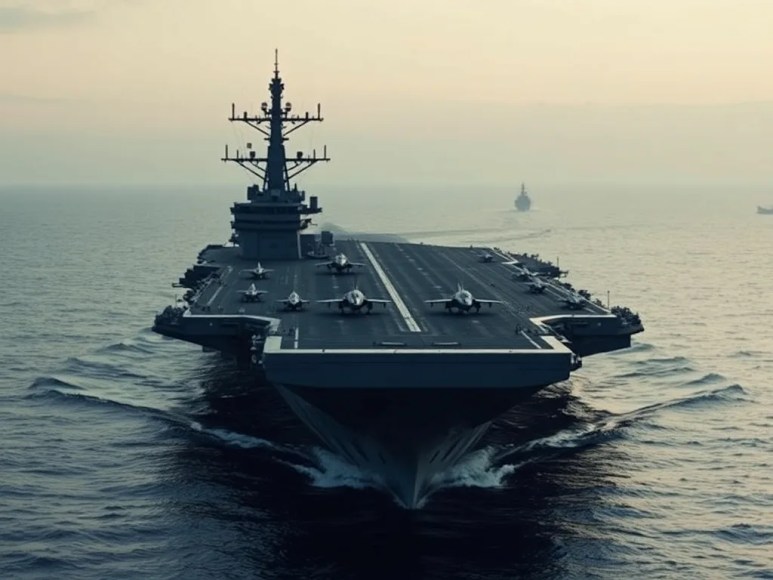
Overview of Type 004 Construction Progress
Shipyards in Dalian continue active construction of China’s first planned nuclear-powered aircraft carrier, the Type 004, with assembly progressing toward a projected 2027 launch. Satellite analyzes indicate the hull has reached roughly 322 meters in length and 46 meters in beam as of October 2026, putting the ship into the size class of contemporary US supercarriers. Current imagery and open-source tracking point to an accelerated modular build approach, where pre-outfitted blocks are joined on a large slipway to shorten deck-to-launch timelines.
Hull Dimensions and What They Mean Operationally
A 322 m by 46 m hull supports flight deck real estate and expanded internal volume for aviation fuel, ordnance, maintenance shops, and crew accommodations. Practically, this lets the carrier sustain higher sortie rates and longer deployments without port calls. For example, a broader flight deck accommodates more simultaneous launch and recovery cycles, reducing deck bottlenecks during high-tempo air operations and enabling continuous air patrol rotations over distant maritime areas.
Nuclear Propulsion: Range, Endurance, and Logistics
Nuclear reactors free the Type 004 from conventional fuel limitations, increasing operational endurance from weeks to many months between replenishments for propulsion. That endurance translates into strategic flexibility: carriers can hold on-station longer during crises, reposition faster without fuel concerns, and reduce dependence on distant tanker escorts. In practice, nuclear propulsion also decreases the logistics tail for fuel but places higher emphasis on specialized maintenance, trained nuclear technicians, and secure reactor-support supply chains.
Electromagnetic Aircraft Launch System (EMALS) and Air Wing Capacity
Type 004 is expected to use electromagnetic catapult launchers rather than steam-driven systems. EMALS offers finer launch power control across aircraft weights, improving sortie generation for both heavy and light platforms and reducing airframe stress. Analysts estimate the carrier could support up to 100 aircraft—mixing fixed-wing fighters, airborne early warning planes, and helicopters—though final air wing composition will depend on doctrine, available aircraft models, and sortie rate goals.
Deployment Timeline and Path to Full Operational Capability
Even after a 2027 launching, full operational capability will likely require phased trials: sea trials for hull and propulsion systems, EMALS and arresting gear integration tests, air wing carrier qualifications, and nuclear safety certifications. Experts estimate a 5–10 year window from launch to declared full readiness, as crews and aviators build carrier qualifications and maintenance routines. This staged approach mirrors other navies’ paths where operational maturity depends as much on personnel training and logistics networks as on delivered hardware.
Strategic Impact on Regional and Global Naval Balance
A nuclear-powered Type 004 improves China’s ability to sustain long-range carrier strike presence, reinforcing blue-water operations across the Western Pacific and beyond. The carrier’s endurance and larger air wing enlarge options for power projection, maritime domain awareness, and integrated task force operations with escort surface combatants and submarines. Regionally, this shifts the balance by increasing China’s capacity for sustained surge deployments, extended patrol rotations, and a persistent deterrent posture in contested sea lanes.
Technical and Operational Uncertainties to Watch
Key unknowns remain: exact reactor design and output, EMALS performance under Chinese operational tempos, precise aircraft mix, and the carrier’s integration into existing command-and-control and logistics networks. Each of these variables affects sortie-generation rates, maintenance cycles, and the carrier’s survivability in high-end conflict scenarios. Monitoring official certifications, carrier strike group drills, and aviation carrier qualifications will illuminate actual capabilities over time.
Examples and Comparable Benchmarks
For context, US Nimitz-class and Ford-class carriers provide benchmarks: they displace around 100,000 tons, support similar air wing sizes, and rely on nuclear propulsion and advanced launch systems. If Type 004 approaches these parameters, it will likely require comparable tendering and escort formations—destroyers, frigates, supply vessels, and submarines—to secure sea lines of communication and provide layered air and missile defense.
Operational Recommendations and Anticipated Roles
Projected roles for Type 004 include power projection, carrier strike group leadership, maritime security patrols, and support for humanitarian assistance and disaster relief during extended deployments. To maximize effectiveness, commanders will need to prioritize integrated training cycles for carrier-qualified pilots, develop robust at-sea replenishment procedures for aviation munitions and spare parts, and establish nuclear-support maintenance nodes.
What to Monitor Next
Watch for indicators that reveal capability maturation: sea trials that demonstrate EMALS and arresting gear reliability, public carrier qualifications of fixed-wing naval aviators, official disclosures about reactor type or output, and escorted task group sailings beyond regional waters. Each milestone narrows the gap between projected potential and implemented operational capacity.