
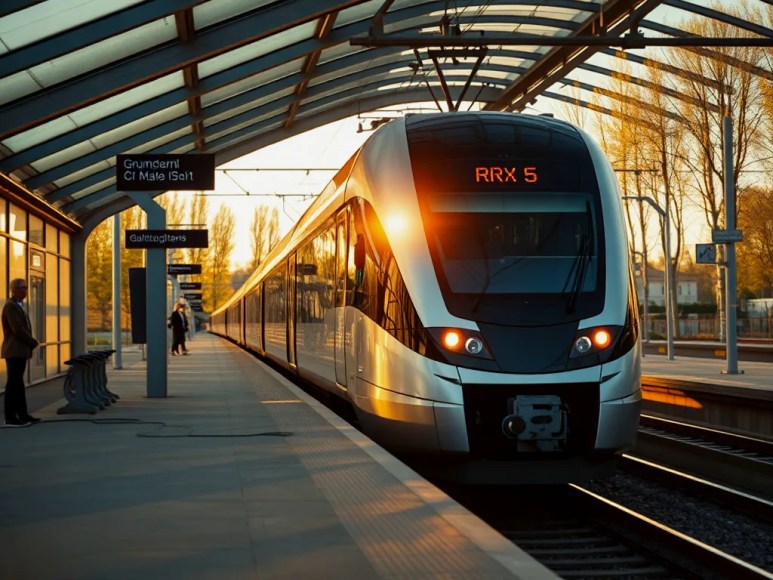
KfW IPEX-Bank and EIB finance the RRX B fleet renewal
KfW IPEX-Bank provides a loan exceeding €300 million to fund procurement of 50 trains for the Rhine-Ruhr Express (RRX) B sub-network in North Rhine-Westphalia. The European Investment Bank (EIB) completes the package with a €225 million financing agreement, while the total project cost sits at approximately €960 million. These public-backed loans reduce upfront capital strain on operators and enable bulk discount procurements, standardized maintenance planning, and long-term depot upgrades aligned with the new fleet.
Which operators receive which trains and why these models were chosen
DB Regio will receive 34 four-car Hitachi Rail Eurocaravaggio trains, each offering around 370 seats. The Eurocaravaggio platform emphasizes high-capacity regional commuting with fast door cycles and energy-efficient traction systems, making it suitable for dense corridor services that require quick dwell times.
WestfalenBahn will take delivery of 16 six-car Stadler KISS MIX trains, configured for roughly 630 seats. The KISS double-deck design maximizes per-train capacity and is chosen for longer, high-demand runs on the RRX network where platform and depot infrastructure support taller stock.
How the new trains boost capacity and passenger experience
Deploying 50 modern trains raises seating capacity across the RRX B routes and allows operators to increase peak frequency without procuring additional train paths. Expected tangible benefits include:
• Higher peak throughput: Larger train sets and more vehicles scheduled during rush hours reduce overcrowding.
• Faster boarding: Multi-door layouts and level floor access shorten station dwell times, improving punctuality.
• Energy and life-cycle savings: New traction systems, regenerative braking, and lightweight materials lower energy use and maintenance costs over ~30 years of forecast service life.
Service rollout: contracts, start dates and contract lengths
New operating contracts are staged to align with fleet delivery and training. For the RRX lines:
• RE 2, RE 42, RE 45: Service under the new contracts begins in December 2031.
• RE 3, RE 7: New operations start in December 2032.
Each contract runs through December 2046, giving operators a stable horizon for revenue planning and allowing amortization of vehicle procurement and depot upgrades.
Ownership, lifecycle planning and maintenance strategy
The trains will transfer into the ownership of regional transport authorities, which commonly allows centralized asset management across multiple operators. Authorities expect roughly 30 years of service from each vehicle. To protect long-term reliability, procurement contracts include:
• Spare parts agreements: Frameworks with Hitachi Rail and Stadler to guarantee parts availability and predictable pricing.
• Technical support and training: On-site support during early operations, plus structured knowledge transfer and certified training for local maintenance staff.
• Condition-based maintenance: Modern trains come with diagnostic systems that enable predictive interventions, reducing unplanned downtime and lowering life-cycle costs.
Operational examples and expected system impacts
Example scenario: replacing older regional sets on RE 2 with Eurocaravaggios allows operators to increase rush-hour seating capacity by an estimated 25–35% without changing timetable slots. On longer RE 3/RE 7 runs, KISS MIX six-car sets provide continuous high-capacity options, lowering per-passenger energy consumption and enabling better passenger distribution across carriages.
Implementation steps operators will follow
To integrate the fleet successfully, operators and authorities will typically follow a phased implementation plan:
1. Delivery and acceptance testing: Factory and in-country tests, including ETCS/PRM compliance checks.
2. Staff training and driver certification: Route familiarization and simulator sessions, followed by supervised in-service runs.
3. Depot upgrades and spares stocking: Adjust platform interfaces, lifting equipment, and inventory of fast-moving spares.
4. Timetable adjustments and gradual capacity ramp-up: Introduce new trains in off-peak slots, then expand to peak services as reliability is confirmed.
What passengers and regional planners should expect next
Passengers should notice steadily improving capacity, punctuality, and onboard comfort as the new trains enter service. Regional planners can use the procurement and financing model as a template for future fleet renewals: combine multilateral bank financing with public ownership of rolling stock to spread cost, optimize maintenance procurement, and coordinate capacity upgrades across a metropolitan rail network.