
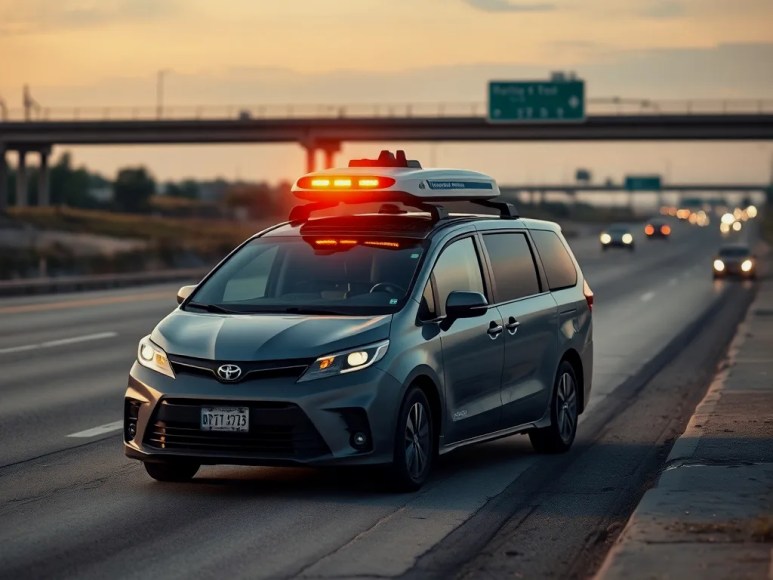
Waymo halts highway robotaxi operations across the US after California ban
Waymo, Alphabet’s autonomous-vehicle unit, suspended its highway robotaxi services nationwide after the California Department of Motor Vehicles (DMV) imposed an immediate ban on autonomous highway operations on 11 November 2026. California regulators said repeated observations — including autonomous vehicles entering active road-construction zones and attempting maneuvers near controlled police operations — created an “immediate threat” to public safety. Following the DMV order, Waymo paused highway driving in other states to re-evaluate system performance and safety controls while continuing city street services where it already operates.
What happened: construction-zone intrusions and risky highway maneuvers
On 5 November, three Waymo vehicles entered an active construction zone on US-101 near Burlingame, California. Officials said those injuries exposed road workers, equipment, and other motorists to significant hazard even though no collisions or injuries occurred. The very next day, social media footage showed a Waymo vehicle on I-280 attempting to pass a California Highway Patrol vehicle that was deliberately slowing traffic through a controlled enforcement or incident area. That footage reigned concerns about how autonomous systems interpret temporary traffic control, police presence, and atypical lane closures.
Why California acted and what the DMV requires
The California DMV framed its order as a temporary prohibition on testing and commercial autonomous operations on state highways until Waymo demonstrates that it has implemented effective corrective measures. The DMV’s requirements include documented system changes, robust safety validation under real-world edge conditions (construction zones, emergency vehicle interactions, temporary signage), and independent verification that software and behavioral models no longer place public safety at undue risk. The ban took effect on 11 November and remains until regulators accept Waymo’s remediation evidence.
How Waymo responded and why it paused other highway operations
Waymo confirmed the California incidents produced no collisions or injuries but said it would pause highway operations beyond California to perform a comprehensive review of its highway-stack behavior. The company emphasized that the pause covers only highways; Its city-driving robotaxi services continue in permitted areas. Waymo cited the need to analyze edge-case behaviors, improve perception and decision layers for temporary and atypical scenarios, and update fleet-wide safety rules before resuming highway driving.
Technical root causes under scrutiny
Engineers and safety inspectors focus on several likely technical contributors:
1) Perception and temporary object handling: Lidar, radar, and camera fusion can detect construction equipment and cones but can struggle to reliably classify and localize Transient markings, temporary barriers, or partially occluded workers when lane geometry changes suddenly.
2) Behavior and policy models: Rule-based or learned driving policies must decide whether to follow default lane-center trajectories or yield to temporary controls. Systems trained primarily on stable road geometry often fail to generalize to short-lived, human-directed traffic patterns.
3) Emergency-vehicle and officer interaction logic: Autonomous stacks sometimes lack explicit heuristics for novel police maneuvers or for recognizing when law enforcement intentionally slows traffic; Absent clear priorities, the vehicle may attempt unsafe passing or lane changes.
4) Human-in-the-loop monitoring and escalation: Remote operators or fallback systems must recognize when automated decisions could create hazards and intervene promptly. Delays in remote intervention or ambiguous operator authority can amplify risk.
Practical steps Waymo and regulators can take — a step-by-step remediation roadmap
Below is a pragmatic sequence of actions that Waymo could document and execute to satisfy regulators and reduce recurrence risk:
Step 1 — Incident forensics: collect comprehensive sensor logs, decision traces, and operator communications for each event; Reproduce scenarios in simulation and closed courses.
Step 2 — Scenario expansion: augment training and validation datasets with synthetic and recorded examples of construction zones, temporary signage, and police-directed traffic patterns across varied lighting and weather conditions.
Step 3 — Perception improvements: refine fusion algorithms to better detect and classify temporary infrastructure and workers; add conservative spatial uncertainty estimates that increase safety margins near ambiguous cues.
Step 4 — Behavior-policy updates: implement explicit fallbacks for temporary-control scenarios — for example, plan slower traversals, increased following distances, and mandatory pulls-to-safe-shoulder when instructed by officers or when lane markings conflict.
Step 5 — Human oversight protocols: tighten remote-operator engagement rules, reduce allowable time-to-intervene thresholds, and conduct targeted operator training for atypical highway events.
Step 6 — Validation and independent review: demonstrate fixes in instrumented closed-course tests and randomized real-world pilots monitored by independent safety auditors; publish objective performance metrics showing reduced intervention rates and near-miss frequency in targeted scenarios.
Step 7 — Regulatory submission and phased reintroduction: submit documentation and test results to DMV, agree on phased highway reintroduction with specific acceptance criteria and ongoing monitoring.
Impact on passengers, partners, and local services
Passengers using Waymo’s services should expect unchanged city rides where permitted, but highway trips — intercity pickups or routes that rely on freeway segments — may pause or require human-driven handoffs Logistics and local partners who depend on predictable highway robotaxi availability will need contingency plans: alternate routing, human drivers for highway legs, or scheduling windows aligned with Waymo’s phased reintroduction. Local agencies may also adjust permitting and inspection regimes for autonomous testing after seeing how quickly regulators move from investigation to prohibition.
How this fits into the broader autonomous-vehicle landscape
The California action follows earlier pauses and reviews across the industry whenever autonomous systems encounter rare but high-consequence edge cases. For example, Waymo itself paused highway operations in May 2026 after similar concerns and resumed only after targeted updates. This pattern highlights a systemic challenge: fielding large fleets amplifies exposure to low-probability events, and regulators now expect demonstrable evidence that fleets can handle temporary, human-directed, and emergency scenarios reliably before allowing full highway autonomy.
What to watch next — signs regulators will lift restrictions
Regulators will likely lift the ban only after receiving documented evidence of technical fixes, successful independent validation, and consistent real-world performance over a predefined trial period. Key indicators include:
– Third-party audit reports showing scenario-specific failure-rate reductions.
– Published metrics on reduced police-related interventions and construction-zone incursions.
– A clear, automated prioritization policy for emergency and officer-led traffic control.
– A staged restart plan with continuous reporting requirements and on-road monitoring.
Bottom line: safety-first highway reintroduction is the path forward
Waymo’s nationwide highway pause reflects an industry inflection point: companies must prove robust handling of transient, human-directed highway conditions before resuming large-scale automated freeway operations. Executing a focused remediation roadmap, validating through independent tests, and agreeing clear regulatory milestones will determine how quickly Waymo restores freeway robotaxi service.