
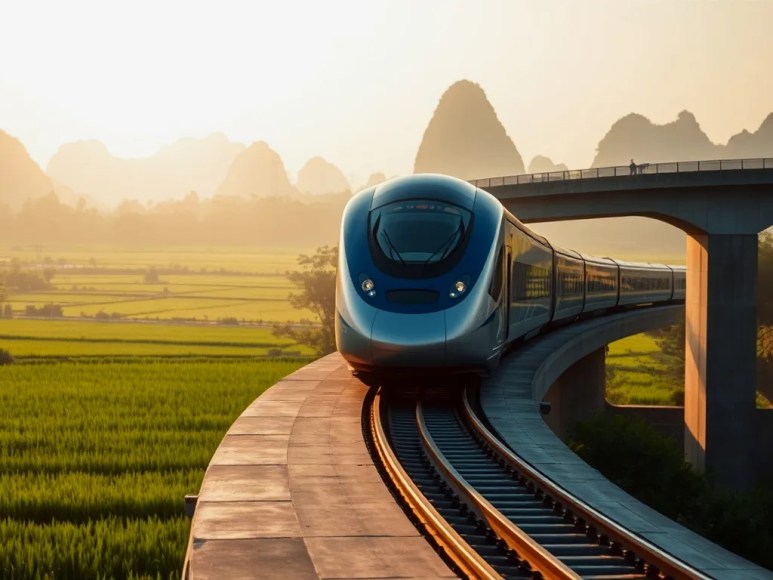
Project overview and contract scope
The 1,541-kilometer North–South High-Speed Rail project in Vietnam has moved into the consultancy phase after signing the TV-02 advisory contract, valued at more than 10.24 trillion Vietnamese dong. The 30-month engagement charges the consortium with route surveys, feasibility studies, preliminary design, and preparation of tender documents that will guide investment decisions and the procurement process.
Who is in the consortium and what each partner contributes
A multinational consortium led by French engineering firm SYSTRA will deliver the work. South Korean partners SAMBO, Yooshin and KNR bring track alignment design, systems integration and methodology construction skills. Vietnamese firms TEDI, TEDI SOUTH, TRICC and Hoang Long supply local know-how: permitting, right-of-way coordination, geotechnical data, and liaison with national authorities. This mix combines international high-speed rail experience with on-the-ground execution capability, and the contract explicitly assigns roles so technology transfer and capacity-building are measurable deliverables.
Design speed, technical parameters and implications
The line will be designed for a maximum operating speed of 350 km/h. Designing for this speed affects alignment, superelevation, curve radii, gradient limits, and track structure choices (slab track versus ballasted track). Key technical implications include:
Alignment and geometry: longer horizontal curve radii to maintain passenger comfort at high speeds; reduced gradients where possible to limit traction power requirements.
Infrastructure: higher-standard bridges and viaducts to control dynamic loads, and longer tunnels with cross-passages and ventilation designed to high-speed safety standards.
Systems: advanced signaling (likely ETCS-level equivalents), continuous welded rail, dedicated high-speed electrification systems, and specialized depot and workshop designs to service 350 km/h rolling stock.
Step-by-step consultancy deliverables and timeline
The 30-month assignment follows a clear sequence of work packages that align with international practice and Vietnamese procurement cycles:
Months 0–6 — Route and baseline studies: collect topographic, geotechnical, environmental and land-use data; identify corridor options; hold stakeholder consultations with provincial authorities.
Months 6–14 — Feasibility and concept design: compare corridor options using multi-criteria analysis (cost, social impact, construction complexity); produce ridership and demand forecasts under scenario ranges; Perform preliminary cost estimates and risk registers.
Months 14–22 — Preliminary design and systems definition: define track geometry, major civil works list, tunnel and bridge concepts, and systems architecture (traction power, signaling, communications). Produce refined cost-benefit analysis and environmental and social impact assessment outlines.
Months 22–30 — Finalization and procurement documents: prepare tender-ready technical specifications, bill of quantities, contract packaging strategy, and evaluation criteria for bidders. Deliver training workshops and knowledge-transfer sessions for Vietnamese engineers to ensure continuity into the implementation phase.
How the work supports investment decisions and risk management
Consultancy outputs create the evidence base for government and development-finance decisions. Feasibility reports will quantify expected capital and lifecycle costs, forecast benefits (travel time savings, modal shift from road/air), and present sensitivity analyzes for demand, inflation, and financing costs. A clear risk register will identify high-risk items—land acquisition delays, geotechnical surprises, and funding gaps—and propose mitigation measures and contractual allocation strategies that investors and lenders require.
Local capacity development and technology transfer
The contract embeds capacity-building tasks: secondment of local engineers into design teams, formal training modules on high-speed systems design, and supervised participation in site survey and geotechnical investigations. Hoang Long, with prior tunnel and highway experience, will gain direct exposure to high-speed rail standards, enabling Vietnam to retain in-country competencies for operation and future extensions.
Economic, social and environmental considerations
Economic modeling in the feasibility phase will evaluate not only direct rail revenues but also wider economic impacts: regional integration, industrial corridor development, and property-value uplift near stations. Social assessments will map resettlement needs and propose compensation frameworks aligned with international good practice. Environmental work will include biodiversity baseline surveys, noise and vibration assessment for communities along alignments, and mitigation designs (noise barriers, track forms, and habitat connectivity measures).
Practical examples and precedent comparisons
Design choices will likely reference comparable projects: alignment selection lessons from China’s 350 km/h lines to balance construction cost and travel time; signaling and procurement approaches from European projects to ensure interoperability and competitive supplier markets; and financing structures used in recent Southeast Asian rail projects that combined public funding with multilateral loans and private-sector participation for station-area development.
What to expect next and decision points for stakeholders
Over the next 30 months stakeholders should expect staged deliverables, public disclosure of corridor options, and targeted consultations where resettlement or environmental impacts are significant. Critical decision points will include approval corridor selection, financing package, and whether to phase construction. Early alignment on procurement packaging (single turnkey versus segmented contracts) will shape market interest and price discovery during tendering.
Key takeaways for policymakers and practitioners
Completing robust feasibility and tender-ready documents within 30 months sets the project up to enter procurement and financing negotiations with lenders. The consortium’s multinational composition provides technical breadth while the inclusion of Vietnamese firms secures local implementation capacity and mandated technology transfer. Designing for 350 km/h drives specific engineering and systems choices that will dominate cost structures and operations planning; managing those choices with transparent risk allocation will be essential to attract sustainable investment.
Be the first to comment