
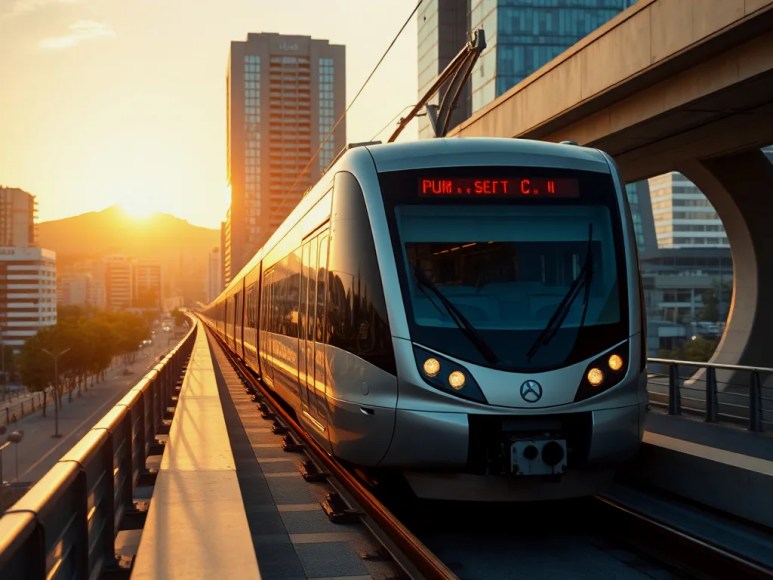
Ankara’s 2027 budget includes four targeted rail projects that expand airport access, improve cross-city connectivity, and serve major institutional hubs. Each project focuses on capacity, speed, and multimodal interchange to reduce travel times and shift trips from road to rail.
Esenboğa Airport Metro
The Esenboğa Airport Metro will link Ankara YHT Terminal, Siteler, Pursaklar and Esenboğa Airport with a continuous rail corridor. Planners prioritize direct airport access to cut transfer times for rail passengers arriving on high-speed trains and long-distance buses. Expected operational outcomes include a reduction in car and taxi trips to the airport during peak hours, a more predictable journey time for travelers, and improved freight and service access to the Siteler industrial area.
Key delivery elements:
Route design: A mixed elevated and tunneled alignment minimizes land acquisition and preserves surface circulation in dense neighborhoods.
Intermodal hubs: Stations at Ankara YHT Terminal and Siteler will include timed transfers between high-speed rail and local metro services, with synchronized schedules to reduce waiting times.
Capacity and frequency: Initial service plans propose headways of 6–10 minutes during peak periods, with rolling stock sized for airport luggage and standing commuters.
Connecting Çayyolu (M2) and Batıkent (M3)
Linking the Çayyolu (M2) and Batıkent (M3) corridors creates a cross-city spine that reduces the need for central transfers and shortens many radial trips. This connection enhances redundancy in the network: when one radial faces disruption, riders can reroute without entering the congested central core.
Practical benefits and examples:
Example trip improvement: A commuter traveling from a Çayyolu suburb to Batıkent currently who must pass through central transfer stations may cut their journey by 20–35% with the new direct link, depending on time of day.
Operational approach: Through-running services and cross-platform interchanges will limit passenger movement between levels, speeding transfers for people with mobility needs.
Etlik City Hospital Rail Link
The Etlik City Hospital line will connect Ankara YHT Terminal, Etlik City Hospital, and Ovacık Depot. Building a reliable rail connection to a major hospital cluster addresses both patient access and staff commuting patterns. Rail access reduces dependence on scheduled shuttle buses and private car trips, improving punctuality for workers and visitors.
Design and service features:
Last-mile integration: Stations will include sheltered walkways, escalators, and signposted routes to outpatient entrances to minimize outdoor exposure in winter months.
Operational scheduling: Timetables will reflect hospital shift changes, increasing frequency during early-morning and late-evening shift transitions to match peak demand.
Emergency coordination: Track plans include provisions for priority paths to enable rapid non-emergency patient transfers and dedicated lanes for hospital logistics vehicles near depot connections.
Sincan–Yenikent–Kazan–Soda Railway
The Sincan–Yenikent–Kazan–Soda project extends regional rail capacity northwest of Ankara, connecting industrial zones and commuter towns. The line supports freight movements to the Soda industrial area and provides regular commuter services for workers in Sincan and Kazan.
Economic and operational impacts:
Freight relief: Shifting heavy freight off highways reduces pavement degradation and lowers congestion costs for regional road users.
Commuter service models: Mixed-traffic scheduling separates freight and passenger windows—passenger trains run at predictable peak times while freight moves during off-peak night windows.
Ridership projection approach: Demand modeling uses local employment forecasts and current modal split data to size service frequency, with pilot services phased in to refine schedules before full deployment.
What these projects mean for travel times and urban form
Collectively, the projects reduce dependence on radial car trips into central Ankara by creating new spoke-to-spoke and spoke-to-terminal connections. Expected outcomes include:
Shorter door-to-door times: Direct airport rail reduces a typical airport-to-city-center journey by 15–30 minutes compared with peak road travel; cross-line connections eliminate many downtown transfers.
Modal shift: Improved frequency and reliability encourage commuters to choose rail over cars, lowering congestion and emissions. Even a 5–10% modal shift in targeted corridors can materially ease peak-hour bottlenecks.
Land-use influence: Stations stimulate transit-oriented development—higher-density housing, services and last-mile commerce cluster within 400–800 meters of major stations, improving walkability and local economic activity.
Timeline, risks, and what to watch for
Inclusion in the 2027 budget signals prioritization and funding allocation but does not guarantee completion by 2027. Typical delivery timeline components:
Year 0–1: Final design, environmental approvals, and land acquisition.
Year 1–3: Civil works, elevated viaducts and tunnels, utility relocations.
Year 3–5: Systems installation, testing, trial operations and phased openings.
Primary risks:
Right-of-way delays caused by complex acquisitions; utility relocation in dense urban sections; funding shortfalls or reprioritization; and geotechnical surprises during tunneling. Mitigation measures include staged contractor procurement, early stakeholder engagement, and contingency budgets.
How residents and businesses can prepare
Actionable steps:
For commuters: Monitor phased openings to adapt daily routes; explore season tickets or employer-subsidized passes as services launch.
For nearby businesses: Plan for temporary disruptions during construction but prepare for increased footfall by adjusting staffing and supply chains within the first year after station openings.
For municipal planners: Update zoning near planned stations to encourage mixed-use development and coordinate bus and bike networks for seamless first/last-mile access.
Quick FAQs (direct answers)
Do these projects mean completion in 2027? No. Budget inclusion funds planning and early works but not necessarily full delivery within one year.
Will the airport metro use heavy or light rail? Designs favor metro-standard rolling stock sized for luggage and high passenger throughput rather than regional heavy rail.
Can freight run on the Sincan–Kazan line? Yes. The line is designed for mixed freight and passenger operations with scheduled freight windows.
Will there be parking at new stations? Larger interchange stations plan for park-and-ride facilities sized to demand modeling, while urban stations emphasize walk, bike, and feeder-bus access.
Bottom line: These four rail projects together create a more connected, resilient, and transit-oriented Ankara. They reduce travel time for key trips, enable freight efficiency, and provide the foundation for targeted urban redevelopment—provided design risks and funding are actively managed during implementation.