
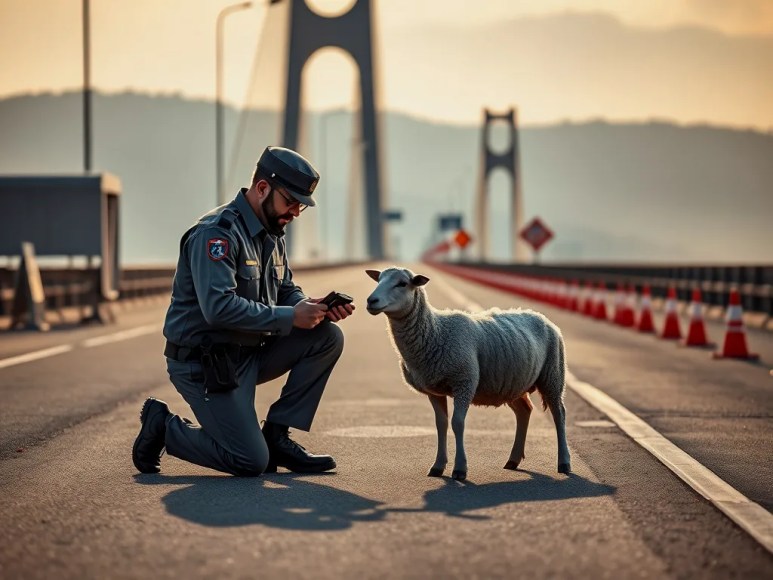
New veterinary road control station established at 1915 Çanakkale Bridge route
The Ministry of Agriculture and Forestry began construction of a dedicated veterinary road control and inspection station along the 1915 Çanakkale Bridge corridor. The station will inspect animal transports moving from Anatolia into Trakya, operate 24/7, and enforce documentation and vaccination requirements to prevent unauthorized or unvaccinated shipments.
How the station preserves Trakya’s foot-and-mouth disease (FMD) discharged-free status
The station’s immediate objective is to maintain Trakya’s unemployed-free (vaccinated ari) FMD status by intercepting risks at the corridor’s busiest gateway Inspectors will check accompanying health certificates, vaccination records, and perform visual and temperature screening. When necessary, rapid on-site tests and quarantines will be implemented to contain suspected cases. By reducing undetected movements, the station lowers the probability of FMD reintroduction and safeguards market access for regional producers.
Operational procedures and step-by-step inspection workflow
Standard workflow: 1) Incoming vehicle presents route permit and animal health certificates. 2) Inspectors cross-check documents against the national animal movement registry. 3) Animals undergo physical and temperature checks; suspicious signs trigger sampling. 4) Confirmed or suspected cases are isolated and transferred to quarantine facilities; trace-back of origin movement begins. 5) Clear vehicles proceed with stamped approval.
Every inspection will be logged digitally to enable traceability and statistical analysis. The digital records will support targeted vaccination campaigns, outbreak simulations, and resource allocation decisions.
National network: eight inspection points, regional roles and coverage
The Çanakkale station joins existing points in Erzurum, Elazığ, Kayseri, Çankırı, Ankara and Istanbul; Once Mersin is finished the network will consist of eight nodes. Each station focuses on specific regional movement corridors: eastern border flows at Erzurum and Elazığ, central Anatolian aggregations at Kayseri and Çankırı, national distribution and export routes through Ankara and Istanbul, and maritime or southern flows via Mersin and Çanakkale. Coordinated sampling, data sharing, and synchronized enforcement will reduce duplicate inspections and close surveillance gaps.
Expected benefits: animal health, trade continuity, and rapid response capacity
Short-term benefits include a measurable decline in undocumented animal movements and faster interdiction of suspect shipments. Mid-term outcomes will be improved disease surveillance metrics: higher test-per-movement ratios, reduced time-to-detection, and clearer epidemiological links for contact tracing. Long-term, maintaining vaccinated-free status preserves export eligibility and stabilizes producer incomes in Thrace and adjacent regions.
Examples and scenarios where the station prevents outbreaks
Example 1 — Unvaccinated shipment intercepted: A livestock truck lacking valid vaccination records is stopped; On-site inspection reveals fever in several animals. Rapid testing and quarantine prevent entry into Trakya markets and trigger a localized containment response at the origin, averting a potential regional outbreak.
Example 2 — Falsified certificates detected through cross-checking: Digital registry comparison exposes mismatched movement permits. Targeted follow-up identifies a distribution node responsible for forged documents, leading to prosecution and a remediation plan that includes farmer education and stricter issuance controls.
Data, metrics and how success will be measured
Key performance indicators will include number of inspections per month, percent of movements with valid documentation, number of suspected cases detected, average time from interception to laboratory confirmation, and downstream incidences of FMD in Trakya. Quarterly reports will compare pre- and post-implementation baselines to quantify impact.
Stakeholder engagement, staffing and training
The project involves provincial and district agricultural managers, local veterinary officers, and support staff. Training modules will cover document verification, clinical signs of major transboundary animal diseases, sample collection, biosafety procedures, and use of the digital registry. Regular drills will maintain readiness for cross-border or multi-site outbreaks.
Next steps and timeline to full network operation
With Çanakkale and Mersin nearing completion, the ministry plans to finalize infrastructure commissioning, recruit remaining staff, and integrate all stations into a national dashboard within months. Once operational, continuous evaluation and iterative improvements will align inspection intensity with seasonal movement patterns and emerging epidemiological data.
Local leadership at the inauguration
The foundation ceremony included Çanakkale Provincial Director of Agriculture and Forestry Ergün Demirhan and regional agricultural administrators, signaling provincial commitment to the national veterinary road control network.
Be the first to comment