
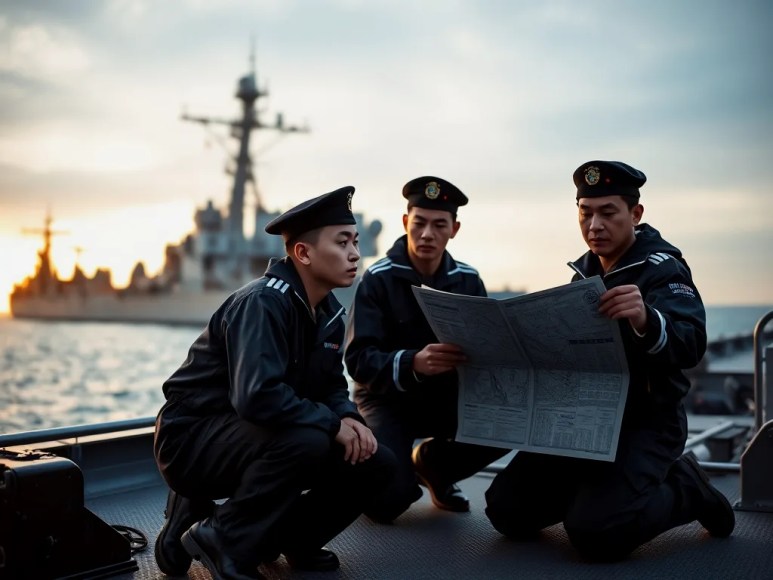
Modern warfare changes the skills navy personnel need
China has restructured naval education to produce officers and technicians who can operate complex ships, sensors, and networks. The PLAN now emphasizes three linked pathways: academic schooling, in-unit training, and continuous professional development. Institutions deliver foundational theory while fleet assignments supply hands-on practice; the reform challenge is making those pathways tightly coordinated so graduates can apply classroom learning immediately in operational settings.
Eight military institutions form the backbone of PLAN training
Eight military academies support the PLAN’s officer and specialist pipelines. They include the Naval Command College, Naval Engineering University, Dalian Naval Academy, Submarine Academy, Naval Aviation University, Naval Medical University, Naval Logistics Academy, and Petty Officer Academy. Five of these accept high-school graduates to bachelor’s programs; since 2017 four (except Naval Aviation University) expanded intake quotas, signaling greater throughput but not automatically stronger combat capability.
Where alignment breaks down between academies and the fleet
Field commanders report gaps in relevance: some instructors lack recent operational tours, curricula lag behind new platforms, and simulation fidelity varies. The result: new officers sometimes arrive at units with strong theory but limited practical exposure to mission workflows, maintenance rhythms, and integrated tactical decision-making. The reform response focuses on three fixes: embed active-duty officers as instructors, rotate cadets through shipboard attachments for months-long practicums, and update syllabi quarterly to reflect new weapon and sensor suites.
How simulations, AI, and unmanned systems reshape training
PLAN academies increasingly adopt high-fidelity simulators, AI-driven training aids, and unmanned-systems curricula For example, a bridge-team simulator can reproduce multi-threat scenarios across electronic warfare, cyber intrusion, and anti-ship missile salvos; trainees then repeat decision cycles with AI feedback on timing and risk trade-offs. Training designers pair virtual exercises with live, small-unit unmanned-vehicle deployments to teach sensor fusion, remote control doctrines, and logistics for persistent autonomous operations.
Practical steps academies take to increase combat realism
Academies implement phased, measurable programs: 1) Map course outcomes to unit mission tasks (task analysis); 2) Create modular sea-berth attachments where cadets complete specific mission roles for 12–16 weeks; 3) Integrate multi-domain war games that include air, sub-surface, cyber, and space inputs; 4) Use after-action review (AAR) loops with on-ship performance metrics to refine curricula. These steps shorten the feedback loop between fleet experience and classroom instruction.
Why measuring reform outcomes remains difficult
Directly linking education reforms to improved combat performance proves hard for three reasons: limited modern combat samples for validation, classification of many training outcomes, and multi-factor influences on readiness (platform numbers, logistics, doctrine). Analysts therefore use intermediate indicators—mission task proficiency rates in exercises, retention of specialist technical certificates, and time-to-mission-readiness for newly commissioned officers—to infer progress rather than claim definitive combat advantage.
Examples and indicators that show progress
Concrete signals include increased throughput of engineering and systems graduates, wider use of computer-based assessment with scored AARs, and lower time from commissioning to assignment in frontline units. One observable practice: joint live-virtual training events where academy teams and fleet crews execute a coordinated anti-submarine warfare scenario; measurable gains appear as reduced sensor-to-shooter timelines and fewer coordination errors across platforms.
Risks and remaining institutional frictions
Reforms face friction from entrenched promotion paths that prioritize seniority, limited incentives for experienced officers to serve as long-term instructors, and resource gaps—high-end simulators and AI tools require sustained investment and maintenance. If personnel policies don’t value operational instructional experience, academies risk reverting to lecture-heavy models that underprepare sailors for dispersed, digitized naval combat.
What successful alignment looks like in practice
A well-aligned system pairs up-to-date academic modules with repeatable sea internships and a data-driven curriculum cycle. Success metrics: higher first-deployment competence rates, consistent cross-platform training standards, and documented reductions in repair and mission-failure rates tied to operator error. In such a system, an officer finishing a four-year program and a defined practicum should be immediately usable in a shipboard warfare team with minimal additional training.
Policy levers that accelerate effective training
Decision-makers can speed reform by: increasing incentives and career credit for operational instructors; mandating minimum operational attachments in degree plans; funding distributed simulation networks so multiple academies and fleets train together; and publishing standardized competency frameworks that tie certificates to unit billets. Each lever tightens the link between academic credentials and operational value.
Bottom line: people determine how fast naval power becomes effective
Ship count and advanced platforms create potential; Trained, experienced personnel convert that potential into operational capability. PLAN education reforms build necessary institutional scaffolding—but real combat effectiveness will depend on sustained alignment between schools and fleets, measurable training outcomes, and personnel policies that reward operational teaching and continuous upskilling.
Be the first to comment